
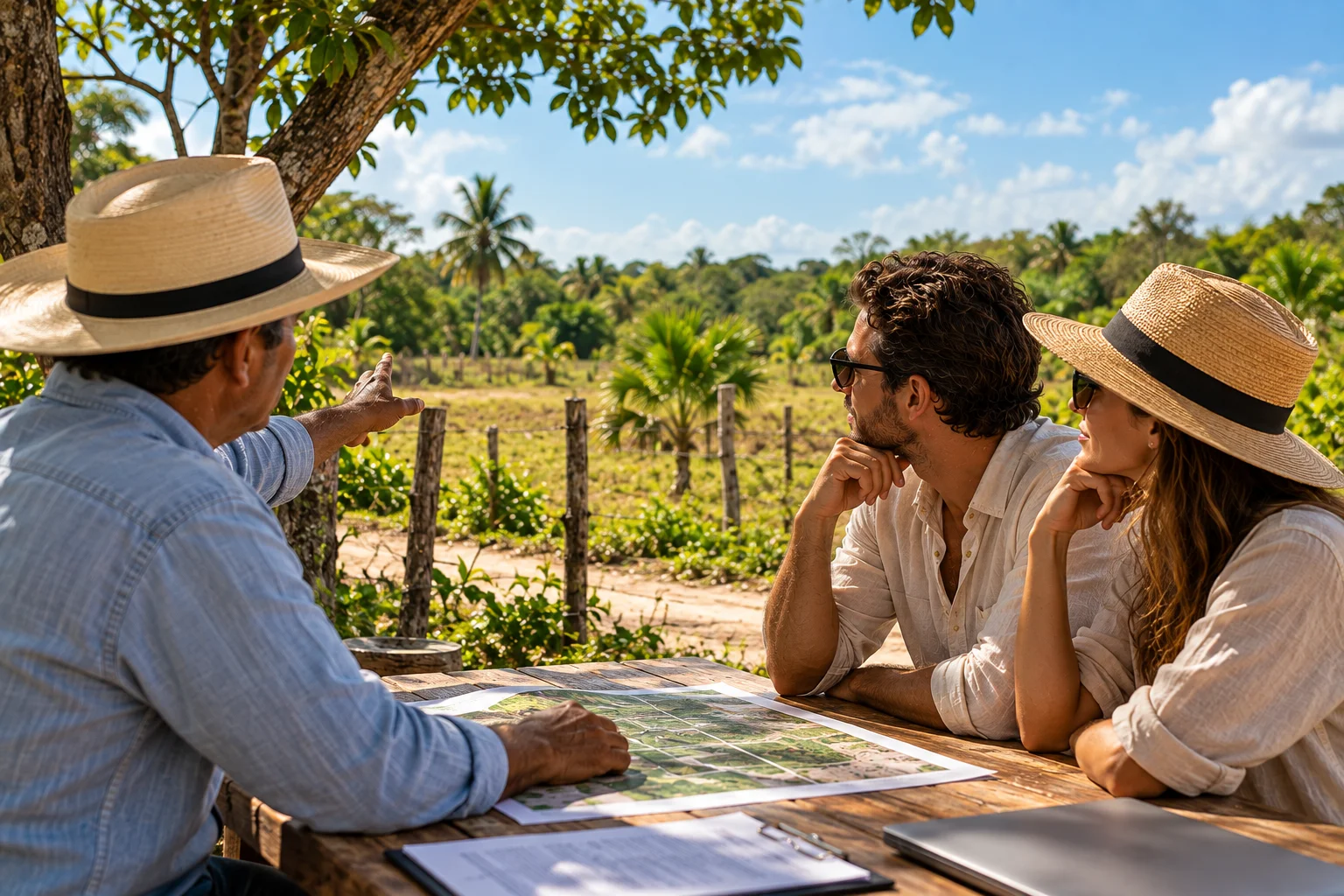
Ejido land in Mexico is land governed by the country’s agrarian property system rather than ordinary private property rules. This distinction matters enormously when you are considering buying land.
An ejido parcel can look exactly like any other lot for sale. It may even have fences, roads, utilities, and somebody offering to “sell” it to you. Legally, however, the situation can be completely different.
That does not mean every property with an ejido history is a problem. Former ejido land can become private property through the proper legal process. The important part is confirming that this process was actually completed.
So, before a cheap parcel near Tulum starts looking like the deal of the century, let’s understand what you would actually be buying.

Sign up for our newsletter to receive a free ebook “5 Things to Avoid When Investing in Mexican Real Estate”.
Definition of Ejido Land
An ejido is a form of social land ownership governed primarily by Mexico’s Agrarian Law. Instead of functioning like ordinary privately titled real estate, the land belongs to an agrarian community known as an ejido.
People recognized within that system can hold specific agrarian rights. Those rights may relate to an individual parcel, common land, or both.
This distinction is crucial for property buyers. Holding rights to an ejido parcel is not automatically the same thing as holding a privately registered property title.
The Registro Agrario Nacional, usually called the RAN, maintains records concerning ejidal and communal land rights. Ordinary private real estate, by contrast, is registered through the applicable Public Registry of Property.
That difference between agrarian rights and private title is at the heart of almost every ejido issue a foreign buyer needs to understand.
How Does the Ejido System Work?
Mexico’s ejido system separates several types of land and rights within the same agrarian community. This is why saying that somebody “owns ejido land” can be misleading.
The ejido has its own recognized members, internal decisions, records, and governing bodies. Individual members may receive rights over particular parcels, while other areas remain for common use.
For a potential buyer, the important question is not simply who occupies a parcel. You need to understand exactly what legal rights that person holds and what type of land you are dealing with.
Who Actually Owns Ejido Land?
Ejido land belongs to the ejido under Mexico’s agrarian property system. An individual ejidatario can hold legally recognized rights within that system, including rights over a specific parcel.
Those parcel rights should not be confused with an ordinary private property title. Until the land completes the required process to enter the private property regime, it remains subject to agrarian law.
This is one reason possession alone proves very little. Someone may have occupied, farmed, fenced, or used a parcel for years without holding the type of private title you would expect when purchasing conventional real estate.
What Is an Ejidatario?
An ejidatario is a person recognized as holding ejidal rights within an ejido. Mexican Agrarian Law establishes the legal framework for acquiring and proving this status.
An ejidatario may have rights to use an individual parcel and participate in decisions concerning the ejido. Depending on the situation, those rights can be documented through agrarian certificates and records maintained within the agrarian system.
This is very different from simply calling someone “the owner” because they are selling a parcel. When we review land for a buyer, we want the documents to tell us what rights actually exist.
Individual Parcels vs Common Ejido Land
Not all land inside an ejido has the same legal function. Some areas can be allocated as individual parcels, while others remain land for common use by the ejido.
An individual parcel gives the corresponding ejidatario specific rights over that defined area. However, having an allocated parcel does not automatically turn it into private property.
Common use land is different. It serves the collective needs of the ejido and is subject to additional rules and protections. You cannot assume that a section of common land can be sold like an individually titled residential lot.
For a real estate buyer, identifying the category of land is therefore one of the first steps. Everything that follows depends on what the records actually show.
How Is Ejido Land Different From Private Property?
The biggest difference is the legal regime governing the land.
Private property has an individual owner whose title can be recorded in the appropriate Public Registry of Property. That registered title can then form the basis for an ordinary real estate purchase, subject to the usual due diligence.
Ejido land operates under agrarian law. An ejidatario may hold parcel rights, but those rights are not automatically equivalent to private ownership recorded in the Public Registry.
This distinction affects how the land can be transferred, who can acquire rights, which authorities and records are relevant, and how a future buyer proves ownership.
It also explains why a contract, receipt, or signed agreement is not enough by itself. A document saying that somebody sold you “their land” does not magically convert agrarian rights into private title.
Can Ejido Land Be Sold?
Rights involving ejido parcels can be transferred in certain circumstances, but this is not the same as an ordinary private property sale.
Mexican Agrarian Law provides specific rules for transfers of parcel rights, including who may receive them and the formalities that apply. Those rules exist within the ejido system.
This is where buyers can get into trouble. A person may describe the transaction casually as “buying the land,” while legally the documents do not transfer privately titled real estate at all.
For a foreign buyer who wants normal ownership of a residential lot, the safer question is usually whether the parcel has already completed the legal process required to become private property.
If it has not, we would not treat the transaction like a normal land purchase. The legal structure needs to be investigated before any money changes hands.
Can Ejido Land Become Private Property?
Yes, certain ejido parcels can enter the private property regime when the requirements established under Mexican agrarian law have been properly completed.
This is the point where the term dominio pleno becomes important.
What Is Dominio Pleno?
Dominio pleno refers to the process through which qualifying parcel land can leave the ejido property regime and become private property.
It is not simply a letter from an ejido representative saying that the parcel can be sold. Formal decisions, procedures, and registrations are required.
Once the applicable process is completed, the parcel can move from the agrarian system into the private property system. That legal change is what matters to a conventional real estate buyer.
How the Privatization Process Works
The process begins within the ejido framework. The ejido assembly has an important role, and the parcel itself must meet the legal requirements for dominio pleno.
The holder then needs to complete the corresponding procedures with the agrarian authorities. When the requirements are satisfied, the agrarian documentation is cancelled as applicable and a private property title can be issued and registered.
The exact file should be reviewed individually. we would never assume that a parcel has become private simply because somebody says “the ejido already approved it.”
How to Confirm That the Process Was Completed
This is where documentary due diligence becomes essential.
Your attorney and notary should verify the property’s history through the relevant agrarian records and confirm that the parcel successfully left the ejido regime. They should also verify the resulting private title and its registration in the appropriate Public Registry of Property.
A seller saying that dominio pleno is “almost finished” is not the same as buying property where the process has already been completed and properly registered.
For us, that difference is simple. We verify the legal status that exists today, not the legal status somebody promises the property will have later.
Can Foreigners Buy Ejido Land in Mexico?
A foreign buyer should not treat ejido land as ordinary private property that can simply be purchased and titled in their name.
While land remains under the ejido regime, transfers of parcel rights are governed by Mexican agrarian law and its eligibility requirements. This is fundamentally different from buying privately titled real estate.
For most foreign buyers interested in a residential lot, the practical route is to wait until the relevant parcel has legally entered the private property regime. Only then should it be evaluated as a conventional real estate purchase.
There is another layer if the property sits within Mexico’s restricted zone. Once former ejido land becomes valid private property, a foreign buyer may still need a fideicomiso in Mexico to acquire residential property there.
Most of the Riviera Maya falls within this coastal restricted zone. Privatizing ejido land therefore does not remove the separate ownership rules that apply to foreign buyers near Mexico’s coastline.
What Are the Risks of Buying Ejido Land?
The biggest risk is believing you are buying private real estate when the documents actually give you something very different.
A low price can make an informal arrangement tempting, particularly around rapidly developing areas. However, fixing a bad ownership structure afterward can be far harder than investigating it before paying.
Buying Without a Registered Private Title
A seller might show you a parcel certificate, possession document, ejido paperwork, or other evidence connecting them with the land. None of these should automatically be treated as a private property title.
If you intend to buy privately owned real estate, your closing professionals need to verify that the property has properly entered the private regime and that the title is registered where required.
Do not rely on the appearance of the parcel either. A wall, electricity connection, road access, or neighboring houses do not establish private ownership.
Agreements With Ejidatarios That Do Not Transfer Ownership
This is one of the situations we would be particularly cautious about.
You may be offered a private contract with an ejidatario and told that signing it effectively makes the parcel yours. However, a private agreement cannot bypass the legal requirements governing ejido rights or create a registered private title where none exists.
You could therefore pay money and obtain a signed document without acquiring the type of ownership you thought you were purchasing.
Disputes Over Boundaries and Ownership Rights
Land disputes can involve parcel boundaries, competing claims, succession issues, or disagreement about who actually holds particular agrarian rights.
These issues become especially important when buying undeveloped land. The physical boundaries shown by a seller should match the legally recognized parcel and later private title.
A proper survey and documentary review can help identify inconsistencies before they become your problem.
Problems Reselling or Financing the Property
If you do not have clear private title, eventually selling the property to a conventional buyer can become difficult.
The next buyer’s attorney or notary may identify the ownership problem immediately. A lender is also unlikely to treat unclear agrarian rights in the same way as registered private property that can properly secure financing.
In other words, a shortcut that makes the initial purchase look cheaper can severely limit your options later.
How Do You Know If a Property Is Ejido Land?
Do not rely on the listing description or the seller’s answer alone. The legal status needs to be verified through documents and the appropriate Mexican records.
The Registro Agrario Nacional maintains information concerning ejidos, communities, parcel rights, and other agrarian matters. If the property has moved into private ownership, the resulting title and registration history should also be reviewed through the appropriate Public Registry of Property.
Your attorney and notary can compare these records with the property being offered for sale. They should confirm whether it remains ejido land, has completed dominio pleno, or has another issue requiring investigation.
We would be particularly careful when somebody says a property is “private now” but cannot readily produce the documentation showing how and when that happened.
What Documents Should You Check Before Buying Former Ejido Land?
Former ejido land is not automatically unsafe. What matters is whether the transition into private property was legally completed and whether the current seller holds valid title.
The exact file varies, but your due diligence may need to review the property’s agrarian history, documentation relating to dominio pleno, the resulting private title, and registration in the Public Registry of Property.
You should also complete the normal checks that apply to other private real estate. These can include liens, property taxes, cadastral information, boundaries, seller identity, and construction documentation where relevant.
For land with an ejido history, we would want the chain from agrarian parcel to current private ownership to make sense on paper. Missing steps deserve investigation, not assumptions.
Ejido Land vs Private Property: Key Differences
| Issue | Ejido Land | Private Property |
|---|---|---|
| Legal regime | Agrarian law | Private property law |
| Individual rights | Ejidal or parcel rights | Private ownership rights |
| Main records | Registro Agrario Nacional | Public Registry of Property |
| Transfer | Subject to agrarian rules | Transferred through normal real estate procedures |
| Foreign buyer | Should not be treated as an ordinary private purchase | Can buy subject to Mexico’s foreign ownership rules |
| Conventional financing | Can be problematic | Potentially available subject to lender requirements |
The key takeaway is that these are two different legal systems. A parcel does not become private property simply because it is marketed, occupied, fenced, or offered for sale.
Can You Build a House on Ejido Land?
Being physically able to build on a parcel does not mean you have private ownership or the legal documentation needed for a normal residential project.
If land remains under the ejido regime, its use and rights are governed by agrarian rules. Local zoning, environmental rules, construction permits, access, and infrastructure requirements can create additional layers.
This is particularly important for foreign buyers. Building a house on land you do not properly own can leave you with a valuable structure sitting on a parcel where your legal rights are very different from what you expected.
If your goal is to build a home, we would first confirm that the parcel has valid private title. Then verify zoning, permitted land use, construction requirements, access, utilities, and any environmental restrictions before buying.
What If Someone Offers You Cheap Ejido Land?
A low price is not automatically suspicious. However, ejido status can be one reason a parcel costs considerably less than comparable privately titled land.
You may hear explanations such as “everyone buys this way,” “the title is coming soon,” or “you only need a contract with the ejidatario.” None of those statements replaces legal due diligence.
We would also be cautious about paying a deposit based on a promise that dominio pleno will be completed afterward. Until the required process is finished, you are dealing with the property’s current legal status, not its possible future status.
Cheap land can become extremely expensive when you cannot register ownership, obtain permits, finance construction, or sell it later.
Is Former Ejido Land Safe to Buy?
Yes, former ejido land can be perfectly legitimate private property once the required legal process has been properly completed.
The fact that a parcel belonged to an ejido decades ago does not automatically make it a bad purchase today. What matters is its current legal status and the chain of documentation connecting its agrarian history with the present private title.
Your attorney and notary should verify that the transition was completed correctly, the current seller has the right to sell, and the title is properly registered.
After that, the property still needs the same due diligence as any other real estate purchase. Former ejido status does not protect you from liens, boundary problems, unpaid taxes, zoning issues, or construction irregularities.
Ejido Land in the Riviera Maya
Ejido history is particularly relevant in the Riviera Maya because development has expanded into areas that were historically rural or agrarian.
As towns grow and land values increase, parcels that once had agricultural purposes can become attractive for housing, hotels, commercial projects, and investment.
That makes understanding the property’s legal history especially important when you move beyond established condominium developments and start looking at individual lots.
Ejido Land Around Tulum
Tulum is an obvious example. Rapid development has pushed buyer interest well beyond the established urban areas, and land can come with very different legal histories.
A parcel advertised as a “lot in Tulum” tells you almost nothing about its ownership status. Before comparing its price with another lot, establish whether you are looking at registered private property or land still connected to the ejido system.
We would be especially careful with inexpensive land promoted primarily through future promises. A planned road, expected development, or proposed privatization does not substitute for the legal status that exists when you buy.
Ejido Land Around Playa del Carmen and the Wider Riviera Maya
The same principle applies around Playa del Carmen, Puerto Morelos, Akumal, and other growing parts of the Riviera Maya.
Land farther from established residential areas can look attractive because you get considerably more space for your budget. That price difference needs context.
At RivieraMayaCozy, we would rather see a buyer spend time investigating the title before becoming emotionally attached to a parcel. Once you have already imagined the house, pool, and garden, walking away from problematic documents becomes much harder.
What Should You Do Before Buying Land With an Ejido History?
If a property is currently ejido land or has an ejido history, investigate that issue before paying a significant deposit or committing to the transaction.
- Confirm whether the parcel is currently ejido land or private property.
- Review the relevant records with an independent Mexican real estate attorney.
- Verify any claimed dominio pleno process.
- Confirm the resulting private title and its registration.
- Check that the seller is legally entitled to sell the property.
- Verify boundaries, cadastral information, liens, and property taxes.
- Investigate zoning, land use, access, and construction restrictions.
- For foreign buyers, confirm the correct ownership structure before closing.
The main lesson is simple. Ejido land in Mexico is not just another type of privately titled lot with a different name.
That does not mean you should automatically reject every property with an ejido history. Once land has legally entered the private property regime and the title checks out, it can be considered like other privately owned real estate.
What we would never do is rely on promises that the paperwork will eventually catch up with the purchase. When buying land in Mexico, especially as a foreigner, establish what you can legally own first. Then decide whether the price makes sense.