
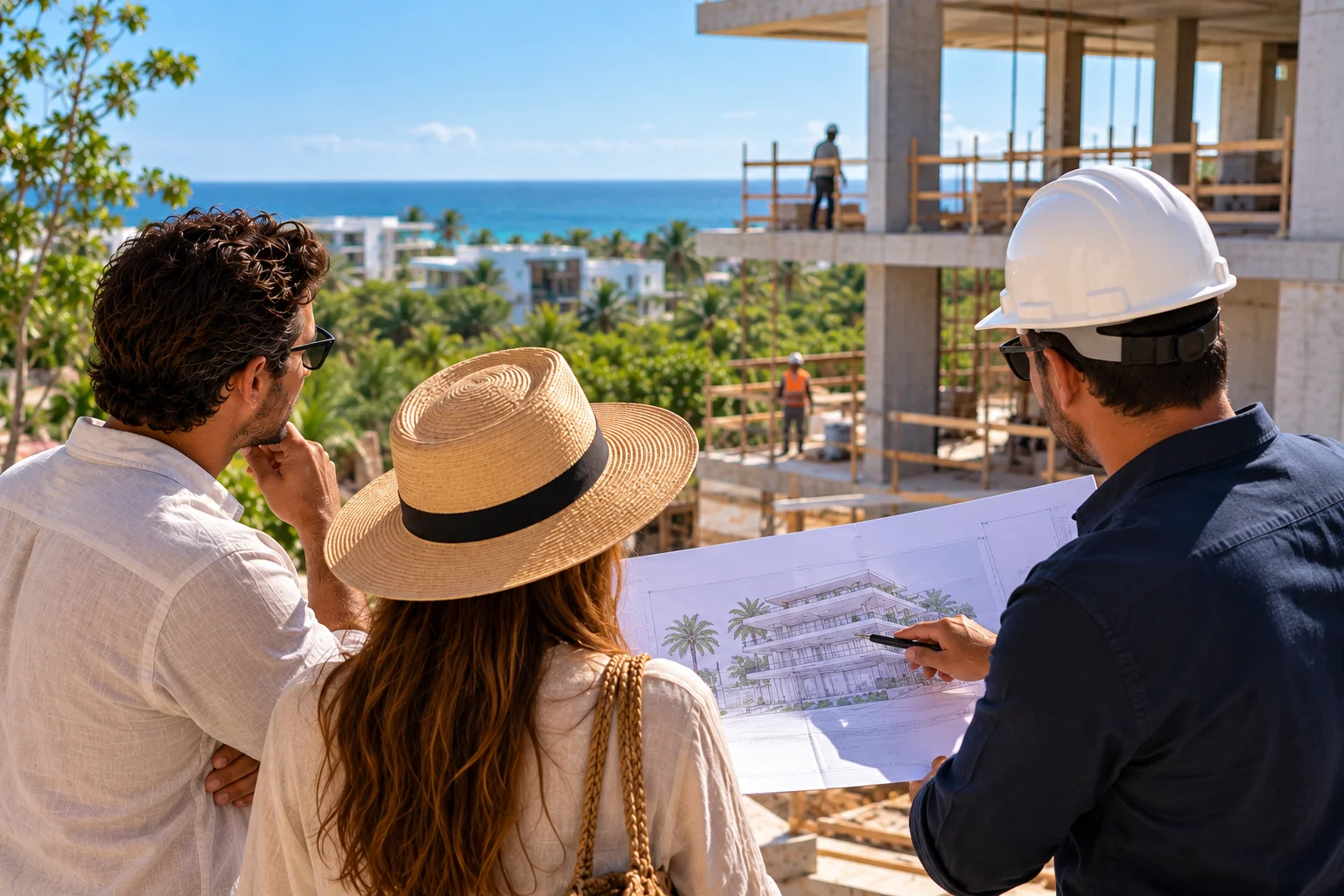
Buying pre construction in Mexico can be safe for foreigners. But it carries more risk than buying a completed property with an established title and physical unit you can inspect.
You are often committing money months or years before delivery. That makes the developer, land ownership, permits, purchase contract, and payment structure extremely important.
We have seen excellent pre construction opportunities in the Riviera Maya. We have also seen projects where attractive prices and impressive renderings hide risks buyers should never ignore.
In this guide, we will explain how to evaluate a pre construction property before putting your money into it.
Buying Pre-Construction at a Glance
Yes, foreigners can safely buy pre construction property in Mexico, provided the development meets the necessary legal requirements and the buyer completes proper due diligence.
However, we would never describe pre construction as a risk free investment. Unlike a completed property, you are purchasing something that may exist only on architectural plans when you sign the agreement.
That creates several uncertainties. Construction could take longer than expected, the developer might encounter financial problems, or the finished property could differ from what was originally advertised.
The biggest mistake we see foreign buyers make is assuming that a development must be legally sound because it has a professional website, impressive renderings, and an established sales office.
None of those things confirms that the developer owns the land, has the necessary permits, or can complete the project.
We recommend treating every pre construction purchase as two separate decisions. First, determine whether the property represents good value. Second, establish whether the developer can legally and financially deliver what you are buying.
A good price means very little if the second part does not check out.
How Does Buying Pre Construction in Mexico Work?
Buying pre construction in Mexico usually involves several payments spread across the development period. You reserve a unit, sign a purchase agreement, make scheduled payments, and complete the final closing when the property is ready.
The exact process varies between developers. Some projects are already under construction when sales begin, while others start selling units before construction has started.
Reservation and Deposit
The process often begins with a reservation agreement and an initial deposit. This temporarily reserves your preferred unit while the parties prepare the next documents.
Reservation amounts vary depending on the developer, property value, and project.
Before paying anything, we recommend confirming the reservation conditions in writing. You should know whether the deposit is refundable, how long the reservation lasts, and what happens if you decide not to proceed.
It is also important to confirm who receives the money. Payments should go to a verified account belonging to the legally appropriate receiving party, not an unrelated individual.
Never assume that a reservation deposit is automatically protected or refundable. The agreement determines much of what happens next.
Promissory Purchase Agreement
After reserving the unit, buyers commonly sign a promissory purchase agreement, known in Spanish as a contrato de promesa de compraventa.
This agreement establishes the conditions under which the developer promises to sell the property and the buyer agrees to purchase it.
It should identify the parties, unit, price, payment obligations, delivery conditions, and other important terms.
However, signing a promissory agreement does not normally mean you already hold registered ownership of the finished property.
This distinction matters because you may be paying substantial amounts before the final deed is signed and registered.
We strongly recommend having an independent Mexican real estate attorney review the agreement before signing. The developer’s standard contract is written for the transaction, but that does not guarantee its terms adequately protect your interests.
Construction Payment Schedule
Most pre construction developments offer payment plans that divide the purchase price into several installments.
For example, a developer might request 30% when signing, another 40% during construction, and the remaining 30% at delivery.
That is only an illustration. Actual payment structures vary considerably between developments.
Some developers offer discounts when buyers pay a larger percentage upfront. Others connect installments to construction progress or specific calendar dates.
We prefer examining how payments relate to actual project progress. Paying most of the purchase price before meaningful construction begins exposes the buyer to greater financial risk.
It is also important to understand what happens if the developer misses a construction milestone. Your contract should explain whether payments remain due when the project falls behind schedule.
Delivery and Closing
Once construction is complete, the developer prepares the property for delivery and the final legal transfer.
These are not necessarily the same event. A developer might allow you to inspect or occupy a unit before the final ownership documents are ready.
Before accepting delivery, you should inspect the finished property and document any defects, missing equipment, or differences from the agreed specifications.
The final closing involves the appropriate legal documentation, the Mexican notary, and the applicable ownership structure.
For foreign residential buyers purchasing within Mexico’s restricted zone, this commonly includes establishing or completing a fideicomiso.
We would also confirm that the condominium regime, individual unit documentation, and required registrations are ready for the transaction.
Receiving the keys is exciting, but it should never be confused with completing the legal transfer of ownership.
Can Foreigners Legally Buy Pre Construction Property in Mexico?
Yes. Foreigners can legally purchase pre construction property in Mexico. The same foreign ownership rules that apply to completed properties also apply to developments under construction.
Your nationality does not prevent you from buying a condo, house, or villa. However, the property’s location determines which ownership structure you will need.
For American, Canadian, and European buyers interested in the Riviera Maya, this usually means purchasing through a Mexican bank trust known as a fideicomiso.
There is one important distinction. Signing a pre construction agreement does not automatically give you ownership of the property. The legal transfer generally takes place later, once the necessary conditions and closing requirements have been satisfied.
Buying Outside the Restricted Zone
Foreigners can generally acquire direct ownership of qualifying private property outside Mexico’s restricted zone.
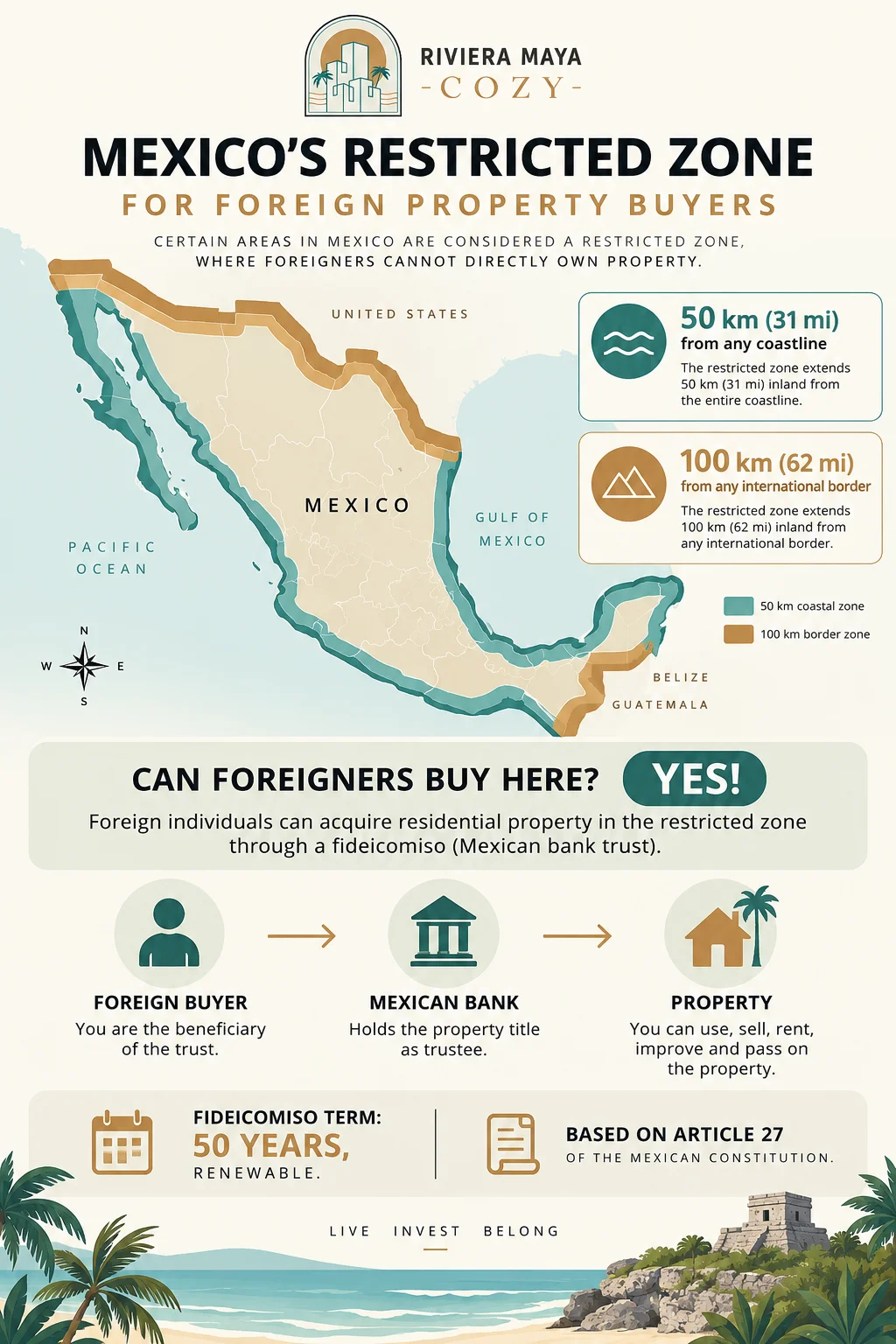
This zone extends 50 kilometers inland from the coast and 100 kilometers from Mexico’s international borders. Properties outside these areas can usually be acquired without establishing a fideicomiso.
For example, a foreigner purchasing a qualifying residential property in an inland city can generally receive direct title through the normal closing process.
The fact that the development is under construction does not change these basic ownership rules.
However, buyers still need to verify the developer’s legal ownership of the land, construction permits, contractual obligations, and ability to transfer the completed property.
Buying Through a Fideicomiso in the Restricted Zone
Most popular coastal destinations in Mexico fall within the restricted zone. This includes Cancún, Playa del Carmen, Tulum, Puerto Morelos, and other Riviera Maya communities.
Foreigners purchasing residential property in these locations commonly use a fideicomiso.
Under this arrangement, a Mexican bank holds legal title as trustee, while the foreign buyer receives the beneficiary rights established by the trust.
Those rights generally allow you to occupy, rent, renovate, sell, and transfer the property, subject to the trust agreement and Mexican law.
With pre construction, the fideicomiso is commonly established or finalized when the property is ready for legal transfer. However, the timing depends on the development and transaction structure.
We recommend confirming the intended ownership arrangement before signing the purchase agreement. Your closing team should establish whether the necessary title and condominium documents will be available when the developer expects to deliver the unit.
You can learn more about this ownership structure in our complete guide to fideicomiso in Mexico.
What Are the Main Risks of Buying Pre Construction in Mexico?
Pre construction can offer attractive purchase prices and payment plans. However, buyers accept risks that are less common when purchasing an existing property.
We believe understanding these risks is essential before deciding whether a particular development represents a good opportunity.
Construction Delays
Construction delays are among the most common concerns with pre construction properties.
A developer might advertise delivery in December, only for construction to continue well into the following year.
Delays can happen for several reasons, including labor shortages, supply problems, permit issues, financing difficulties, and unexpected construction complications.
Not every delay indicates a dishonest developer. Construction schedules can change even when a project is properly managed.
However, delays become much more concerning when the developer stops communicating, repeatedly changes delivery dates, or cannot explain why construction has slowed.
For buyers planning to rent the property, delays also mean lost potential rental income. If you intend to move into the property, you may need to extend your existing accommodation.
We recommend reviewing the delivery provisions carefully, including any grace period and the remedies available when deadlines are missed.
Projects That Are Never Completed
The most serious risk is paying for a property that never gets finished.
A development might begin construction, collect payments from buyers, and later stop operating because the project becomes financially or legally impossible to complete.
In some situations, construction may never progress beyond land preparation or foundations.
Recovering your investment can become difficult, especially if the developer has already spent the money and has insufficient assets to satisfy buyers’ claims.
This is why we investigate the developer and the project’s financial and legal structure before recommending substantial payments.
An attractive discount does not compensate for the possibility of losing a large portion of your investment.
Developer Financial Problems
A developer can own the land and possess construction permits while still experiencing financial difficulties.
Construction requires substantial capital. If sales slow, expenses increase, or financing disappears, the developer may struggle to continue.
Some developments depend heavily on payments from buyers to finance ongoing construction. That arrangement can create additional exposure when sales fall below expectations.
We therefore look beyond the number of units already sold. A project advertising 80% sales does not necessarily have 80% of its construction budget available.
The developer’s completed projects, financing arrangements, construction progress, and contractual obligations can provide useful information about the level of risk.
However, even a developer with several completed buildings is not guaranteed to finish every future project.
Changes to the Finished Property
Another risk involves receiving something different from what you expected.
Architectural renderings are marketing tools. They may show furniture, landscaping, materials, views, or amenities that are not included in the purchase agreement.
During construction, developers may also change suppliers, finishes, equipment, or certain design elements.
Some changes are minor. Others can materially affect the property’s value or usefulness.
Imagine purchasing a condo because the development advertises a large rooftop pool and coworking area. If those amenities are removed or significantly reduced, the finished property may no longer meet your expectations.
We recommend ensuring that important specifications and promised amenities are properly documented in the contract and its attachments.
Do not rely on verbal assurances from the sales team.
Missing Permits or Legal Problems With the Land
A development can encounter serious problems if the underlying land has unresolved legal issues or the required authorizations are missing.
Before construction begins, the developer needs the appropriate legal rights to the land and the permits applicable to the project.
Depending on the location and development, these may involve municipal construction approvals, land use requirements, environmental authorizations, and other regulatory obligations.
A project near environmentally sensitive areas may face additional restrictions.
In the Riviera Maya, we also pay particular attention to land with an ejido history. Former ejido land can become legitimate private property, but the required legal process must have been completed correctly.
If the developer cannot establish clear ownership or lacks essential authorizations, buyers may face construction delays, legal disputes, or difficulties obtaining title.
A building permit alone does not prove that every other legal requirement has been satisfied.
Difficulty Recovering Your Money
Many foreign buyers assume that if a development fails, they can simply cancel the purchase and receive a refund.
Unfortunately, recovering money is not always that straightforward.
Your rights depend on the contract, applicable Mexican law, the circumstances of the developer’s failure, and the legal remedies available.
Even when a buyer has a valid claim, collecting the money may require negotiations, legal proceedings, or enforcement against the developer’s assets.
If the company lacks sufficient funds, a favorable legal decision may not result in immediate repayment.
This is one reason we pay close attention to how deposits and construction payments are handled.
We would rather see a buyer investigate the payment structure before transferring money than discover afterward that the funds are difficult to recover.
Pre construction risk cannot be eliminated completely. However, proper due diligence, independent legal advice, and carefully negotiated contractual protections can significantly improve your position.
What Should You Check Before Buying a Pre Construction Property?
Before buying pre construction in Mexico, we recommend investigating the development itself rather than focusing exclusively on the unit you want.
A beautiful condo with an attractive payment plan means very little if the developer cannot legally complete the project or transfer ownership.
We normally start with five areas: land ownership, construction permits, existing debts, developer history, and the property’s legal background.
Who Owns the Land?
The first question is simple. Does the developer actually own the land where the project will be built?
You might assume this is obvious, especially when construction has already started. However, developers sometimes operate through separate companies or agreements with landowners.
That arrangement is not automatically problematic. What matters is whether the company selling the units has the legal authority to develop the land and complete the promised transfers.
We recommend asking an independent Mexican real estate attorney to verify the property’s ownership documents and registration with the appropriate Public Registry of Property.
The attorney should also confirm that the land description matches the development site. Property boundaries, registered ownership, and the seller’s legal authority should all be consistent.
If the developer cannot provide satisfactory documentation, we would not recommend proceeding until the situation is clarified.
Does the Developer Have the Required Permits?
Construction permits are another essential part of due diligence. A developer should have the authorizations required for the specific project and its current stage.
Depending on the development, these can include land use approvals, construction licenses, environmental authorizations, and other municipal or regulatory documents.
Requirements vary according to the location, project characteristics, and applicable regulations.
For example, a small residential building in an established neighborhood may face different requirements from a large development near protected natural areas.
We would also check whether the approved project matches what the developer is selling.
If the permits authorize a smaller building than the one advertised, that discrepancy needs an explanation before you commit money.
Another common mistake is accepting statements such as “the permits are being processed” without understanding which authorizations are still missing.
Some approvals may legitimately be pending at an early stage. However, the buyer should understand what remains outstanding and how that affects construction and delivery.
Does the Property Have Liens or Other Legal Issues?
Even when the developer owns the land, it may be subject to mortgages, liens, legal claims, or other registered encumbrances.
Some developments use financing secured against the land. That does not automatically make the project unsafe, but it requires careful legal review.
Your attorney should investigate existing encumbrances and determine how they will be handled before the individual units are transferred to buyers.
For example, if a bank holds a mortgage over the development land, the closing process may require a partial release covering your specific unit.
We would want that process clearly documented rather than relying on a verbal promise that everything will be resolved later.
Outstanding property taxes, legal disputes, and inconsistencies in the ownership documents should also be investigated.
Does the Developer Have a Proven Track Record?
A developer’s history can tell you a great deal about how the company operates.
We prefer developers who can demonstrate completed projects, reasonable delivery records, and buildings that remain properly maintained after residents move in.
However, we do not automatically reject a company simply because it is developing its first project. Every established developer started somewhere.
For newer companies, we would investigate the people behind the business, their previous construction experience, financing arrangements, and professional partners.
A company formed recently may have experienced professionals behind it. Equally, a familiar brand name does not guarantee that every project operates through the same legal entity.
The important part is verifying the actual company responsible for your purchase.
Is the Land Ejido or Former Ejido Land?
This question is particularly relevant when buying property in developing areas of Quintana Roo.
Ejido land belongs to Mexico’s agrarian property system. It does not operate under the same ownership rules as ordinary privately titled real estate.
Some ejido parcels can legally become private property through a process involving dominio pleno.
However, the process must be completed correctly. A developer claiming that land has been privatized should be able to provide documentation supporting that claim.
We recommend verifying the relevant agrarian history, private title, and registration before considering the property legally ready for development and sale.
Former ejido land is not automatically problematic. Many legitimate properties have an agrarian history.
The problem arises when buyers assume that an agreement with an ejidatario or an unfinished privatization process provides the same protection as registered private ownership.
How Do You Research a Developer in Mexico?
Researching the developer is one of the most useful steps you can take before purchasing pre construction property.
We recommend looking beyond the company’s website and sales presentation. You want evidence of how the developer performs when it comes to actual construction, delivery, and building quality.
Review Previously Completed Projects
Start by asking the developer for a list of completed developments.
Look at when those projects were delivered, their locations, and whether they resemble the property you are considering.
A company that has completed several small residential buildings may have useful experience. However, that does not necessarily demonstrate its ability to deliver a much larger project with extensive amenities.
We would also investigate whether the completed developments were built by the same people and companies involved in the new project.
Some developers operate through separate legal entities for each development. Understanding those relationships can help identify who is actually responsible for construction and contractual obligations.
Visit Existing Developments
If possible, visit one or more completed buildings.
Photographs taken immediately after construction can look impressive. A building that has been occupied for several years provides a much better opportunity to evaluate construction quality.
Pay attention to common areas, elevators, pools, drainage, exterior finishes, and signs of ongoing maintenance problems.
In the Riviera Maya, we also look for issues related to humidity, water infiltration, and deterioration caused by the coastal climate.
These problems do not necessarily indicate poor construction. However, repeated defects across several projects should encourage further investigation.
If you can speak with existing owners, ask about their experience with the developer, delivery process, warranties, and repairs.
Check Delivery History
One of the most useful questions is whether the developer delivered previous projects when promised.
Construction delays can happen for legitimate reasons. We would not automatically reject a developer because one building was delivered several months late.
However, repeated delays deserve attention, particularly when the company consistently announces unrealistic completion dates.
We recommend comparing advertised delivery schedules with actual completion dates whenever reliable information is available.
It is also worth investigating how the developer communicated with buyers during delays.
A company that provides regular updates and explains problems is generally easier to work with than one that disappears whenever construction falls behind.
Look Beyond Marketing Materials and Projected Returns
Pre construction developments often advertise attractive amenities, future property appreciation, and potential rental income.
These projections can help explain the developer’s commercial strategy, but they should never replace independent analysis.
For example, a project in Tulum might advertise an annual rental return of 10% or more. Before taking that figure seriously, we would ask how it was calculated.
Does it represent gross revenue or net income? What occupancy rate does it assume? Are management, HOA fees, taxes, utilities, and maintenance included?
We would also compare the projected rental rates with existing properties in the surrounding neighborhood.
A projected return is not a guarantee unless there is a genuine contractual obligation supporting it. Even then, the developer’s financial ability to honor that obligation matters.
Marketing materials should help you understand the project. Legal documents, independent research, and realistic financial calculations should determine whether you buy it.
What Should Be Included in a Pre Construction Purchase Contract?
The purchase contract is one of the most important documents in any pre construction transaction. It establishes what the developer must deliver, when payments are due, and what happens if something goes wrong.
Unfortunately, many buyers focus on the purchase price and payment plan without reading the remaining conditions carefully.
We recommend having an independent Mexican real estate attorney review the entire agreement before signing. The developer’s standard contract may contain provisions that favor the seller considerably more than the buyer.
In Mexico, certain residential real estate transactions are also subject to consumer protection requirements, including NOM-247-SE-2021. Where applicable, the developer must comply with the relevant contractual and information requirements.
However, regulatory requirements do not replace the need to examine your individual agreement.
Property Specifications
The contract should clearly identify the property you are purchasing. This includes the development, unit number, location, floor, and relevant measurements.
We would also expect important specifications to be documented, including the agreed finishes, fixtures, equipment, and any included furniture.
If you are purchasing a furnished condo, ask for an inventory describing exactly what comes with the property.
For example, a rendering showing a fully furnished living room does not necessarily mean the developer will deliver the sofa, television, dining table, and decorations.
The same applies to common amenities. If a rooftop pool, gym, parking space, or storage area materially influences your decision, confirm how those features are addressed in the legal documentation.
Pay particular attention to clauses allowing the developer to modify the design or specifications. Some flexibility may be reasonable during construction, but significant changes should not be left entirely to the developer’s discretion.
Purchase Price and Payment Schedule
The contract should establish the total purchase price, currency, payment dates, and accepted payment methods.
If the property is advertised in U.S. dollars, confirm whether payments must actually be made in dollars or Mexican pesos.
Exchange rate provisions matter because currency movements can affect the final amount you pay.
We would also check whether the advertised price includes taxes, parking, furniture, equipment, or other charges.
The payment schedule should be easy to understand. Each installment needs a clearly defined amount and due date or construction milestone.
Finally, verify the consequences of late payments. Some agreements impose substantial penalties on buyers while offering very limited compensation when the developer fails to meet its own obligations.
Estimated Delivery Date
Every pre construction agreement should establish when the developer expects to deliver the property.
However, the wording matters enormously. An estimated completion date may be accompanied by a grace period or provisions allowing extensions under certain circumstances.
For example, a contract might advertise delivery in December but allow several additional months before the developer faces contractual consequences.
That does not automatically make the agreement unreasonable. Construction schedules need some flexibility.
What concerns us is an agreement that allows the developer to postpone delivery repeatedly without meaningful limits or remedies for the buyer.
We would also distinguish physical delivery from legal closing. A completed apartment is not necessarily ready for title transfer if important condominium or registration documents remain outstanding.
Delay and Cancellation Clauses
The contract should explain what happens when construction falls behind schedule.
Look for the circumstances under which the developer can extend the delivery date, how buyers must be notified, and what remedies become available after the permitted delay period.
Some agreements contain force majeure provisions covering extraordinary events outside the developer’s reasonable control.
Those provisions deserve careful review. Ordinary business difficulties should not automatically excuse every missed deadline.
Cancellation rights are equally important. You should understand when you can terminate the agreement and whether doing so creates a financial penalty.
We recommend reviewing the developer’s cancellation rights as carefully as your own.
Refund Terms and Penalties
One of the most important questions is what happens to your money if the transaction does not proceed.
The contract should establish the circumstances under which deposits and construction payments may be refunded.
It should also specify the applicable deadlines, penalties, and procedures for requesting repayment.
We would be cautious about agreements that impose large penalties on buyers while allowing the developer to cancel with minimal consequences.
Another concern is vague language promising a refund without establishing when the money must actually be returned.
Remember that a contractual refund right is not the same as guaranteed repayment. If the developer becomes insolvent, recovering money may still be difficult.
Developer Obligations
The developer’s responsibilities should extend beyond simply constructing the apartment.
Depending on the project, these obligations may include obtaining required permits, completing common areas, establishing the condominium regime, providing necessary documentation, and delivering the unit according to agreed specifications.
We would also examine warranties, defect correction procedures, and the developer’s responsibilities after delivery.
For example, if you discover water infiltration shortly after receiving the property, the contract and applicable law should help establish how the issue must be addressed.
Finally, check which legal entity is responsible for fulfilling these obligations. The company signing your contract should have the appropriate authority and clearly defined responsibilities.
Should You Hire a Lawyer Before Buying Pre Construction?
Yes. We strongly recommend hiring an independent Mexican real estate attorney before purchasing pre construction property.
That recommendation becomes even more important when you are transferring substantial amounts before the property exists.
An attorney can investigate the land title, developer’s legal authority, permits, registered encumbrances, and contractual protections.
They can also identify provisions that may expose you to unnecessary financial risk.
For example, a contract might require you to pay 80% of the purchase price before construction reaches an advanced stage. Your attorney can explain the implications and whether additional protections are available.
We also recommend using a lawyer who represents your interests rather than relying exclusively on the developer’s legal team.
The developer’s attorneys have a responsibility to their client. That client is usually the developer, not you.
Hiring independent legal representation adds an expense to the transaction. However, compared with the amount involved in buying property, it can be a very reasonable investment.
We would much rather discover a legal problem before signing than attempt to resolve it after transferring tens of thousands of dollars.
What Is the Role of the Notary Public?
A Mexican Notario Público plays an important legal role in real estate transactions.
Unlike a typical notary public in the United States, a Mexican notary is a qualified legal professional appointed under the applicable state system.
The notary formalizes the transfer through the appropriate public instruments and handles important aspects of the closing process.
Depending on the transaction, this can include reviewing ownership documentation, calculating applicable acquisition taxes, formalizing the deed, and arranging registration.
For foreign buyers purchasing residential property in the restricted zone, the notary also participates in the closing process involving the fideicomiso.
However, there is an important distinction between the notary’s role and that of your independent attorney.
The notary is not automatically your personal legal representative. Their involvement also does not guarantee that the developer will finish construction or fulfill every contractual promise.
Pre construction buyers need legal protection long before the final closing.
That is why we recommend involving an independent attorney when reviewing the initial agreement, rather than waiting until the property is ready for delivery.
How Should You Pay for a Pre Construction Property?
Payment structure deserves almost as much attention as the purchase price.
When you buy a completed property, the final payment and legal transfer can generally be coordinated through the closing process.
Pre construction is different. You may transfer substantial amounts months or years before receiving the finished property.
We therefore examine when payments become due, who receives the money, and what protections exist if the developer cannot complete the project.
Typical Payment Plans
Developers in Mexico offer different payment structures depending on the project and construction stage.
One development might request 30% when signing, 40% during construction, and 30% at delivery. Another might offer monthly installments or discounts for larger initial payments.
Some developers also connect installments to construction milestones rather than fixed calendar dates.
We generally prefer payment structures that limit the amount of money exposed before meaningful construction progress.
However, the schedule alone does not determine whether a transaction is safe. The developer’s financial position, legal documentation, and available payment protections matter too.
Why Large Upfront Discounts Need Careful Evaluation
Developers sometimes offer substantial discounts when buyers pay most or all of the purchase price upfront.
For example, imagine a condo advertised at $200,000 USD. The developer offers a 10% discount if you pay the full amount during the early construction stage.
That represents a $20,000 saving, which certainly gets your attention.
However, you are also transferring $180,000 before receiving the finished property.
If construction stops or the developer experiences financial problems, recovering that money may become difficult.
We would therefore evaluate the discount against the additional exposure rather than treating it as an automatic bargain.
A lower purchase price is valuable, but only if the property is eventually delivered according to the agreed terms.
Keeping Records of Every Payment
Every payment should be properly documented.
We recommend using traceable payment methods and transferring funds only to verified accounts authorized under the transaction documents.
Before sending money, confirm the recipient’s legal name, bank details, payment reference, and relationship to the development.
Keep copies of transfer confirmations, receipts, invoices where applicable, signed agreements, and correspondence acknowledging each payment.
For international transfers, remember that currency conversion and banking charges can affect the amount received.
Your contract should explain how those differences are handled.
We would also request an updated payment statement periodically, showing the amounts received and the remaining balance.
Clear records make the final closing easier and can become extremely important if a disagreement arises.
Are Pre Construction Deposits Protected in Mexico?
Pre construction deposits in Mexico are not automatically protected by a government guarantee or a universal escrow system. This is something every foreign buyer should understand before transferring money.
When you pay a developer, the level of protection depends on the purchase agreement, payment arrangement, applicable laws, and financial structure of the development.
Some buyers assume their deposit will remain untouched until construction reaches a certain stage. However, developers may use buyer payments to finance construction and other project expenses.
That means your money could already be spent if the developer encounters financial problems.
We recommend asking several questions before making a substantial deposit:
- Who receives the payment, and which legal entity controls the funds?
- Will the money go directly to the developer or into a separate account?
- Is there an escrow arrangement or another form of payment protection?
- Under what circumstances can you request a refund?
- What happens to your payments if the developer becomes insolvent?
Escrow arrangements can provide additional protection when properly structured. However, they are not automatically included in Mexican pre construction transactions.
Even when escrow is available, we recommend reviewing its conditions carefully. You need to understand when funds can be released and who controls those decisions.
Another important consideration is Mexico’s consumer protection framework. PROFECO, the Federal Consumer Protection Agency, oversees certain consumer transactions, including residential real estate sales covered by applicable regulations.
Some residential purchase agreements must comply with registration and disclosure requirements. However, these protections do not mean the government guarantees repayment if a developer fails.
We would never recommend assuming that a deposit is safe simply because the developer is registered, has a sales office, or uses a professionally prepared contract.
The safest approach is to understand exactly where your money goes and what legal remedies exist before making the payment.
What Happens If the Development Is Delayed?
If your pre construction property is delayed, your options depend primarily on the purchase contract and applicable Mexican law.
Construction delays are relatively common, but that does not mean buyers must accept unlimited extensions without consequences.
Most agreements establish an estimated delivery date. Some also include a grace period during which the developer can finish construction without triggering certain contractual penalties.
For example, imagine purchasing a condo in Playa del Carmen with an estimated delivery date of June 2027.
The agreement might allow an additional 180 days before specific delay remedies become available. In that situation, the contractual consequences may differ from what you expected when reading the advertised delivery date.
This is why we recommend reviewing the entire delivery clause rather than relying on the date shown in marketing materials.
When construction falls behind schedule, we would first request a written explanation from the developer.
Ask for an updated construction timeline, the reasons for the delay, and confirmation of any changes to the payment schedule.
It is also worth checking whether construction continues at a reasonable pace. A delayed project with active workers and visible progress is different from a development where construction has stopped completely.
If the developer exceeds the contractual delivery period, you may have grounds to request compensation, enforce contractual obligations, or terminate the agreement.
However, the available remedies depend on the circumstances. A lawyer should evaluate your contract before you stop making payments or formally cancel the purchase.
We would be particularly cautious about signing an amendment that extends the delivery date while removing existing penalties or refund rights.
Some extensions are reasonable. Giving up important contractual protections without receiving anything in return is a different matter.
What Happens If the Developer Does Not Finish the Project?
An unfinished development is one of the most serious situations a pre construction buyer can face.
If construction stops permanently, recovering your investment may become complicated. The outcome depends on the developer’s financial condition, contractual obligations, and legal status of the project.
There is an important difference between a developer temporarily suspending construction and a company that has become insolvent or abandoned the development.
In the first situation, negotiations or restructuring might allow construction to resume.
In the second, buyers may need to pursue legal remedies to recover their money or protect whatever rights they have acquired.
We recommend contacting an independent Mexican attorney immediately if a developer stops construction and cannot provide a credible explanation.
The attorney can examine the contract, investigate the company’s situation, and determine which legal actions may be appropriate.
Depending on the circumstances, possible options can include requesting contract termination, demanding repayment, pursuing a civil claim, or using applicable consumer protection procedures.
However, winning a legal dispute does not automatically mean you will recover the full amount.
If the developer has insufficient assets or multiple creditors, collecting money can become difficult. Buyers may also face lengthy proceedings and additional legal expenses.
Another complication involves the land itself.
If the developer borrowed money using the development land as collateral, a lender may have registered security rights that affect the available remedies.
Buyers who signed promissory agreements do not necessarily have the same legal position as someone who already holds registered ownership.
We would also avoid assuming that buyers can simply take control of an unfinished building and complete construction themselves.
That might be possible under certain legal and financial arrangements, but it requires careful analysis of ownership, creditor rights, permits, and outstanding construction obligations.
The most effective protection is prevention. Once a developer has spent your payments and abandoned construction, even a strong contract may not guarantee financial recovery.
What Happens When the Property Is Ready for Delivery?
When construction finishes, the developer will normally notify buyers that their units are ready for inspection or delivery.
This is an important stage because you finally have the opportunity to examine the actual property rather than relying on plans and renderings.
However, we recommend approaching delivery carefully. A developer announcing that your condo is ready does not necessarily mean every contractual and legal requirement has been satisfied.
Final Inspection and Punch List
Before accepting the property, we recommend conducting a detailed inspection.
You should check the condition of the walls, floors, ceilings, doors, windows, bathrooms, kitchen, electrical installations, plumbing, and included equipment.
Test the air conditioning, water pressure, drainage, lighting, and other systems wherever possible.
In coastal locations such as Tulum and Playa del Carmen, we pay particular attention to waterproofing, drainage, and signs of moisture infiltration.
These issues can become expensive if they are not addressed properly.
Any defects or unfinished work should be documented in a punch list. In Mexico, this is often called a lista de pendientes.
The list should describe each issue and establish how the developer will correct it.
We recommend taking photographs and obtaining written acknowledgment from the developer.
For larger purchases, hiring an independent construction inspector or qualified engineer can be worthwhile.
A professional inspection may reveal problems that are difficult to identify during a casual walkthrough.
Confirming the Finished Unit Matches the Contract
Once you have inspected the property’s general condition, compare it with the specifications included in your purchase agreement.
Check the unit’s layout, agreed measurements, finishes, fixtures, appliances, and other included features.
If you purchased a furnished condo, review the inventory item by item.
We would also verify any parking space, storage area, terrace, or other feature included in the transaction.
Common amenities deserve attention too.
If the developer promised a gym, rooftop pool, coworking space, or other facilities, determine whether they have been completed and whether their use is subject to additional restrictions.
Minor differences may be acceptable under the agreement. However, significant changes should be evaluated before signing documents confirming satisfactory delivery.
We recommend avoiding unconditional acceptance of the property when important defects or missing features remain unresolved.
If the developer asks you to sign a delivery certificate, have your attorney explain its legal consequences.
Closing and Receiving the Title
Physical delivery and legal ownership are separate matters.
Even after inspecting the finished condo, you still need to complete the appropriate closing process to receive legally recognized ownership rights.
For foreign residential buyers purchasing in Mexico’s restricted zone, this usually involves a fideicomiso.
The Mexican notary coordinates the relevant legal instruments and registration procedures, working with the trustee bank and other parties as necessary.
Before closing, we recommend confirming that the developer can legally transfer the specific unit.
For condominium properties, this includes verifying that the necessary condominium documentation has been established and that the individual unit can be properly identified and transferred.
Your closing team should also review any outstanding encumbrances, required releases, taxes, and other obligations affecting the transaction.
Once the appropriate deed or trust instrument has been executed, the relevant registration procedures must be completed.
The exact documentation and timeline depend on the property and ownership structure.
We recommend keeping copies of the signed closing documents, payment confirmations, condominium regulations, warranties, and other important records.
Finally, remember that receiving the keys does not automatically mean the property has been registered in your name or under your fideicomiso.
We consider the transaction complete only when the legal transfer and required registration have been properly handled.
Is Pre Construction Cheaper Than Buying a Completed Property?
Pre construction properties in Mexico are often advertised at lower prices than completed units. However, that does not automatically make them better investments.
Developers frequently offer introductory prices during the early sales stages. As construction progresses and more units sell, they may increase prices.
For example, imagine a developer offering a condo in Playa del Carmen for $180,000 USD during its initial sales phase. A comparable completed condo in the same neighborhood might cost $210,000 USD.
On paper, the pre construction unit appears $30,000 cheaper. That represents a discount of approximately 14.3% compared with the completed property.
However, the comparison is not quite that simple.
The completed condo is available immediately. You can inspect its construction quality, evaluate the building’s condition, and potentially start using or renting it shortly after closing.
With pre construction, you might wait another two years before receiving the keys. During that period, your money is committed to a property that cannot generate rental income.
We also recommend comparing the actual specifications rather than relying exclusively on the advertised price.
A cheaper pre construction condo might have less interior space, fewer included appliances, higher HOA fees, or additional closing expenses.
Another consideration is the final market value. Developers sometimes advertise substantial appreciation between the initial sales stage and delivery.
For example, a sales presentation might suggest that a $180,000 condo will be worth $240,000 when construction finishes.
That is a projection, not a guaranteed increase in value.
If the surrounding market becomes oversupplied or property prices stagnate, the finished unit might be worth considerably less than the developer predicted.
We recommend comparing pre construction prices with actual resale listings and, where available, recent completed transactions involving similar properties.
The potential discount should be large enough to justify the additional waiting period, construction uncertainty, and financial exposure.
Sometimes pre construction offers genuine value. Other times, buying an existing property at a slightly higher price makes considerably more sense.
Pre Construction vs Resale Property in Mexico
Choosing between pre construction and resale property depends on your priorities, available budget, and tolerance for risk.
Both options can make sense for foreign buyers. However, they offer very different purchasing experiences.
| Factor | Pre Construction | Resale Property |
|---|---|---|
| Purchase price | May offer early sales discounts | Based on existing market conditions |
| Availability | Requires waiting for completion | Usually available after closing |
| Construction risk | Higher until completion | Generally lower |
| Property inspection | Limited before construction finishes | Full inspection usually possible |
| Payment options | Developer installment plans are common | Usually requires payment at closing |
| Rental income | Cannot begin before the property is usable | May begin shortly after closing |
| Customization | Sometimes possible during construction | Usually requires renovations |
One advantage of pre construction is the opportunity to purchase a new property with modern layouts and equipment.
Depending on the developer and construction stage, you may also be able to select finishes or make certain design changes.
Developer payment plans can make the purchase more accessible to buyers who prefer spreading payments over time.
However, these benefits come with uncertainty. You cannot fully evaluate the finished building, its maintenance requirements, or the actual quality of common amenities before completion.
Resale properties offer a different advantage. What you see is generally what you are buying.
You can inspect the unit, examine the building, investigate HOA expenses, and evaluate the surrounding neighborhood as it exists today.
For investment properties, you may also be able to review previous rental performance.
Of course, resale properties have their own risks. Older buildings can require expensive repairs, and buyers still need to investigate title, debts, condominium regulations, and legal documentation.
We would not automatically recommend one option over the other.
For buyers who need a property immediately or prefer greater certainty, resale often makes more sense.
For buyers who can wait and have carefully evaluated the developer, pre construction may offer opportunities that are harder to find in completed buildings.
Are Guaranteed Rental Returns on Pre Construction Properties Safe?
Some developers in Mexico advertise guaranteed rental returns to attract foreign investors.
You might encounter offers promising 6%, 8%, or even 10% annual returns for a certain number of years.
These offers deserve careful investigation because the word “guaranteed” can create a misleading sense of security.
A rental guarantee is only as reliable as the company responsible for making the payments and the legal agreement supporting the promise.
For example, imagine purchasing a $200,000 condo in Tulum with an advertised guaranteed annual return of 8%.
That represents $16,000 per year, assuming the guarantee applies to the full purchase price.
However, we would immediately want to understand several details.
First, who is responsible for paying the guaranteed amount? Is it the developer, a separate property management company, or another legal entity?
Second, does the guarantee represent gross rental revenue or actual income after expenses?
Third, what happens if the company responsible for payments experiences financial problems?
Finally, does the purchase price already include a premium intended to finance the advertised returns?
That last question is particularly important.
A developer could potentially sell a property above its realistic market value and use part of the additional revenue to fund guaranteed payments during the initial years.
In that situation, the buyer may effectively be receiving part of their own money back.
We are not suggesting that every rental guarantee works this way. However, it is a possibility worth investigating.
Another concern involves the period after the guarantee expires.
A property promising 8% annual returns for three years might generate substantially less once the guarantee ends and rental income depends entirely on actual bookings.
We recommend evaluating the property’s independent rental potential without including the guaranteed payments.
Look at comparable properties, realistic occupancy rates, nightly prices, management expenses, HOA fees, maintenance, and applicable taxes.
If the numbers do not make sense without the guarantee, we would be cautious about proceeding.
For us, a rental guarantee is an additional contractual feature to investigate, not a substitute for evaluating the investment itself.
Is Pre Construction in Riviera Maya Safe?
Buying pre construction in the Riviera Maya can be safe, but the level of risk varies significantly between developments.
The region includes established urban neighborhoods, rapidly developing residential areas, and locations where infrastructure is still catching up with construction.
We recommend evaluating each project individually rather than assuming that every development in a popular destination offers similar security.
Location matters, but the developer’s financial condition, legal documentation, construction progress, and contractual obligations matter even more.
Buying Pre Construction in Playa del Carmen
Playa del Carmen has an established residential market with completed condominiums, houses, and developments at different construction stages.
One advantage is the availability of comparable properties. Buyers can examine existing buildings and evaluate what similar units actually offer.
For example, if you are considering a pre construction condo near the city center, you can compare its price with completed properties in surrounding neighborhoods.
You can also investigate local rental demand, HOA expenses, accessibility, and the condition of nearby infrastructure.
We recommend paying attention to the immediate surroundings rather than relying exclusively on the development’s location description.
A property advertised as being minutes from the beach might still be located on a busy street or in an area with ongoing construction.
Another consideration is neighborhood density. Some areas already contain numerous condominium buildings competing for similar buyers and renters.
That competition can affect future resale prices and rental performance.
We also recommend investigating parking availability, water supply, drainage, and the legal status of the condominium development.
Playa del Carmen offers many opportunities to compare new projects with existing properties. We consider that an advantage when evaluating pre construction purchases.
Buying Pre Construction in Tulum
Tulum requires particularly careful project selection.
The destination has attracted substantial residential development, including condominiums marketed primarily to international investors.
Many projects emphasize vacation rental income, appreciation potential, and proximity to popular attractions.
However, not every development has the same access to infrastructure or established rental demand.
We recommend investigating roads, electricity, water supply, wastewater management, and other essential services before purchasing.
Do not assume that every service shown in a presentation will necessarily be available when the property is delivered.
Some developments depend on infrastructure improvements that involve parties beyond the developer’s direct control.
Another important consideration is competition.
In areas with many similar condominiums, buyers may eventually compete with numerous owners offering comparable units for rent or resale.
That can make the developer’s projected rental income difficult to achieve.
We would also investigate the legal history of the land, environmental authorizations, and the developer’s previous projects.
For buyers interested in Tulum, we generally prefer developments with clear documentation, credible construction progress, and realistic financial assumptions.
An attractive rendering and a relatively low entry price are not enough.
Buying Pre Construction in Cancun
Cancún offers a different real estate environment from Playa del Carmen and Tulum.
The city has an established residential population, major commercial areas, hospitals, schools, and extensive urban infrastructure.
Pre construction opportunities range from residential condominiums to larger developments targeting international buyers.
However, we recommend distinguishing between properties designed for permanent residents and those marketed primarily as vacation rental investments.
These properties may have different locations, operating expenses, rental restrictions, and potential tenant markets.
For example, a condo in an established residential neighborhood may appeal to local professionals and families.
A property near tourist areas might target visitors seeking shorter stays.
Neither approach is automatically better. The important part is understanding who will realistically use or rent the property.
We also recommend checking the developer’s experience with projects of a similar size.
Larger developments can involve complex construction schedules, condominium arrangements, and financing structures.
For waterfront or coastal properties, construction quality and long term maintenance deserve additional attention because of exposure to humidity, salt, and severe weather.
As elsewhere in Mexico, buyers should verify land ownership, permits, contractual protections, and the process for receiving registered title.
Overall, we see opportunities across all three destinations. However, we would never consider a pre construction property safe simply because it is located in Playa del Carmen, Tulum, or Cancún.
The individual development must earn that confidence through proper documentation, realistic planning, and a credible ability to complete construction.
What Are the Warning Signs of a Risky Pre Construction Project?
Some pre construction projects look attractive at first but reveal serious problems once you start asking questions. We have learned that certain warning signs deserve immediate attention, regardless of the property’s price or location.
One of the biggest concerns is a developer who cannot provide basic legal documentation. If the company refuses to share ownership records, construction permits, or information about its legal structure, we would consider that a major red flag.
Another warning sign is excessive pressure to make a deposit. Sales representatives sometimes claim that prices will increase tomorrow or that only one unit remains available.
Those statements might be accurate, but they should never prevent you from completing proper due diligence.
We recommend paying particular attention to the following situations:
- Missing legal documents. The developer cannot demonstrate clear land ownership or provide satisfactory evidence of the required authorizations.
- Unrealistic prices. Units cost substantially less than comparable properties without a convincing explanation.
- Large upfront payments. The developer requests most of the purchase price before meaningful construction progress.
- Unclear delivery dates. The contract contains vague deadlines or allows unlimited extensions.
- Unbalanced contracts. Buyers face substantial penalties, while the developer has few enforceable obligations.
- Unverified rental promises. Marketing materials advertise unusually high returns without supporting financial information.
- Limited developer history. The company cannot demonstrate relevant experience or explain who is responsible for construction.
- Inconsistent information. Sales representatives provide conflicting answers about permits, specifications, or payment conditions.
- Unusual payment requests. Buyers are instructed to transfer money to personal accounts or unrelated companies without proper documentation.
- Construction inactivity. Work appears to have stopped, but the developer continues requesting payments without providing credible explanations.
One warning sign does not automatically mean a project is fraudulent. A new developer, for example, may have limited company history but experienced construction professionals behind it.
However, several warning signs appearing together should make you reconsider the purchase.
We are particularly cautious when developers refuse independent legal review or discourage buyers from contacting their own attorneys.
A legitimate seller should expect foreign buyers to verify important documents before transferring substantial amounts.
Another concern is a development that repeatedly changes its name, ownership structure, or delivery schedule without a clear explanation.
These changes may have legitimate business reasons, but they deserve investigation.
Remember that a professional website, attractive showroom, and active social media presence do not establish financial stability or legal compliance.
We would rather miss a potential discount than recommend a project whose basic documentation cannot withstand reasonable scrutiny.
How Can Foreign Buyers Reduce the Risk?
There is no way to eliminate every risk associated with buying pre construction in Mexico. However, foreign buyers can take several practical steps to protect their interests.
We recommend approaching the purchase as a legal and financial transaction first. The property’s design, amenities, and location should come after confirming that the development is legitimate.
Start by working with an independent Mexican real estate attorney who understands transactions involving foreign buyers.
Your attorney should verify the land ownership, legal authority of the seller, registered encumbrances, applicable permits, and purchase agreement.
For properties in the restricted zone, you should also confirm how the eventual fideicomiso will be established and when the legal transfer can take place.
Next, investigate the developer’s previous projects. Visit completed buildings when possible and speak with existing owners.
We also recommend comparing the advertised purchase price with completed properties in the surrounding market.
A pre construction discount only makes sense when you understand what you are receiving in exchange for the additional risk.
Payment arrangements deserve special attention. Whenever possible, negotiate a schedule that limits your financial exposure before construction reaches meaningful milestones.
If an escrow arrangement or another payment protection mechanism is available, have your attorney evaluate its actual terms.
Do not assume that a separate account automatically guarantees repayment.
We also recommend keeping sufficient financial reserves. Construction delays can create unexpected expenses, particularly if you intend to relocate or depend on future rental income.
For investment properties, calculate returns using conservative assumptions rather than the developer’s most optimistic projections.
Finally, consider visiting the construction site periodically or arranging independent progress inspections.
For buyers living abroad, a local representative can help verify that construction is progressing and report any significant changes.
These precautions involve additional time and expense. However, they are relatively small compared with the potential consequences of purchasing a property that cannot be completed or legally transferred.
Who Should Consider Buying Pre Construction in Mexico?
Pre construction can be a good option for foreign buyers who have flexible timelines, sufficient financial reserves, and a clear understanding of the risks.
We generally consider it more suitable for buyers who do not need immediate access to the property.
For example, someone planning to retire in Playa del Carmen in three years might be comfortable purchasing a condo that is still under construction.
The waiting period may fit their plans, particularly if the developer offers a reasonable payment schedule.
Buyers interested in new buildings, modern layouts, and the possibility of selecting certain finishes may also find pre construction appealing.
Another potential advantage is access to units that may be difficult to find in the resale market.
For example, purchasing during an early sales phase might provide a wider choice of floor plans, orientations, and locations within the development.
However, we would only consider these advantages meaningful after verifying the developer and the property’s legal status.
Pre construction may also suit investors who can tolerate delays and do not depend on immediate rental income.
These buyers should have enough financial flexibility to handle construction taking longer than expected.
We would be more cautious with someone investing nearly all their savings into a single unfinished property.
The same applies to buyers who need rental income to cover essential living expenses or existing financial obligations.
For those situations, a completed property with an established rental history may be more appropriate.
Ultimately, the best pre construction buyers are not necessarily those with the largest budgets. They are people who understand the uncertainty, can afford to wait, and are willing to investigate the development properly.
When Should You Walk Away From a Pre Construction Deal?
Sometimes the safest real estate decision is choosing not to buy.
We understand that walking away can be frustrating, especially after finding a property with the right layout, location, and price.
However, no discount is worth accepting serious legal or financial problems that remain unresolved.
We would strongly reconsider a pre construction purchase if the developer cannot establish clear legal rights to the land.
The same applies when essential permits are missing and the developer cannot provide a credible explanation or timeline for obtaining them.
Another reason to walk away is a contract that leaves you with substantial financial obligations but provides almost no meaningful protection if the developer fails.
For example, imagine an agreement requiring you to pay 90% of the purchase price before completion while allowing the developer to postpone delivery indefinitely.
Even if the property appears attractively priced, that arrangement exposes you to considerable risk.
We would also be uncomfortable proceeding when a developer refuses to provide documentation for independent legal review.
There is a difference between confidential business information and documents necessary to establish whether a property can legally be sold.
If the developer cannot provide reasonable evidence supporting its claims, we recommend looking elsewhere.
Financial pressure is another reason to reconsider.
If purchasing the property would leave you without sufficient savings to handle delays, unexpected expenses, or changes in personal circumstances, the investment may not fit your situation.
Finally, pay attention to inconsistencies that remain unexplained.
A developer might advertise one delivery date, provide another in the contract, and communicate a third during negotiations.
These differences do not automatically indicate fraud, but they should be resolved before you commit money.
At RivieraMayaCozy, we believe a successful property purchase begins with knowing when to say no.
Mexico offers plenty of real estate opportunities, including completed properties and developments at different construction stages.
You do not need to accept unnecessary risks simply because a sales representative describes a particular unit as a limited opportunity.
Buying pre construction in Mexico can be safe for foreigners, but safety comes from proper verification, reasonable contractual protections, and a developer capable of delivering the finished property.
When those conditions are missing, walking away is often the smartest investment decision you can make.