
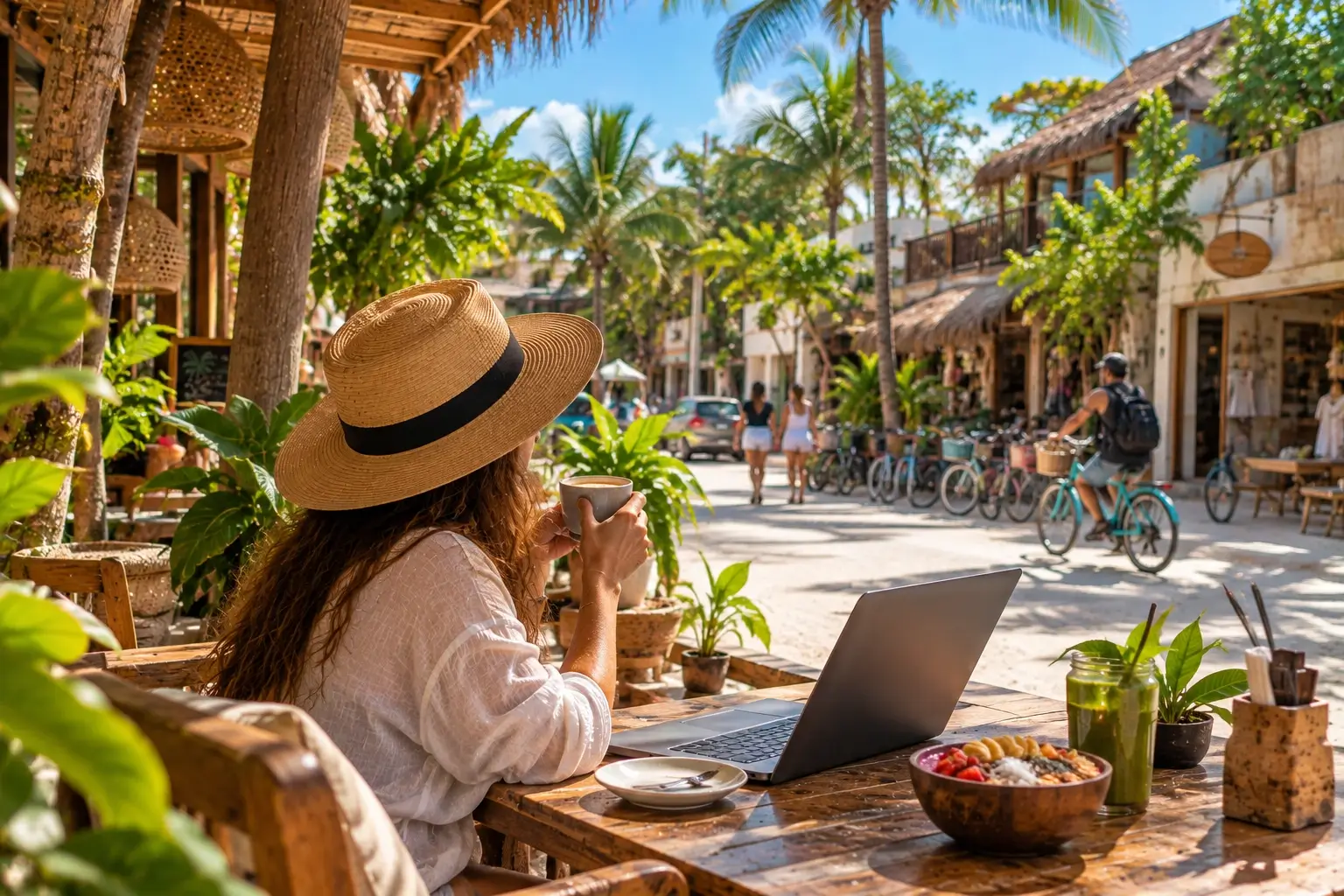
How much does it actually cost to live in Tulum? Well, that depends on whether you want a simple apartment in town or a luxury condo near the beach. The difference can easily reach thousands of dollars per month.
Tulum has changed considerably over the past decade. New residential developments, restaurants, and tourism have brought more housing options, but also higher prices in certain areas. Still, living here doesn’t necessarily require a luxury budget.
In this guide, we’ll break down the cost of living in Tulum, including housing, groceries, transportation, healthcare, and everyday expenses. We’ll also explain where your money goes further and which costs newcomers tend to underestimate.
Cost of Living in Tulum: Overview
The average cost of living in Tulum depends heavily on your neighborhood, housing preferences, and daily habits. Someone renting a modest apartment in Tulum Centro will have a completely different budget from someone living in Aldea Zama.
As a general starting point, we recommend budgeting approximately 22,000 to 28,000 MXN ($1,189 to $1,514 USD) per month for a single person living relatively modestly.
For a more comfortable lifestyle, including a modern apartment, regular restaurant visits, and enough money for entertainment, expect approximately 40,000 to 50,000 MXN ($2,162 to $2,703 USD) monthly.
Luxury living is another story. Premium condos, private transportation, beach clubs, and frequent dining at upscale restaurants can push monthly expenses above 80,000 MXN ($4,324 USD).
These figures assume you’re renting and living alone. Couples and families have different expenses, which we’ll cover later.
One important difference between Tulum and other Riviera Maya destinations is transportation. The town center and beach zone are several kilometers apart, and getting between them can become expensive if you rely on taxis.
Infrastructure also varies between neighborhoods. Some residential developments have paved roads, reliable utilities, and established services. Others are still surrounded by construction or have limited infrastructure.
We’ve seen properties with similar rental prices offer very different living experiences. That’s why we always recommend evaluating the location and operating expenses alongside the monthly rent.
Estimated Monthly Cost of Living in Tulum
The following table compares three lifestyles for a single adult renting an apartment in Tulum. These are practical budgeting estimates rather than official citywide averages.
All figures are monthly. We use an illustrative exchange rate of 18.50 MXN per $1 USD for consistency throughout this guide.
| Monthly Expense | Budget | Comfortable | Luxury |
|---|---|---|---|
| Housing | 10,000 MXN ($541) |
20,000 MXN ($1,081) |
40,000 MXN ($2,162) |
| Utilities and Internet | 1,800 MXN ($97) |
3,000 MXN ($162) |
6,000 MXN ($324) |
| Groceries | 4,000 MXN ($216) |
6,000 MXN ($324) |
9,000 MXN ($486) |
| Dining Out | 1,500 MXN ($81) |
5,000 MXN ($270) |
12,000 MXN ($649) |
| Transportation | 1,500 MXN ($81) |
3,500 MXN ($189) |
7,000 MXN ($378) |
| Healthcare | 1,000 MXN ($54) |
2,500 MXN ($135) |
5,000 MXN ($270) |
| Entertainment | 2,000 MXN ($108) |
5,000 MXN ($270) |
12,000 MXN ($649) |
| Total Monthly | 21,800 MXN ($1,178) |
45,000 MXN ($2,432) |
91,000 MXN ($4,919) |
The budget lifestyle assumes a modest apartment in town, mostly home cooked meals, limited restaurant visits, and inexpensive transportation. You can enjoy Tulum without spending much on nightlife or organized activities.
The comfortable lifestyle allows for a modern furnished condo, regular dining out, and occasional visits to beach clubs. It also includes a larger transportation allowance, which is particularly important in Tulum.
The luxury budget assumes premium accommodation, frequent restaurant visits, private transportation, and considerably more spending on entertainment.
Of course, these are examples rather than fixed spending requirements. Someone who owns a property outright may have much lower housing expenses. Meanwhile, a renter who regularly visits expensive beach clubs could exceed the comfortable budget without living in a luxury condo.
Healthcare allowances in this table represent monthly budgeting provisions. They are not guaranteed insurance premiums and may not cover major medical emergencies.
We also haven’t included one time relocation expenses, rental deposits, furniture purchases, or other initial costs.
For most people considering a move, housing and transportation are the two expenses worth investigating first. Choosing the right neighborhood can make a substantial difference to both.
Unlike Playa del Carmen, where many central neighborhoods allow residents to walk almost everywhere, Tulum is more spread out. Living close to restaurants and supermarkets doesn’t necessarily mean you’re close to the beach.
We recommend calculating your budget around the activities you expect to do regularly. If you plan to visit the beach several times per week, transportation deserves more attention than it would for someone who prefers spending time in town.
Ultimately, the cost of living in Tulum can be manageable, but it isn’t automatically cheap. The biggest savings usually come from choosing practical housing, shopping locally, and avoiding tourist prices for everyday purchases.
Housing Cost in Tulum

Housing is usually the biggest expense when calculating the cost of living in Tulum. However, rental prices vary considerably depending on the neighborhood, property type, and distance from the beach.
You can find relatively affordable apartments in Tulum Centro, particularly in older residential buildings. Meanwhile, modern condos in Aldea Zama and properties near the beach generally command higher rents.
One interesting aspect of Tulum’s housing market is the number of recently constructed condominiums. The town has experienced substantial residential development, creating a wide selection of furnished apartments aimed at investors, vacation renters, and foreign residents.
However, newer doesn’t always mean better. Some developments offer excellent amenities but are located on unfinished roads or in areas where infrastructure is still developing.
We recommend looking beyond the rental price and considering electricity, transportation, internet reliability, and the building’s maintenance. These expenses can make a significant difference to your monthly budget.
Average Monthly Rent in Tulum
For a furnished one bedroom apartment in Tulum, we recommend budgeting approximately 10,000 to 20,000 MXN ($541 to $1,081 USD) per month.
At the lower end, you’ll generally find smaller apartments, older properties, or accommodation farther from the most popular residential areas.
For 15,000 to 20,000 MXN, you may find a modern furnished condo with amenities such as a swimming pool, security, or a rooftop terrace.
However, prices depend heavily on the development, location, and rental conditions. Some owners offer discounts for longer contracts, while others maintain higher prices because they also market their properties to vacation renters.
Two bedroom condos generally cost more, although the difference isn’t always substantial. This can make larger apartments attractive to couples or remote workers who need a separate office.
Houses and villas cover a much wider price range. A modest residential house may be relatively affordable, while a luxury villa with a private pool can cost several times more than a typical apartment.
The following table provides estimated monthly rental prices for different property types in Tulum.
These are indicative ranges for residential rentals, not verified market averages. Prices can change with seasonality, availability, furnishings, and contract length.
| Property Type | Monthly Rent (MXN) | Monthly Rent (USD) |
|---|---|---|
| Studio Apartment | 7,000 to 13,000 MXN | $378 to $703 |
| One Bedroom Apartment | 10,000 to 20,000 MXN | $541 to $1,081 |
| Two Bedroom Condo | 15,000 to 30,000 MXN | $811 to $1,622 |
| Residential House | 18,000 to 40,000 MXN | $973 to $2,162 |
| Villa or Luxury Home | 35,000 to 100,000+ MXN | $1,892 to $5,405+ |
All USD amounts use an illustrative exchange rate of 18.50 MXN per $1 USD.
Keep in mind that furnished apartments aren’t always fully equipped for everyday living. Some properties marketed to vacation renters have limited storage, small kitchens, or furniture that isn’t particularly practical for permanent residents.
We recommend inspecting the property carefully before signing a long term contract. A beautiful rooftop pool won’t compensate for an uncomfortable apartment where you spend most of your time.
Rental Prices in Different Neighborhoods
Neighborhood selection has a major influence on housing costs in Tulum. However, the differences aren’t limited to rental prices. Road conditions, infrastructure, nearby services, and transportation requirements also vary considerably.
Tulum Centro is generally one of the more affordable and practical areas for everyday living. You’ll find supermarkets, local restaurants, pharmacies, and other essential services within relatively short distances.
Modest apartments in Centro may rent for approximately 7,000 to 12,000 MXN monthly. Newer furnished properties can cost considerably more, especially in convenient locations.
For someone trying to minimize expenses, Centro is often a sensible starting point. You can handle many daily activities without relying on taxis.
La Veleta has become popular among foreign residents and remote workers. The neighborhood offers numerous condominium developments, cafés, restaurants, and furnished apartments.
One bedroom rentals commonly fall within an estimated range of 12,000 to 22,000 MXN, although individual properties can sit outside that range.
However, La Veleta has some important disadvantages. Certain streets remain unpaved, construction continues in different sections, and infrastructure quality varies between developments.
We recommend checking the immediate surroundings rather than assuming that every property in La Veleta offers the same living conditions.
Aldea Zama is another established residential area popular with foreign buyers and renters. It includes modern condominiums, restaurants, shops, and residential developments.
Rental prices are generally higher than in many parts of Centro. A furnished one bedroom condo might cost approximately 15,000 to 25,000 MXN monthly.
Larger properties and premium developments can cost considerably more.
Aldea Zama can be attractive if you prefer modern residential buildings and access to condominium amenities. However, having a bicycle, scooter, or car can make everyday life more convenient.
Region 15 offers numerous newer condominium developments, including properties marketed toward investors and vacation renters.
Rental prices can be competitive, particularly when owners are looking for reliable tenants on longer contracts.
However, the neighborhood is still developing. Some properties are surrounded by construction, and road conditions vary significantly.
We recommend paying particular attention to access roads, electricity, water supply, and internet connectivity before renting.
Region 8 is another area attracting residential development. Its location can appeal to people interested in properties relatively close to the beach corridor.
However, infrastructure and accessibility differ between individual developments. Some streets and services are still evolving, so it’s important to inspect the area personally.
Finally, the Tulum Beach Zone operates in a completely different price category.
Accommodation near the beachfront is generally expensive, and many properties primarily serve the tourism market rather than permanent residents.
Long term rentals can be difficult to find, and prices may be substantially higher than in town.
For most people relocating to Tulum, we recommend focusing on Centro, La Veleta, Aldea Zama, and selected residential developments farther inland.
The beach zone may be attractive for a particular lifestyle, but it rarely makes financial sense for someone trying to keep monthly expenses under control.
Long Term Rentals vs Vacation Rentals
Tulum has a substantial vacation rental market, which creates some interesting opportunities and challenges for people looking for permanent accommodation.
Many furnished condos are marketed to tourists through short term rental platforms. However, some owners also accept monthly or annual tenants.
A long term residential contract generally offers better value than booking the same property for several weeks through a vacation rental platform.
For example, a condo advertised for 1,500 MXN per night could theoretically generate 45,000 MXN over 30 fully booked nights.
However, that doesn’t mean its long term rental value is 45,000 MXN. Vacation rental rates include different operating costs, booking conditions, and income expectations.
An owner may prefer a reliable tenant paying 17,000 MXN monthly rather than managing frequent guest changes and uncertain occupancy.
For residents planning to stay at least six months, we generally recommend looking for properties offered under conventional residential contracts.
These arrangements can provide more predictable expenses and fewer restrictions related to tourist bookings.
However, you should always confirm the minimum contract duration, payment conditions, and whether the property owner can terminate or decline to renew the agreement.
Some owners prefer shorter contracts because they want to make the property available during the busiest tourist months.
Others offer lower monthly prices in exchange for a commitment of six or twelve months.
We recommend discussing these conditions before paying a deposit.
Another important consideration is the building itself.
Living in a condominium dominated by vacation rentals can be different from living in a primarily residential building.
Frequent guest arrivals, luggage movement, and changing occupancy levels may affect the atmosphere.
If you’re looking for a quiet place to work remotely or settle permanently, ask about the building’s rental policies and typical occupancy.
Additional Costs When Renting
Monthly rent is only part of the housing budget in Tulum. Depending on the property, you may need to pay additional expenses directly.
One of the most important is electricity.
Air conditioning is widely used because of Tulum’s tropical climate. Electricity bills can become substantial, particularly in larger apartments or properties with inefficient equipment.
We recommend requesting recent electricity bills before renting, ideally covering different seasons.
Water is another consideration. Some condominium developments include water in their maintenance arrangements, while others charge residents separately.
In certain areas, water delivery or private water storage systems may create additional expenses.
Internet service may also be excluded from the rent. This is particularly important for remote workers, as service availability and reliability can vary between developments.
Another expense to clarify is the HOA fee, commonly called the maintenance fee.
Many condominium buildings charge monthly fees to cover shared facilities, swimming pools, security, landscaping, and building maintenance.
For residential rentals, these fees are sometimes included in the advertised price. However, some owners require tenants to pay them separately.
We recommend confirming this in writing before signing a contract.
For example, a condo advertised for 16,000 MXN monthly may actually cost 19,000 MXN if the owner charges an additional 3,000 MXN maintenance fee.
That difference represents 36,000 MXN over a year.
Security deposits are another upfront expense. Landlords commonly request the equivalent of one month’s rent, although requirements vary.
Some landlords also request the first month’s rent in advance, references, a guarantor, or additional documentation.
Depending on the agreement, you may encounter a póliza jurídica, which is a legal protection arrangement used in some Mexican rental contracts.
The cost and responsibility for paying it should be clarified before committing to the property.
We also recommend checking whether the apartment includes basic household equipment.
A furnished condo may include a bed, sofa, refrigerator, and air conditioning but lack a washing machine, kitchen equipment, or adequate storage.
Purchasing these items can add several thousand pesos to your initial expenses.
Finally, consider transportation.
A cheaper apartment in Region 15 may require regular taxi rides or vehicle ownership, while a slightly more expensive property in Centro could allow you to walk to supermarkets and restaurants.
We always recommend calculating the complete monthly cost rather than comparing rental prices alone.
For example, consider two apartments:
- Apartment A: 13,000 MXN rent, 2,500 MXN utilities, and 4,000 MXN transportation. Total: 19,500 MXN monthly.
- Apartment B: 17,000 MXN rent, 2,000 MXN utilities, and 500 MXN transportation. Total: 19,500 MXN monthly.
Both apartments cost the same overall, despite having very different rental prices.
Of course, the better option depends on your lifestyle. Someone who works from home and rarely visits the beach may prefer the cheaper apartment farther inland.
Someone who enjoys walking to restaurants and shops might find the central property considerably more convenient.
For newcomers, we often recommend renting before purchasing a property. Spending several months in Tulum gives you time to understand the neighborhoods, transportation requirements, and everyday expenses.
That experience can be particularly valuable if you’re considering buying a condo or house for permanent residence.
Prices of Real Estate in Tulum

Buying property in Tulum can make sense if you’re planning to stay for several years. However, purchasing isn’t automatically cheaper than renting, especially when you include closing costs, maintenance, and other ownership expenses.
One interesting aspect of Tulum’s real estate market is the variety of properties available. You can find relatively affordable studios, modern condos with shared amenities, residential houses, and luxury villas with private pools.
Prices depend heavily on the neighborhood, property size, construction quality, and legal status. Two condos with similar floor plans can have very different prices depending on their location and development.
We also recommend paying attention to the property’s infrastructure. A modern condo with a swimming pool might look attractive, but reliable electricity, water supply, road access, and proper maintenance are equally important.
For foreign buyers, Tulum has another consideration. Because the city falls within Mexico’s restricted zone, foreigners generally purchase residential property through a bank trust known as a fideicomiso.
Let’s look at the main property types and the expenses involved.
Condo Prices
Condominiums are among the most common properties purchased by foreigners in Tulum. Many developments offer furnished studios, one bedroom apartments, and larger units with shared facilities.
For a modest studio or compact one bedroom condo, asking prices may start around $90,000 to $130,000 USD. However, the cheapest properties aren’t necessarily the best investments or places to live.
Location, construction quality, developer reputation, and building maintenance can make a substantial difference.
For a modern one bedroom condo in areas such as La Veleta or Region 15, we recommend considering an approximate budget of $130,000 to $200,000 USD.
Two bedroom condos often fall between $180,000 and $300,000 USD, depending on the development, size, and included amenities.
Premium properties in Aldea Zama, established residential developments, and locations closer to the beach can cost considerably more.
These are broad asking price ranges rather than verified market averages. Individual listings can fall outside them, particularly when owners are motivated to sell.
One important detail is that Tulum has experienced considerable condominium development. This means buyers can sometimes find multiple properties with similar layouts and amenities competing in the same neighborhood.
We recommend comparing several developments rather than making a decision based on one attractive listing.
Pay particular attention to the usable interior space. Some condos advertise a total area that includes terraces, balconies, or other spaces.
A property with 80 square meters of total area might have considerably less enclosed living space.
We also recommend reviewing the building’s occupancy and maintenance arrangements. A development with numerous unsold units may face different financial challenges from an established condominium with a functioning owners’ association.
For buyers planning to live in Tulum permanently, practical features deserve attention. Adequate storage, a functional kitchen, reliable internet, and comfortable living areas may be more valuable than decorative amenities.
If you’re exploring condos for sale in Tulum, we recommend comparing the complete ownership costs alongside the purchase price.
House and Villa Prices
Houses offer more privacy and living space than most condominiums, making them attractive to families and buyers planning to settle in Tulum.
However, houses are generally more expensive to purchase and maintain, particularly when they include private swimming pools and gardens.
For a modest residential house, prices may start around $150,000 to $250,000 USD, depending on the neighborhood and condition.
Larger houses with modern finishes, additional bedrooms, and private outdoor areas commonly require budgets of approximately $250,000 to $450,000 USD.
Luxury villas can cost $500,000 USD or substantially more.
Properties with premium architecture, large plots, multiple bedrooms, and private pools can exceed $1 million USD.
As with condos, these figures represent indicative asking price ranges rather than guaranteed market values.
One advantage of buying a house is greater control over the property. You may have more flexibility regarding renovations, outdoor spaces, and everyday use.
However, ownership also means taking responsibility for expenses that condominium residents often share.
For example, a house with a private pool requires regular cleaning, chemicals, electricity for the pump, and occasional equipment repairs.
Gardens need maintenance, particularly during the rainy season when vegetation grows quickly.
Security, exterior lighting, and water systems may create additional expenses.
We recommend considering these costs before deciding that a house offers better value than a condo.
Another important factor is the property’s location.
Some houses are located in established residential communities with paved roads and functioning infrastructure. Others sit in newer areas where development is still ongoing.
For permanent residents, access to supermarkets, schools, medical facilities, and main roads can be more important than proximity to tourist attractions.
We also recommend verifying construction permits, property boundaries, and legal documentation before purchasing.
These checks are particularly important for independently constructed houses or properties that have undergone substantial modifications.
Land Prices
Buying land in Tulum can be attractive if you want to build a house rather than purchase an existing property.
However, land purchases require considerably more research than buying a completed condo.
Prices vary enormously depending on location, lot size, infrastructure, zoning, and legal status.
For example, a residential lot farther from the main tourist areas might be advertised for $40,000 to $80,000 USD.
Lots in established residential communities or more desirable locations can cost $100,000 to $200,000 USD or considerably more.
Premium land suitable for larger residential or commercial projects may have a completely different pricing structure.
These examples are broad market illustrations, not current verified averages. Land should always be compared using price per square meter and the property’s actual development potential.
One of the biggest mistakes buyers make is assuming that every parcel of land advertised for sale can legally accommodate a residential building.
That isn’t necessarily the case.
Before purchasing, we recommend confirming the property’s zoning, permitted land use, construction restrictions, and access to public roads.
You should also investigate whether electricity, water, and other essential services are available.
A relatively inexpensive lot can become considerably more expensive if you need to arrange additional infrastructure.
In Tulum, environmental restrictions deserve particular attention.
Some parcels may be subject to limitations related to vegetation, protected areas, environmental regulations, or the local ecological planning framework.
These restrictions can affect how much of the land you’re allowed to develop.
We also recommend checking the property’s legal classification.
Some land advertised around Tulum has an ejido background. Ejido land is subject to a different legal framework from ordinary private property.
Purchasing land without properly verifying its ownership status can create serious legal problems.
Even when a seller claims that a parcel has been privatized, we recommend independently verifying the documentation through a qualified Mexican real estate attorney and the appropriate authorities.
For foreign buyers, the restricted zone rules also apply to residential land purchases.
We generally recommend focusing on legally registered private property with clear ownership documentation and confirmed development rights.
If you’re considering land for sale in Tulum, remember to calculate the complete project budget.
That includes the purchase price, closing costs, architectural plans, permits, construction, utility connections, and a reserve for unexpected expenses.
A $70,000 lot doesn’t necessarily mean you can complete your dream home for $200,000. The final cost depends on the land’s characteristics and the type of property you intend to build.
Closing Costs and Fideicomiso Fees
When purchasing property in Tulum, you need to budget for more than the advertised selling price.
Buyers generally pay closing expenses that may include acquisition taxes, notary fees, registration charges, certificates, and other administrative costs.
For planning purposes, we recommend setting aside approximately 5% to 8% of the purchase price for closing costs.
However, the actual amount depends on the transaction, applicable taxes, property value, and ownership structure.
For example, purchasing a condo for $200,000 USD could involve approximately $10,000 to $16,000 USD in closing expenses.
That means your total initial budget might reach $210,000 to $216,000 USD before furniture, renovations, or other purchases.
We recommend obtaining a detailed closing estimate from the notary before signing a binding purchase agreement.
For foreign buyers, another important expense is the fideicomiso.
Under Mexico’s Constitution, foreigners cannot acquire direct ownership of residential real estate within the restricted zone. This includes land located within 50 kilometers of the coastline.
Tulum falls within this zone.
A fideicomiso allows a foreign buyer to hold beneficial rights to the property through a Mexican bank acting as trustee.
Although the bank holds legal title as trustee, the foreign beneficiary generally retains the rights to use, enjoy, sell, lease, and transfer the property, subject to the trust terms and applicable law.
For the initial setup, we recommend budgeting approximately $500 to $1,500 USD in bank trust fees, although actual charges vary between institutions and transactions.
There may also be government permit expenses and other administrative charges associated with establishing the trust.
The fideicomiso also carries an annual bank administration fee, commonly around $500 to $1,000 USD.
These are indicative ranges. The bank’s current fee schedule should always be confirmed before purchasing.
Importantly, a fideicomiso is not the same as renting property from the bank.
The foreign beneficiary holds enforceable property rights through the trust, and the arrangement can generally be renewed or extended according to the applicable legal framework.
For a more detailed explanation, we recommend reading our guide to fideicomiso in Mexico.
Another consideration is whether you’re purchasing a completed property or a unit still under construction.
With preconstruction purchases, payment schedules, delivery conditions, and the timing of title transfer can affect your financial commitments.
We recommend reviewing the purchase agreement carefully and ensuring that the developer has the required permits and legal documentation.
For any property purchase, independent legal verification is worth the expense.
A relatively small investment in professional due diligence can help identify problems that would be considerably more expensive to resolve later.
Ongoing Property Ownership Expenses
Owning a property in Tulum eliminates monthly rent, but it doesn’t eliminate housing expenses.
Depending on the property, you’ll still need to pay maintenance fees, utilities, property taxes, insurance, and occasional repairs.
For condominium owners, the HOA fee is often one of the largest recurring expenses.
These fees cover shared services such as swimming pool maintenance, cleaning, security, landscaping, common area electricity, and building administration.
For a typical condo, monthly maintenance fees might range from 2,000 to 5,000 MXN.
Developments with extensive amenities, larger common areas, or premium services can charge considerably more.
We recommend checking the exact maintenance fee before purchasing and asking whether increases are expected.
For example, a condo with a 4,000 MXN monthly HOA fee costs 48,000 MXN annually before electricity, insurance, and other expenses.
Over five years, that represents 240,000 MXN, assuming the fee doesn’t increase.
We also recommend reviewing the condominium’s financial situation.
Buildings with insufficient maintenance reserves may eventually require additional payments from owners to cover major repairs.
These are sometimes called special assessments.
In newer developments, we pay particular attention to whether the advertised HOA fee realistically covers the building’s operating expenses.
A very low maintenance fee isn’t necessarily a positive sign if it means the condominium cannot properly maintain its facilities.
Property tax, known as predial, is another recurring expense.
In Mexico, annual property taxes are generally lower than those in many parts of the United States. However, the actual amount depends on the property’s assessed value and applicable municipal rules.
We recommend checking the property’s current predial statement rather than relying on a general estimate.
Homeowners should also consider insurance.
Property insurance can help protect against certain risks, although coverage, exclusions, deductibles, and premiums vary.
In Tulum, we recommend paying particular attention to hurricane and storm related coverage.
The region is exposed to tropical storms and hurricanes, and not every insurance policy provides the same protection.
For houses and villas, maintenance expenses can be more substantial.
Private swimming pools, gardens, water pumps, air conditioning units, and exterior surfaces all require attention.
The tropical climate can also accelerate wear on certain building materials and equipment.
Humidity, heavy rainfall, and salt exposure in coastal locations may increase maintenance requirements.
We recommend setting aside a separate reserve for repairs rather than assuming everything will function perfectly throughout the year.
For example, replacing an air conditioning unit or repairing a water pump can create an unexpected expense of several thousand pesos.
Property owners who don’t live in Tulum throughout the year may also need a property manager.
Management services can include regular inspections, coordinating maintenance, paying bills, and supervising cleaning.
If you plan to rent your property to tourists, additional expenses may include cleaning, booking commissions, guest management, supplies, and increased maintenance.
Those costs should be evaluated separately from ordinary residential ownership expenses.
Finally, foreign owners using a fideicomiso need to include the annual bank trust fee in their calculations.
When we help buyers evaluate properties, we recommend preparing a realistic annual ownership budget before making an offer.
For example, a condo with a 3,000 MXN monthly HOA fee already requires 36,000 MXN annually. Add electricity, water, insurance, property taxes, trust fees, and repairs, and the total becomes considerably higher.
That doesn’t necessarily make purchasing a bad financial decision. It simply means the comparison between renting and buying needs to include all expenses.
For someone planning to remain in Tulum for many years, ownership may offer greater stability and the opportunity to build equity.
However, we recommend making that decision based on your financial situation, intended length of stay, and the property’s actual condition.
If you’re exploring real estate in Tulum, our advice is to compare the complete cost of ownership rather than focusing exclusively on the purchase price.
Utilities Cost in Tulum

Utilities are an important part of the cost of living in Tulum, particularly if you’re renting or buying a property in a newer residential development. Electricity is usually the largest expense, but water supply and infrastructure can also affect your monthly budget.
For a typical one or two bedroom apartment, we recommend budgeting approximately 1,800 to 4,500 MXN ($97 to $243 USD) per month for basic utilities, internet, and mobile phone service.
However, larger properties with multiple air conditioning units, private swimming pools, or additional water systems can cost considerably more to operate.
One important difference between Tulum and more established cities is that infrastructure varies significantly between neighborhoods. Some developments have reliable utility connections, while others depend on additional equipment or private services.
We’ve seen modern condos with impressive amenities but surprisingly complicated water and electricity arrangements. That’s why we always recommend investigating how a property operates before signing a rental contract or purchasing it.
Electricity and Air Conditioning
Electricity is usually the most expensive utility in Tulum, particularly during the hotter months.
The city has a tropical climate with high temperatures and humidity throughout much of the year. For many residents, air conditioning is essential for comfortable living.
Electricity is supplied by Comisión Federal de Electricidad (CFE), Mexico’s national electricity utility.
Residential electricity prices depend on the applicable tariff, consumption, and government subsidies. This means two households can pay very different amounts even when living in similar apartments.
For a small apartment with moderate air conditioning use, monthly electricity expenses might average approximately 500 to 1,200 MXN.
For a larger condo with multiple air conditioning units, expenses can reach 1,500 to 3,000 MXN monthly or more.
These figures are practical budgeting estimates rather than fixed electricity rates.
Actual consumption depends on the property’s size, insulation, equipment efficiency, and how frequently residents use air conditioning.
For example, someone who works outside the home and only uses air conditioning at night will generally consume less electricity than someone working remotely with the AC running throughout the day.
Another important consideration is the type of air conditioning equipment.
Modern inverter units generally consume less electricity than older, inefficient systems when used under comparable conditions.
We recommend checking the age and condition of the installed units before renting or purchasing a property.
One detail that newcomers sometimes overlook is that CFE commonly issues residential electricity bills every two months.
If you receive a bill for 3,000 MXN, that may represent approximately 1,500 MXN in monthly consumption.
However, you should always check the billing period rather than assuming every electricity bill covers two months.
High consumption can also create another problem.
Mexico has a residential electricity classification known as DAC (Doméstica de Alto Consumo).
When a household’s average consumption exceeds the applicable threshold, the account may be moved to this classification.
DAC customers lose the normal residential electricity subsidy, potentially increasing their bills substantially.
The consumption threshold depends on the applicable local tariff, so we recommend checking the property’s electricity history rather than relying on a universal number.
For buyers, we suggest requesting several recent CFE bills before making a purchase decision.
Ideally, review electricity consumption during both cooler and hotter months.
This is particularly important for condos with large windows, poor insulation, or air conditioning units that operate continuously.
For houses and villas, electricity expenses can increase further because of pool pumps, exterior lighting, water pumps, and other equipment.
We recommend including these operating costs when comparing properties. A slightly more expensive condo with efficient equipment may actually cost less to maintain over time.
Water, Gas and Water Delivery
Water deserves special attention in Tulum because the available infrastructure isn’t identical throughout the city.
In established neighborhoods, properties may have access to municipal water services. However, some newer developments use additional storage systems, private wells, or water deliveries.
Depending on the property, water expenses may be included in the HOA fee, charged separately, or managed through the building’s own arrangements.
For a typical apartment with a functioning water connection, we recommend budgeting approximately 150 to 400 MXN monthly.
However, this estimate may not reflect the actual cost of water in developments that depend on private delivery services.
Some buildings use water storage tanks, commonly called cisternas, along with pumps to maintain water pressure.
When the regular supply is insufficient, additional water may need to be delivered by tanker trucks, known locally as pipas.
The cost depends on the quantity ordered, supplier, delivery location, and local availability.
For individual homeowners, purchasing a full tanker delivery can cost considerably more than a normal monthly water bill.
In condominium developments, these expenses may be shared between owners through maintenance fees or additional assessments.
We recommend asking several questions before renting or buying:
- Does the property have a regular water connection?
- Is water included in the rent or HOA fee?
- Does the building regularly purchase water deliveries?
- Who pays for additional deliveries when the supply is insufficient?
- Does the property have adequate water storage and functioning pumps?
These questions are particularly important in developing neighborhoods such as parts of Region 15 and Region 8.
However, infrastructure varies between individual streets and buildings. We wouldn’t assume that every property in a particular neighborhood has the same water arrangements.
Gas is another regular household expense.
Many properties in Tulum use LP gas for cooking and heating water. Gas may be stored in individual cylinders or larger stationary tanks.
For a small household, we recommend budgeting approximately 200 to 500 MXN monthly for gas.
Actual expenses depend on the number of residents, cooking habits, and water heating equipment.
Some newer condos use electric stoves and water heaters instead.
In these properties, you may have no gas expenses, but electricity consumption can be higher.
We recommend confirming which appliances use electricity and which use gas before calculating your monthly utility budget.
Another consideration is drinking water.
We generally recommend using properly treated or bottled water rather than drinking untreated tap water.
Many residents purchase large refillable water containers called garrafones, which typically hold around 20 liters.
Depending on the supplier and delivery arrangement, refills might cost approximately 20 to 60 MXN.
For a household using several containers each month, this adds another small recurring expense.
Internet and Mobile Phone Plans
Internet access is an important consideration in Tulum, especially for remote workers and people running businesses online.
Although many modern condominium developments advertise internet access, connection quality varies significantly.
Some properties have access to fiber optic connections, while others depend on wireless services or different infrastructure.
For a standard residential internet package, we recommend budgeting approximately 450 to 900 MXN monthly.
Higher speed packages and specialized connections may cost more.
However, price isn’t necessarily the biggest issue. Availability and reliability can be more important, particularly in developing neighborhoods.
We recommend confirming the actual internet provider and connection type before signing a rental contract.
If you work remotely, ask the landlord for a recent speed test from inside the apartment.
It’s also worth checking whether the connection is private or shared between several units.
A building may advertise high speed internet while providing a shared connection that becomes slower when multiple residents are online.
We also recommend asking about recent service interruptions.
Internet reliability can vary between streets, even within the same neighborhood.
For mobile phone service, prepaid plans are widely available in Mexico.
A typical monthly budget of 150 to 350 MXN may cover basic calls, messages, and mobile data, depending on the provider and package.
Residents requiring larger data allowances or international calling features may spend more.
Mobile coverage also varies by location.
We recommend checking signal strength inside the property, particularly in newer residential areas or buildings with thick concrete walls.
For remote workers, maintaining a mobile data connection as a backup can be useful.
However, mobile internet shouldn’t automatically be treated as a complete replacement for a reliable home connection.
Some residents also consider satellite internet services when conventional connections aren’t available.
These arrangements can involve higher monthly fees and additional equipment costs.
For most people living in established neighborhoods, a conventional residential internet connection will generally be the more economical option.
Estimated Monthly Utility Costs in Tulum
The following table summarizes approximate monthly utility expenses for a typical one or two bedroom apartment in Tulum.
These estimates assume normal residential consumption and a functioning utility setup. They don’t include major water delivery problems, unusually high electricity consumption, or additional equipment expenses.
Dollar equivalents use our illustrative exchange rate of 18.50 MXN per $1 USD.
| Utility | Monthly Cost (MXN) | Monthly Cost (USD) |
|---|---|---|
| Electricity | 500 to 2,500 MXN | $27 to $135 |
| Water | 150 to 400 MXN | $8 to $22 |
| Gas | 200 to 500 MXN | $11 to $27 |
| Home Internet | 450 to 900 MXN | $24 to $49 |
| Mobile Phone | 150 to 350 MXN | $8 to $19 |
| Total Monthly | 1,450 to 4,650 MXN | $78 to $251 |
These are estimated monthly equivalents. Actual electricity bills may cover a longer billing period, and gas purchases may occur less frequently than once per month.
For a single person living in a small apartment, total utility expenses can remain close to the lower end of the range.
Couples and families generally consume more electricity and water, particularly when several rooms require air conditioning.
For a larger house or villa, monthly utility expenses can exceed 5,000 MXN, especially when the property has a swimming pool, multiple air conditioning units, and additional water equipment.
We also recommend distinguishing between regular utility expenses and infrastructure related costs.
For example, a condo might have relatively inexpensive electricity and internet, but the building could occasionally require additional payments for water deliveries or pump repairs.
Those expenses may appear through the HOA rather than directly on your utility bills.
When comparing properties, we recommend asking for a complete breakdown of recurring expenses rather than focusing only on electricity and water.
Overall, utilities don’t necessarily make Tulum expensive. However, air conditioning consumption and the property’s infrastructure can create substantial differences between otherwise similar homes.
For anyone planning to rent or buy, understanding these costs before moving in is one of the easiest ways to avoid unexpected monthly expenses.
Food Cost

Food expenses in Tulum depend heavily on where you shop and how often you eat out. You can maintain a reasonable grocery budget, but restaurants in tourist areas can quickly become expensive.
For a single person who prepares most meals at home, we recommend budgeting approximately 4,000 to 6,000 MXN ($216 to $324 USD) per month for groceries.
If you regularly eat at restaurants, expect to spend another 2,000 to 5,000 MXN monthly. Of course, that amount can increase considerably if you prefer restaurants in the beach zone.
One important difference between Tulum and Playa del Carmen is the concentration of expensive restaurants catering to international visitors. Tulum has plenty of affordable local food, but you’ll need to know where to look.
We generally recommend separating your food budget into groceries and dining out. This makes it easier to understand where your money goes and adjust your spending when necessary.
Grocery Shopping
Grocery shopping in Tulum is relatively straightforward for everyday products. However, the selection of supermarkets is smaller than in Playa del Carmen or Cancún.
Chedraui is one of the main supermarkets used by residents. You’ll also find smaller grocery stores, convenience shops, fruit and vegetable vendors, and neighborhood businesses throughout town.
For basic products such as eggs, rice, beans, chicken, tortillas, and seasonal vegetables, prices are generally manageable.
However, imported products and specialty foods can be considerably more expensive.
For example, someone who prepares meals using locally available ingredients can maintain a relatively modest grocery budget. Someone regularly purchasing imported cheese, organic snacks, specialty coffee, and international brands will spend more.
We recommend comparing prices between supermarkets and smaller local shops rather than assuming larger stores always offer the best deals.
Fresh produce can sometimes be cheaper at neighborhood fruit and vegetable shops, particularly when you purchase seasonal products.
For a single person, a monthly grocery budget of 4,000 to 5,000 MXN should be a reasonable starting point for basic home cooking.
If you prefer premium products, imported foods, or a more varied diet, budgeting 6,000 to 8,000 MXN may be more realistic.
For couples, we recommend approximately 7,000 to 10,000 MXN monthly, depending on dietary preferences.
Families with children will generally need a larger allowance, particularly if they regularly purchase meat, dairy products, and packaged foods.
Another consideration is shopping outside Tulum.
Some residents occasionally visit Playa del Carmen for larger purchases, particularly when looking for products unavailable locally.
However, we wouldn’t recommend making frequent shopping trips solely to save a small amount on groceries.
Transportation costs can easily eliminate those savings.
For example, saving 300 MXN on groceries doesn’t make much sense if you spend 400 MXN on fuel or transportation.
We recommend planning larger shopping trips around other activities whenever possible.
Another small expense is drinking water.
Most residents use bottled or properly treated water for drinking rather than consuming untreated tap water.
Large refillable containers, commonly called garrafones, are a popular option.
These typically hold around 20 liters and may cost approximately 20 to 60 MXN per refill, depending on the supplier and delivery arrangement.
Purchasing refillable containers is generally more economical than relying on individual bottles every day.
Eating at Local Restaurants
Despite Tulum’s reputation for expensive restaurants, affordable local food is widely available in town.
The key is looking beyond the beach zone and the restaurants primarily serving international tourists.
In Tulum Centro, you’ll find taquerías, small family restaurants, traditional Mexican kitchens, and businesses serving everyday meals.
A simple breakfast might cost approximately 80 to 150 MXN, depending on the restaurant and what you order.
For lunch, some local restaurants offer a comida corrida, which is a set meal that may include soup, a main dish, rice or beans, tortillas, and a drink.
These meals commonly cost around 100 to 180 MXN.
Individual tacos might cost approximately 20 to 45 MXN, depending on the ingredients and restaurant.
That means you can enjoy a filling meal without spending several hundred pesos.
We recommend exploring restaurants along the streets surrounding the main commercial areas rather than limiting yourself to the most visible tourist establishments.
Local restaurants are particularly useful for residents who work outside the home or don’t want to prepare every meal.
However, eating out regularly still adds up.
For example, spending 150 MXN on lunch five days per week represents approximately 3,300 MXN over 22 working days.
Add occasional dinners and coffees, and your restaurant budget can quickly exceed 5,000 MXN.
For someone trying to minimize the cost of living in Tulum, cooking at home and visiting local restaurants occasionally is usually the most economical approach.
Another advantage of local restaurants is that prices are often more predictable than in tourist establishments.
However, we recommend checking menus before ordering, particularly when visiting unfamiliar places.
Dining at Tourist Restaurants
Tulum has an extensive restaurant scene aimed at international visitors. You’ll find everything from casual cafés to expensive beachfront restaurants.
However, the prices can be very different from those in residential neighborhoods.
In popular tourist areas, a main course might cost approximately 250 to 500 MXN.
At premium restaurants, individual dishes can easily exceed 600 MXN, particularly when ordering seafood, imported ingredients, or specialty meals.
The beach zone is generally the most expensive area for dining.
Restaurants located inside boutique hotels or beach clubs may charge substantially more than similar establishments in town.
For a couple, dinner at a midrange tourist restaurant might cost approximately 900 to 1,500 MXN, depending on drinks and menu choices.
At upscale establishments, the bill can exceed 2,000 MXN without much difficulty.
We recommend paying particular attention to beverages.
Cocktails, imported drinks, and specialty coffees can significantly increase the final bill.
For example, ordering two main courses, two cocktails, and a shared dessert can turn a relatively simple dinner into a substantial expense.
Another consideration is tipping.
In sit down restaurants, a tip of approximately 10% to 15% is customary when you’re satisfied with the service.
We recommend checking your bill before adding a tip, particularly in tourist areas where additional charges may occasionally appear.
Some establishments also have minimum spending requirements, especially when dining at beach clubs or using their facilities.
These arrangements can make a casual afternoon considerably more expensive than expected.
For residents, we recommend treating premium restaurants as part of the entertainment budget rather than everyday food expenses.
That doesn’t mean you should avoid them. Tulum has plenty of interesting places to eat, and enjoying them can be part of the reason you moved here.
However, visiting expensive restaurants several times per week will have a noticeable impact on your monthly spending.
Typical Grocery and Restaurant Prices in Tulum
The following table provides estimated prices for common groceries and restaurant meals in Tulum.
These are illustrative retail and menu price ranges rather than verified citywide averages. Prices vary between stores, restaurants, neighborhoods, and seasons.
Dollar equivalents use our illustrative exchange rate of 18.50 MXN per $1 USD.
| Item | Price (MXN) | Price (USD) |
|---|---|---|
| Milk (1 Liter) | 25 to 40 MXN | $1.35 to $2.16 |
| Eggs (12) | 35 to 60 MXN | $1.89 to $3.24 |
| Chicken Breast (1 kg) | 140 to 200 MXN | $7.57 to $10.81 |
| Rice (1 kg) | 25 to 50 MXN | $1.35 to $2.70 |
| Bananas (1 kg) | 20 to 40 MXN | $1.08 to $2.16 |
| Tomatoes (1 kg) | 25 to 55 MXN | $1.35 to $2.97 |
| Bottled Water (1.5 Liters) | 15 to 30 MXN | $0.81 to $1.62 |
| Local Restaurant Meal | 100 to 180 MXN | $5.41 to $9.73 |
| Three Tacos | 60 to 135 MXN | $3.24 to $7.30 |
| Tourist Restaurant Main Course | 250 to 500 MXN | $13.51 to $27.03 |
| Dinner for Two (Midrange) | 900 to 1,500 MXN | $48.65 to $81.08 |
| Cappuccino | 60 to 100 MXN | $3.24 to $5.41 |
These examples show why two residents can have very different food budgets despite living in the same city.
Someone who shops locally and prepares most meals at home may spend around 4,000 MXN monthly on groceries, plus occasional restaurant visits.
Meanwhile, someone who regularly eats at tourist restaurants could spend 10,000 MXN or more on dining alone.
For a comfortable lifestyle, we recommend budgeting approximately 10,000 to 12,000 MXN per month for groceries and dining combined for a single person who enjoys eating out regularly.
You can certainly spend less, particularly if you prefer traditional Mexican food and cook most of your meals.
However, we wouldn’t recommend calculating your food budget using only supermarket prices if you expect to visit restaurants several times per week.
Overall, food doesn’t necessarily make Tulum expensive. The biggest difference comes from your habits and the places you choose.
Shopping locally, preparing meals at home, and keeping tourist restaurants for occasional outings can help you maintain a reasonable monthly budget without giving up the experiences that make living in Tulum enjoyable.
Transportation Cost

Transportation is one of the expenses that makes the cost of living in Tulum different from Playa del Carmen or Cancún. The town is relatively compact, but its main residential neighborhoods, supermarkets, and beach areas are spread across several kilometers.
For someone living in Tulum Centro, getting around can be inexpensive. You can walk to restaurants, visit local shops, and use colectivos for certain journeys. However, living in Aldea Zama, La Veleta, or Region 15 may require more planning.
We recommend budgeting approximately 1,000 to 2,000 MXN ($54 to $108 USD) monthly if you primarily walk, cycle, and use public transportation.
Someone who regularly takes taxis or owns a vehicle should expect considerably higher expenses. For a comfortable lifestyle, a transportation budget of 3,000 to 5,000 MXN per month is a more realistic starting point.
The biggest factor is how often you travel between town and the beach. That single habit can make a noticeable difference to your monthly spending.
Colectivos and Public Transportation
Colectivos are one of the cheapest transportation options available in Tulum. These shared vans operate along established routes and connect the town with other destinations along the Riviera Maya.
For example, residents can use colectivos to travel toward Playa del Carmen, Akumal, and other communities along Highway 307.
Fares depend on the distance and route. For short local journeys where shared transportation is available, we recommend allowing approximately 15 to 30 MXN per ride.
Longer journeys naturally cost more.
However, public transportation in Tulum has limitations. The network is not as extensive or convenient as what you might find in a larger Mexican city.
Many residential developments are located away from the main transportation routes. This means you may need to walk a considerable distance before reaching a colectivo stop.
Another issue is service frequency. Depending on the route, transportation may be less convenient during evenings or quieter periods.
We recommend checking the actual transportation options near a property before renting or purchasing it.
For example, a condo in Region 15 might offer attractive rental prices, but reaching the supermarket or town center could require a bicycle, scooter, or taxi.
Someone living in Centro may have fewer transportation expenses because essential services are within walking distance.
Public transportation can also be useful for occasional trips to Playa del Carmen.
However, we wouldn’t recommend relying exclusively on colectivos if your daily routine involves frequent journeys between different parts of Tulum.
For residents who work remotely and spend most of their time near home, public transportation may be sufficient. For people commuting regularly, having another transportation option can make life considerably easier.
Taxis
Taxis are widely available in Tulum, but they can become one of the most expensive parts of everyday life.
This is particularly true when traveling between Tulum Centro and the beach zone.
Unlike many cities where taxis are mainly used for occasional convenience, Tulum’s layout can make them a regular expense for residents without a vehicle.
For a relatively short journey within town, we recommend budgeting approximately 100 to 200 MXN, depending on the route and applicable fare.
Trips between central Tulum and the beach zone can cost considerably more. Depending on the destination and circumstances, fares may reach several hundred pesos.
These are indicative budgeting ranges rather than official taxi tariffs. Actual charges should be confirmed before traveling.
We recommend asking about the price before entering the taxi, especially when traveling from hotels, beach clubs, or tourist areas.
Let’s consider a simple example.
Imagine living in Tulum Centro and visiting the beach twice per week. If each round trip costs 500 MXN, you would spend approximately 4,000 MXN over four weeks.
That’s an additional $216 USD monthly, using our illustrative exchange rate of 18.50 MXN per dollar.
For a couple, the expense may be easier to justify because both people share the same taxi. However, frequent individual trips can become expensive.
We recommend including these journeys in your budget before choosing a neighborhood.
A relatively inexpensive apartment in town might still be the better financial option. However, you should understand how much transportation will cost if beach visits are part of your regular routine.
Ride sharing applications are another consideration, but their availability and practical operation can change because of local regulations and transportation conditions.
We wouldn’t recommend assuming that an application will always provide a cheaper alternative to local taxis.
For permanent residents, having a bicycle, scooter, or car often provides more predictable transportation expenses.
Owning a Car or Scooter
Owning a vehicle can make living in Tulum considerably more convenient.
This is particularly true if you live outside Centro, regularly visit the beach, or need to travel to Playa del Carmen for shopping and other services.
However, vehicle ownership introduces expenses beyond the initial purchase.
For a car, you’ll need to consider fuel, insurance, maintenance, registration, and occasional repairs.
For someone who already owns a modest vehicle, we recommend budgeting approximately 2,500 to 5,000 MXN monthly for operating expenses and a maintenance reserve.
This estimate excludes the purchase price, financing payments, and major unexpected repairs.
Fuel consumption depends on how frequently you drive and the type of vehicle you own.
Someone who mainly travels between Centro and nearby residential neighborhoods will generally spend less than someone commuting regularly to Playa del Carmen.
However, driving in Tulum has some disadvantages.
Traffic can become congested around the town center, main intersections, and roads leading toward the beach.
Parking can also be difficult or expensive in certain tourist areas.
Some beach establishments offer parking for customers, while others charge separately or have limited spaces.
We recommend checking parking arrangements before driving to unfamiliar beach clubs or restaurants.
Road conditions are another consideration.
Although major roads are paved, some residential streets in developing neighborhoods remain unfinished.
Potholes, uneven surfaces, and standing water during heavy rainfall can make driving less comfortable.
For these reasons, we recommend choosing a vehicle that suits the roads you expect to use regularly.
A scooter is another popular transportation option.
Small gas scooters generally consume less fuel than cars and are easier to park.
For regular scooter use, we recommend budgeting approximately 700 to 1,800 MXN monthly for fuel, routine maintenance, and an allowance for insurance.
However, this estimate excludes purchasing the scooter and major repairs.
Scooters can be particularly practical for single residents and couples who mainly travel short distances.
However, we recommend considering safety before choosing one as your primary transportation.
Tulum has busy roads, changing weather conditions, and sections with uneven pavement.
Heavy rain can make riding more difficult, especially in neighborhoods where drainage is limited.
We also recommend avoiding unnecessary risks on highways and roads with fast moving traffic.
A valid license, appropriate helmet, and compliance with local traffic regulations are essential.
For families, a car may be more practical because of grocery shopping, school transportation, and traveling with children.
For a single person living in La Veleta or Aldea Zama, a scooter may provide a reasonable balance between convenience and operating costs.
Cycling and Walking
Walking and cycling can help reduce the cost of living in Tulum, but their practicality depends heavily on your neighborhood.
Tulum Centro is generally the most convenient area for people who want to walk to everyday services.
Supermarkets, pharmacies, restaurants, banks, and local shops are concentrated around the town’s established commercial streets.
Someone living in a central apartment may be able to complete most daily errands without spending anything on transportation.
However, other neighborhoods are less convenient for pedestrians.
Parts of La Veleta, Region 15, and Region 8 have limited sidewalks, unfinished roads, or considerable distances between residential buildings and commercial services.
We recommend checking the actual walking route between a property and nearby supermarkets rather than relying only on the distance shown on a map.
A supermarket located one kilometer away may seem convenient, but the journey can be uncomfortable if the road lacks sidewalks or lighting.
Cycling is another popular option, particularly for residents who want to avoid taxi expenses.
Tulum has cycling infrastructure along certain routes, including sections connecting residential areas with the beach corridor.
However, the network is not continuous, and road conditions vary.
We recommend evaluating the specific route you intend to use before depending on a bicycle for everyday transportation.
For example, cycling between Centro and the beach may be practical for some residents. However, the journey can become uncomfortable during the hottest hours.
Tulum’s tropical climate is an important consideration.
Temperatures and humidity can make walking or cycling physically demanding, particularly during summer.
Heavy rainfall can also affect road conditions and visibility.
For this reason, we recommend maintaining a small transportation allowance even if you plan to cycle regularly.
Occasional taxi rides may still be necessary during storms, when carrying groceries, or when traveling after dark.
For someone who enjoys cycling and works remotely, a bicycle can be one of the cheapest ways to get around Tulum.
However, it won’t necessarily replace a car or scooter for every resident.
Getting Between Tulum Centro and the Beach
The distance between Tulum Centro and the beach is one of the most important factors to understand before moving here.
Many newcomers imagine living in a small beach town where everything is within walking distance.
However, Tulum’s main residential center is located inland, while the beach zone stretches along the coast.
Depending on your starting point and destination, reaching the beach can involve traveling several kilometers.
The northern and southern sections of the beach zone also have different access arrangements and traffic conditions.
Some beach areas are reached through roads associated with the national park, while others are accessed through the southern hotel zone.
Access conditions, park regulations, parking arrangements, and transportation options can change. We recommend checking the current rules before planning regular visits.
For residents without a vehicle, this separation can become a major inconvenience.
Taking taxis several times per week may significantly increase your monthly expenses.
Cycling is an alternative, but it requires suitable weather, safe routes, and enough time for the journey.
Owning a scooter or car provides more flexibility, although parking and traffic remain considerations.
We recommend thinking carefully about how often you realistically expect to visit the beach.
If you plan to go once or twice per month, occasional taxi expenses may be perfectly manageable.
However, if you want to swim every morning or spend several afternoons per week at beach clubs, transportation becomes a much bigger part of your lifestyle.
For example, imagine two people renting similar apartments for 15,000 MXN monthly.
One person lives in Centro, works remotely, and visits the beach twice per month. Their transportation expenses may remain relatively low.
The other visits the beach four times per week and regularly relies on taxis. Their monthly transportation expenses could exceed 6,000 MXN, depending on the fares.
Both residents pay the same rent, but their total cost of living in Tulum is very different.
We also recommend considering traffic during busy tourist periods.
A journey that takes relatively little time under normal conditions may become considerably longer when roads are congested.
This is particularly relevant for residents who work in the hotel zone or need to travel there regularly.
When evaluating residential properties, we always recommend checking the actual journey to the beach rather than relying exclusively on advertised distances.
A development described as being close to the beach may still require a substantial journey because of the available road network.
Overall, transportation in Tulum can remain affordable if you live near essential services and don’t depend heavily on taxis.
However, for residents who want regular beach access, owning a bicycle, scooter, or car may provide better long term value.
We recommend including transportation in your housing calculations from the beginning. A cheaper apartment isn’t necessarily a better deal if getting around becomes expensive and inconvenient.
Healthcare Cost

Healthcare is another important expense when calculating the cost of living in Tulum, especially if you’re planning to retire or relocate permanently. While routine medical services can be relatively affordable, the town has fewer healthcare facilities than Playa del Carmen or Cancún.
For a generally healthy adult, we recommend setting aside approximately 1,000 to 2,500 MXN ($54 to $135 USD) per month for basic healthcare expenses. This can help cover occasional consultations, medications, and routine examinations.
However, this allowance doesn’t necessarily cover comprehensive health insurance. Major medical treatment, hospitalization, and emergencies require a separate financial plan.
One important consideration is that some specialized medical services aren’t readily available in Tulum. Residents may need to travel to Playa del Carmen or Cancún for certain procedures, specialists, or hospital treatment.
We recommend considering both medical expenses and access to healthcare when choosing where to live, particularly if you have ongoing medical needs.
Doctor and Specialist Visits
Tulum has private medical clinics, general practitioners, pharmacies, and healthcare providers offering routine consultations.
For a standard appointment with a general practitioner, you might pay approximately 400 to 800 MXN, depending on the clinic and services provided.
Specialist consultations generally cost more. We recommend budgeting approximately 700 to 1,500 MXN for a private appointment, although certain specialists may charge considerably higher fees.
These are indicative planning estimates rather than fixed medical prices.
Some pharmacies also have small medical offices where patients can receive basic consultations at relatively low prices.
These services can be convenient for minor illnesses, although they aren’t suitable for every medical situation.
For more complicated conditions, diagnostic examinations, or specialized treatment, you may need to visit a larger medical facility.
We recommend keeping the following approximate costs in mind:
- General practitioner consultation: 400 to 800 MXN.
- Specialist consultation: 700 to 1,500 MXN.
- Basic laboratory tests: 300 to 1,000 MXN, depending on the tests required.
- Medical imaging: prices vary considerably depending on the procedure and facility.
- Emergency treatment or hospitalization: potentially several thousand to tens of thousands of pesos or more.
One advantage of private healthcare in Mexico is that patients can often arrange consultations directly with medical specialists.
However, availability varies between specialties, and not every service can be accessed locally in Tulum.
For foreigners, language can also be an important consideration.
Some doctors regularly treat international patients and speak English. Others primarily provide consultations in Spanish.
We recommend confirming language availability before scheduling an appointment, particularly when discussing complicated medical conditions.
Another practical consideration is emergency transportation.
If you live in a residential development with unfinished roads or limited access, reaching a medical facility may take longer than expected.
For families and retirees, we recommend evaluating the distance to healthcare facilities alongside housing prices and neighborhood amenities.
Private Health Insurance
Private health insurance can become one of the larger recurring expenses for foreigners living in Tulum.
The cost depends on your age, medical history, deductible, coverage limits, and whether you choose a Mexican or international insurance policy.
For a younger adult, a Mexican private medical insurance policy might cost approximately 15,000 to 35,000 MXN annually.
That represents roughly 1,250 to 2,917 MXN per month when divided across the year.
However, older residents and people requiring more comprehensive coverage may face considerably higher premiums.
For retirees, annual insurance costs can exceed 50,000 MXN, depending on age, eligibility, and the selected policy.
These are broad budgeting estimates, not insurance quotations. Actual premiums require an individual assessment.
We recommend comparing policies carefully rather than choosing the cheapest available option.
For example, a policy with a relatively low annual premium may have a substantial deductible.
This means you could still need to pay a significant amount before the insurer begins covering eligible expenses.
Coinsurance is another important consideration. Depending on the policy, you may need to pay a percentage of covered medical expenses.
We also recommend checking which hospitals are included in the insurer’s network.
This is particularly important in Tulum because some medical procedures may require treatment in Playa del Carmen or Cancún.
A policy that provides access to suitable hospitals in those cities may offer greater flexibility than one with limited local coverage.
For American retirees, another important detail is Medicare.
Original Medicare generally doesn’t cover routine medical treatment in Mexico, although limited exceptions exist.
Some Medicare Advantage plans may provide certain international emergency benefits, but coverage depends on the individual policy.
We recommend verifying these conditions before relocating rather than assuming your existing American health insurance will work in Mexico.
Foreign residents who meet the applicable eligibility requirements may also have access to Mexico’s public healthcare system through IMSS.
However, enrollment conditions, coverage limitations, waiting periods, and eligibility requirements should be verified individually.
For our budgeting purposes, we generally recommend evaluating private healthcare expenses separately, especially if you prefer choosing your own doctors and hospitals.
One final consideration is travel insurance.
Travel insurance policies are usually designed for temporary trips rather than permanent residence. Some policies limit coverage based on trip duration or country of residence.
We wouldn’t recommend relying on ordinary travel insurance as your only medical protection when moving to Tulum permanently.
Dental Care and Prescription Medication
Dental care is one area where foreign residents may find substantial savings compared with prices in the United States.
Tulum has private dental clinics offering routine examinations, cleanings, fillings, and other treatments.
For a standard dental cleaning, we recommend budgeting approximately 500 to 1,000 MXN.
Simple fillings may cost around 700 to 1,500 MXN, depending on the materials and complexity of the procedure.
More extensive treatments, including crowns, root canals, and implants, require individual quotations.
We recommend choosing dental providers based on professional qualifications, treatment quality, and patient experience rather than price alone.
For complicated procedures, some residents prefer visiting larger dental clinics in Playa del Carmen or Cancún.
These cities generally offer a wider selection of specialists and treatment facilities.
Prescription medication is another expense worth investigating before relocating.
Many common medications are available through Mexican pharmacies, and generic alternatives can be relatively affordable.
However, imported medications, specialized treatments, and certain branded products can be considerably more expensive.
If you take medication regularly, we recommend checking its availability and price in Mexico before moving.
Some medicines are sold under different brand names, even when the active ingredient is identical.
Others may require a prescription from a Mexican medical professional.
For example, someone managing a chronic medical condition may need regular appointments, laboratory tests, and prescription refills.
These expenses can add up over time, particularly if the required medication isn’t widely available.
We recommend calculating your healthcare budget around your actual medical needs rather than using a general estimate intended for a healthy adult.
Medical Services Outside Tulum
One important difference between living in Tulum and larger Riviera Maya cities is access to specialized healthcare.
Tulum has medical facilities capable of providing routine treatment and certain emergency services. However, more complex procedures may require traveling elsewhere.
Playa del Carmen is approximately 65 kilometers north of Tulum and offers a wider selection of private clinics, hospitals, and medical specialists.
Depending on traffic and your starting point, the journey typically takes around an hour by car.
Cancún is farther away, approximately 130 kilometers from Tulum, but has additional hospitals and specialized medical facilities.
Travel times vary depending on traffic, road conditions, and the specific hospital.
For routine appointments, traveling to another city may be inconvenient but manageable.
However, the situation becomes more complicated when dealing with medical emergencies or conditions requiring frequent treatment.
We recommend considering this carefully if you’re planning to retire in Tulum or relocate with family members who have ongoing medical needs.
For example, someone who requires specialist appointments several times per month may find living closer to Playa del Carmen more convenient.
Transportation expenses should also be included in the healthcare budget.
If you own a car, occasional medical visits outside Tulum may not create a major financial burden.
However, residents without private transportation may need to arrange taxis, private drivers, or other transportation services.
These costs can become substantial when appointments are frequent.
Another consideration is hospital admission.
Private hospitals in Mexico may require payment arrangements, insurance authorization, or a deposit before certain treatments.
We recommend understanding your insurance provider’s procedures before you need medical care.
Keep important documents, insurance information, and emergency contact details easily accessible.
For residents living in newer developments, we also recommend checking whether emergency vehicles can reach the property without difficulty.
Some residential areas have unfinished roads or limited infrastructure, which can complicate access during heavy rainfall.
Overall, healthcare in Tulum can be affordable for routine consultations and basic treatment. However, access to specialized services is more limited than in Playa del Carmen or Cancún.
For healthy adults, this may not be a major concern. For retirees, families, and people managing chronic conditions, we recommend giving healthcare access considerable weight when deciding where to live.
Choosing a slightly more expensive property in an established neighborhood may be worthwhile if it provides better access to medical facilities and reliable transportation.
Cost of Entertainment and Leisure Activities

Entertainment is one of the easiest expenses to underestimate when calculating the cost of living in Tulum. The town offers plenty of affordable activities, but its tourism industry also caters to visitors with substantial budgets.
You can spend a morning swimming in a cenote, enjoy lunch at a local restaurant, and return home without spending much. On the other hand, a single afternoon at a premium beach club can cost more than several days of groceries.
For a single person enjoying a relatively modest lifestyle, we recommend budgeting approximately 1,500 to 3,000 MXN ($81 to $162 USD) monthly for entertainment.
For a more comfortable lifestyle, including fitness classes, occasional beach clubs, and weekend activities, a budget of 4,000 to 6,000 MXN ($216 to $324 USD) is more realistic.
Residents who regularly visit premium restaurants, attend wellness retreats, or participate in organized excursions can easily spend 10,000 MXN monthly or more.
The good news is that Tulum doesn’t require expensive activities to be enjoyable. Much of its appeal comes from the surrounding nature, beaches, and outdoor lifestyle.
Gyms and Fitness Classes
Tulum has a growing fitness and wellness scene, with traditional gyms, yoga studios, Pilates classes, and specialized training facilities.
However, prices vary considerably depending on the type of establishment.
For a basic gym membership in town, we recommend budgeting approximately 500 to 900 MXN per month.
Larger fitness centers with additional equipment, group classes, or premium facilities may charge 1,000 to 1,800 MXN monthly.
Specialized fitness studios generally cost more, particularly those targeting international residents and tourists.
For example, an individual yoga or Pilates class might cost approximately 200 to 400 MXN, depending on the studio and instructor.
Monthly packages can reduce the price per class, especially if you attend several times per week.
However, attending individual classes regularly can become expensive.
Imagine paying 300 MXN for a yoga class three times per week. Over four weeks, that represents approximately 3,600 MXN.
That’s considerably more than a conventional gym membership.
We recommend considering how often you’ll realistically use a particular facility before purchasing a membership.
Location also matters. A cheaper gym may not represent better value if you need to pay for transportation every time you visit.
For residents living in Aldea Zama, La Veleta, or Region 15, we recommend checking which fitness facilities are accessible from the property.
Some condominium developments also include gyms as part of their shared amenities.
These facilities can help reduce monthly expenses, although the equipment and available space vary between buildings.
We recommend inspecting the gym before treating it as a substitute for a separate membership. Some residential gyms contain only a few basic machines.
Outdoor exercise is another option.
Walking, running, cycling, and bodyweight workouts can help you maintain an active lifestyle without paying membership fees.
However, Tulum’s climate deserves consideration. High temperatures and humidity can make outdoor exercise uncomfortable during the hottest hours.
Beach Clubs and Beach Access
Beach clubs are one of the biggest potential entertainment expenses in Tulum.
The destination is known for its beachfront hotels, restaurants, and clubs, many of which cater primarily to international visitors.
However, you don’t need to visit a beach club to enjoy the coastline.
Mexico’s beaches are generally public under federal law, although access routes, protected area regulations, and available facilities can affect how visitors reach particular sections.
In Tulum, this distinction is especially important because parts of the coastline fall within protected areas, including Tulum National Park and the surrounding conservation framework.
Access procedures, permitted activities, and applicable fees can change. We recommend checking the current arrangements before visiting.
Public beach access doesn’t automatically mean every parking area, facility, or service is free.
For residents who simply want to swim, relax, or spend time near the water, choosing an accessible public beach can keep expenses relatively low.
Beach clubs offer a different experience.
They may provide loungers, umbrellas, food, drinks, music, swimming pools, and other facilities.
Some establishments charge an entrance fee. Others require a minimum amount of spending on food and beverages.
For a relatively casual beach club visit, we recommend budgeting approximately 500 to 1,000 MXN per person.
Premium establishments may require 1,500 to 3,000 MXN per person or considerably more, particularly during busy periods.
These are illustrative spending ranges rather than fixed admission prices. Individual venues establish their own conditions.
We recommend confirming the minimum consumption requirement before arriving.
For example, a beach club might advertise access with a minimum spend of 1,000 MXN. This generally means you must purchase food and drinks worth that amount, although the exact conditions depend on the establishment.
Some venues may also charge separately for certain facilities or services.
Transportation adds another expense.
If you live in Tulum Centro and rely on taxis, the journey to and from the beach could significantly increase the total cost of your visit.
For example, consider a couple spending 1,000 MXN each at a beach club, plus 600 MXN on transportation.
That afternoon costs approximately 2,600 MXN ($141 USD).
Visiting twice per month would represent 5,200 MXN, even before considering other entertainment expenses.
We recommend treating beach clubs as occasional activities if you’re trying to maintain a moderate monthly budget.
For residents who want frequent beach access, transportation arrangements and proximity to suitable access points may be more important than the beach clubs themselves.
Cenotes and Outdoor Activities
One of the advantages of living in Tulum is having access to numerous cenotes and natural attractions.
Cenotes are natural sinkholes filled with groundwater, and many are suitable for swimming, snorkeling, or diving.
Popular locations around Tulum include Gran Cenote, Cenote Calavera, and Casa Cenote.
However, entrance fees vary considerably.
For a relatively simple cenote visit, we recommend budgeting approximately 150 to 400 MXN per person.
More popular or heavily developed attractions may charge 500 MXN or more.
Some locations offer additional activities such as snorkeling equipment rentals, guided tours, or diving.
These services generally increase the total cost.
For example, a couple visiting a cenote with an entrance fee of 350 MXN each would spend 700 MXN before transportation or equipment rentals.
That can still represent good value for a day outdoors, particularly compared with premium beach clubs.
However, visiting several cenotes every week can become expensive.
We recommend checking current entrance fees and operating conditions before traveling, especially when visiting attractions outside the town center.
Some cenotes are located on private property, and access rules can differ significantly.
Another popular activity is snorkeling.
Depending on the location, you may be able to snorkel independently or join an organized excursion.
Guided snorkeling trips generally cost more because they include equipment, transportation, or access to particular areas.
Diving is another major attraction around Tulum.
The region offers both cenote diving and access to coastal dive sites.
However, diving requires appropriate training and equipment, particularly when entering overhead environments.
For certified divers, guided excursions can cost several thousand pesos depending on the location, number of dives, and included services.
We recommend choosing qualified operators and never treating specialized cenote diving as an ordinary swimming activity.
For residents who enjoy outdoor activities, these experiences can become a regular part of life.
However, we suggest establishing a monthly allowance rather than assuming every natural attraction is inexpensive.
Tulum’s surroundings offer plenty of opportunities for recreation, but many popular locations operate as commercial attractions with entrance fees.
Day Trips and Weekend Activities
Tulum is also a convenient starting point for exploring other parts of the Riviera Maya and the Yucatán Peninsula.
Popular destinations include Akumal, Playa del Carmen, Cobá, Bacalar, and Valladolid.
Each destination offers a different experience, from beaches and snorkeling to archaeological sites and colonial architecture.
However, transportation can become a significant part of the total expense.
For nearby destinations, colectivos and buses may provide relatively affordable transportation.
For more remote attractions, renting a vehicle or joining an organized tour may be more practical.
For example, visiting Cobá independently can be relatively inexpensive if you use affordable transportation and limit additional activities.
However, the total cost increases when you include entrance fees, meals, guides, and transportation.
A day trip to Bacalar involves a longer journey, making transportation and travel time more important considerations.
We recommend allowing approximately 500 to 1,500 MXN per person for a modest independent day trip, depending on the destination and activities.
Organized excursions can cost considerably more.
Some tours include transportation, meals, entrance fees, and guides, while others charge separately for certain services.
We recommend checking exactly what’s included before booking.
For residents who enjoy traveling around the region, weekend hotel stays can become another regular expense.
Accommodation prices vary significantly by destination and season.
A simple weekend away may be relatively affordable, while staying at a premium hotel or resort can cost several thousand pesos per night.
One advantage of living in Tulum is that you don’t need to experience every attraction immediately.
Unlike tourists trying to fit everything into a short vacation, residents can spread activities across several months.
We recommend taking advantage of that flexibility.
For example, you might visit a cenote one weekend, explore Cobá the following month, and save a larger excursion for a special occasion.
This approach makes entertainment expenses more predictable.
Some attractions also offer discounts to qualifying Quintana Roo residents.
However, eligibility requirements vary. A local rental contract or address doesn’t necessarily qualify you for every discount.
We recommend checking which identification documents are accepted before planning around reduced admission prices.
For a single person who enjoys occasional excursions, a monthly allowance of 2,000 to 4,000 MXN may be sufficient for modest activities.
Residents who regularly book diving trips, guided excursions, and weekend accommodation should expect higher expenses.
Overall, entertainment in Tulum can be surprisingly affordable or extremely expensive, depending on your preferences.
Someone who enjoys cycling, local restaurants, and occasional cenote visits can maintain a relatively modest leisure budget.
Meanwhile, frequent beach club visits, premium fitness classes, and organized excursions can easily push monthly entertainment spending above 10,000 MXN.
We recommend choosing a budget that reflects your actual lifestyle. Tulum offers plenty of ways to enjoy living here without spending tourist prices every weekend.
How Much Money Do You Need to Live Comfortably in Tulum?

Living comfortably in Tulum means different things to different people. For some, it means renting a modest apartment, cooking at home, and visiting the beach on weekends. Others prefer a modern condo, regular restaurant visits, and enough money for entertainment without constantly checking their bank accounts.
Based on the expenses we’ve discussed, we recommend a monthly budget of approximately 40,000 to 50,000 MXN ($2,162 to $2,703 USD) for a single person who wants a comfortable lifestyle.
However, you can certainly live in Tulum for less. Someone renting a modest apartment in Centro and maintaining relatively simple habits might spend around 22,000 to 28,000 MXN monthly.
At the other end of the spectrum, residents who prefer luxury condos, premium restaurants, and frequent beach club visits can easily spend 80,000 MXN or more.
Household size also makes a considerable difference. Couples can share housing and utility expenses, while families need to account for larger properties, transportation, healthcare, and potentially private education.
Let’s examine three common household situations.
Monthly Budget for a Single Person
For a single person, housing will usually represent the largest monthly expense. Fortunately, Tulum offers several options depending on your preferred neighborhood and living standards.
If you’re trying to minimize expenses, we recommend looking for a modest studio or one bedroom apartment in Tulum Centro.
For example, consider someone renting an apartment for 10,000 MXN monthly. They spend another 2,000 MXN on utilities, 4,000 MXN on groceries, and 2,000 MXN on restaurants.
Add 1,500 MXN for transportation, 1,000 MXN for healthcare, and 2,000 MXN for entertainment.
That creates a total monthly budget of approximately 22,500 MXN ($1,216 USD).
This lifestyle is possible, but it requires some planning.
You probably won’t visit expensive beach clubs every weekend, and you’ll need to pay attention to transportation costs.
However, you can still enjoy local restaurants, visit nearby attractions, and maintain a comfortable apartment.
For someone who wants more flexibility, we recommend increasing the budget to approximately 40,000 to 50,000 MXN.
At this level, you could rent a modern furnished condo in La Veleta or Aldea Zama, depending on the property.
You’d also have more room for dining out, fitness activities, transportation, and occasional excursions.
For example, a comfortable monthly budget might look like this:
- Rent: 20,000 MXN.
- Utilities and internet: 3,000 MXN.
- Groceries: 6,000 MXN.
- Restaurants and cafés: 5,000 MXN.
- Transportation: 3,500 MXN.
- Healthcare: 2,500 MXN.
- Entertainment: 5,000 MXN.
The total comes to 45,000 MXN ($2,432 USD) per month.
We consider this a reasonable starting point for a single person who wants to enjoy Tulum without constantly worrying about everyday expenses.
However, it doesn’t include major medical emergencies, international travel, loan payments, or substantial savings contributions.
We recommend keeping those expenses separate from your regular living budget.
Monthly Budget for a Couple
Living as a couple can make Tulum more affordable on a per person basis because you share several major expenses.
Rent, internet, electricity, and transportation don’t necessarily double when another person joins the household.
For example, a one bedroom apartment that costs 16,000 MXN monthly may provide enough space for two people.
Both residents can share the rent rather than paying for separate apartments.
However, grocery expenses, restaurant spending, healthcare, and certain leisure activities will increase.
For a couple maintaining a relatively modest lifestyle, we recommend budgeting approximately 30,000 to 40,000 MXN ($1,622 to $2,162 USD) monthly.
This assumes you’re renting a reasonably priced apartment, preparing most meals at home, and avoiding frequent premium activities.
For a more comfortable lifestyle, a monthly budget of 50,000 to 65,000 MXN ($2,703 to $3,514 USD) provides greater flexibility.
Let’s consider a couple renting a furnished two bedroom condo for 22,000 MXN monthly.
They spend approximately 3,500 MXN on utilities and internet, 9,000 MXN on groceries, and 7,000 MXN on restaurants.
Transportation costs another 4,500 MXN, while healthcare and entertainment account for 4,000 and 6,000 MXN respectively.
The total is approximately 56,000 MXN ($3,027 USD) monthly.
At this budget, the couple can enjoy a modern apartment, regular restaurant visits, and occasional excursions.
However, we recommend adjusting the figures based on your transportation preferences.
A couple sharing a scooter may spend considerably less than one maintaining two cars.
Similarly, living in Centro and walking to everyday services can reduce expenses compared with relying on taxis from a developing neighborhood.
For couples planning to purchase property, the calculation changes.
Eliminating rent can reduce monthly spending, but you’ll still need to account for HOA fees, utilities, property taxes, insurance, repairs, and any applicable fideicomiso charges.
We recommend comparing these expenses with your current rental budget before deciding whether buying makes financial sense.
Monthly Budget for a Family of Four
For families, the cost of living in Tulum depends heavily on housing requirements, transportation, and education.
A family with two children will generally need a larger apartment or house than a single resident or couple.
That increases rent, electricity consumption, groceries, and maintenance expenses.
For a family of four maintaining a relatively modest lifestyle, we recommend budgeting approximately 50,000 to 65,000 MXN ($2,703 to $3,514 USD) monthly.
However, this assumes limited spending on private education and relatively careful management of other expenses.
For a more comfortable lifestyle, a budget of 75,000 to 95,000 MXN ($4,054 to $5,135 USD) is a more realistic starting point.
For example, a family renting a three bedroom house or spacious condo might spend approximately 28,000 MXN monthly on housing.
Utilities and internet could cost another 5,000 MXN, while groceries might reach 14,000 MXN.
Add 8,000 MXN for restaurants, 7,000 MXN for transportation, 6,000 MXN for healthcare, and 7,000 MXN for entertainment.
That brings the total to approximately 75,000 MXN ($4,054 USD) before education expenses.
Schooling is one of the biggest variables for families relocating to Tulum.
Mexico has public schools, but some foreign families prefer private or bilingual education.
Private school tuition varies significantly depending on the institution, grade level, and included services.
For planning purposes, we recommend allowing approximately 4,000 to 10,000 MXN monthly per child when considering private education.
Some schools may charge more, particularly those offering specialized or international programs.
Enrollment fees, uniforms, transportation, supplies, and extracurricular activities can create additional expenses.
For a family with two children attending private school, education could add another 8,000 to 20,000 MXN monthly or more.
This means a family budget that initially appears comfortable at 75,000 MXN could approach 95,000 MXN once schooling is included.
We recommend researching schools before choosing a residential neighborhood.
Living near your children’s school can reduce transportation expenses and make everyday routines considerably easier.
Another consideration is access to healthcare.
Families with young children may need more frequent medical consultations, vaccinations, dental appointments, and occasional specialist visits.
We recommend maintaining an appropriate insurance policy or a separate medical reserve.
Finally, transportation becomes particularly important for families.
While a single person may manage comfortably with a bicycle or scooter, a family with two children will often find owning a car more practical.
That introduces fuel, insurance, maintenance, and other expenses.
Overall, Tulum can be a good place for families, but we wouldn’t automatically describe it as an inexpensive destination for international households.
Housing, education, and transportation can make the total monthly budget considerably higher than expected.
Monthly Living Expenses by Household Size
The following table summarizes our recommended monthly budgets for different household sizes.
These estimates assume you’re renting rather than owning property. They include typical living expenses such as housing, utilities, groceries, restaurants, transportation, healthcare allowances, and entertainment.
Private school tuition, major medical expenses, international travel, debt payments, and savings contributions are excluded.
Dollar equivalents use our illustrative exchange rate of 18.50 MXN per $1 USD.
| Household | Budget Lifestyle | Comfortable Lifestyle |
|---|---|---|
| Single Person | 22,000 to 28,000 MXN ($1,189 to $1,514) |
40,000 to 50,000 MXN ($2,162 to $2,703) |
| Couple | 30,000 to 40,000 MXN ($1,622 to $2,162) |
50,000 to 65,000 MXN ($2,703 to $3,514) |
| Family of Four | 50,000 to 65,000 MXN ($2,703 to $3,514) |
75,000 to 95,000 MXN ($4,054 to $5,135) |
These figures are intended as practical planning estimates rather than minimum income requirements.
Someone who already owns a property without a mortgage may spend considerably less than a renter with similar habits.
On the other hand, someone who frequently visits expensive restaurants, maintains multiple vehicles, or requires comprehensive private healthcare may spend more.
We also recommend keeping a financial reserve when relocating to Tulum.
Initial expenses can include rental deposits, furniture, household equipment, transportation, and setting up essential services.
For someone arriving from another country, these costs can make the first few months substantially more expensive than the regular monthly budget.
We generally recommend having enough savings to cover at least three to six months of essential expenses, depending on your employment situation and financial obligations.
This is particularly important for freelancers, remote workers, and retirees relying on investment income.
Finally, remember that your budget will probably change after you’ve lived in Tulum for several months.
You may discover cheaper grocery stores, adjust your transportation habits, or decide that a different neighborhood offers better value.
We recommend using these estimates as a starting point, then tracking your actual expenses during the first few months.
That will give you a much clearer understanding of how much money you personally need to live comfortably in Tulum.