
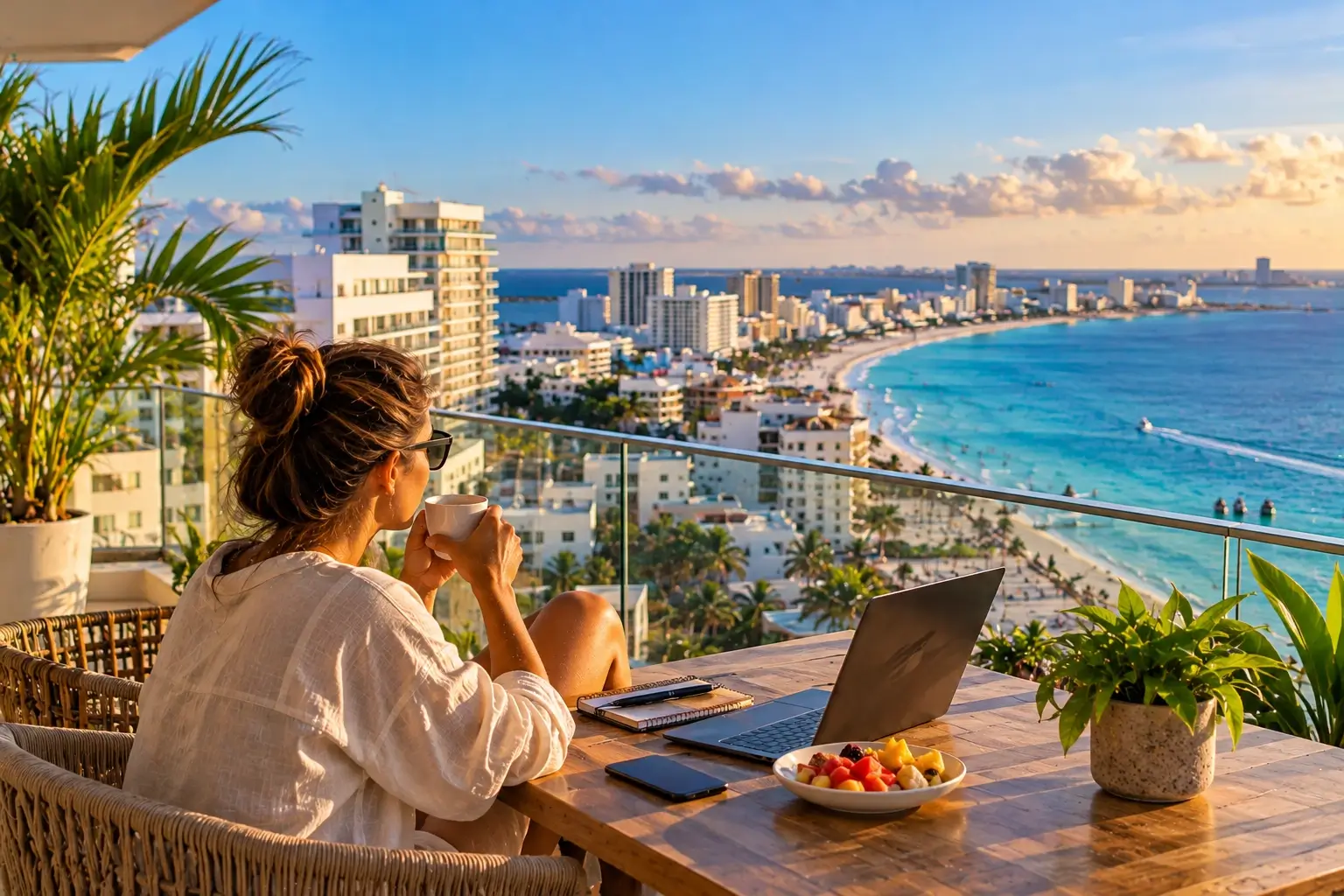
How much does it cost to live in Cancun? That depends on whether you want a simple apartment downtown or a waterfront condo overlooking the Caribbean. The difference can easily reach several thousand dollars per month.
One of Cancun’s biggest advantages is that it’s a functioning city, not just a vacation destination. Beyond the resorts, you’ll find residential neighborhoods, supermarkets, hospitals, schools, shopping centers, and public transportation.
We’ve helped international buyers explore different parts of the Riviera Maya, and Cancun offers something that smaller destinations often struggle to provide: a wide selection of housing options and everyday services at different price points.
However, living in Cancun isn’t necessarily cheap. Electricity, private healthcare, car ownership, and housing in premium neighborhoods can increase your expenses considerably.
In this guide, we’ll break down the cost of living in Cancun using realistic monthly budgets. We’ll also explain how your choice of neighborhood affects your expenses and what you should consider before renting or buying property.
Cost of Living in Cancun: At a Glance
- For a single person renting an apartment, we recommend budgeting approximately 20,000 to 27,000 MXN ($1,081 to $1,459 USD) per month for a relatively modest lifestyle in Cancun. This assumes you’re living in an affordable residential neighborhood, preparing most meals at home, and using public transportation whenever possible.
- For a more comfortable lifestyle, we recommend approximately 35,000 to 45,000 MXN ($1,892 to $2,432 USD) monthly. At this level, you could rent a modern apartment in a desirable residential area, eat out regularly, and maintain a reasonable entertainment budget.
- If you prefer luxury accommodation, premium restaurants, private transportation, and frequent leisure activities, monthly expenses can exceed 75,000 MXN ($4,054 USD). These estimates apply to a single adult renting a property. Couples and families have different expenses, which we’ll examine later in the article.
One important advantage of Cancun is that you don’t need to live near the beach to enjoy a comfortable lifestyle.
Unlike Tulum, where many residential neighborhoods are still developing, Cancun has extensive established residential areas with supermarkets, hospitals, shopping centers, and other services.
This makes everyday life more convenient, particularly if you’re planning to relocate permanently rather than spend a few months working remotely.
However, Cancun’s cost of living varies considerably between neighborhoods.
For example, renting an apartment in a traditional residential area might cost 9,000 MXN monthly. A modern condo in Puerto Cancun could cost several times that amount.
Transportation also affects your budget. Someone living near public bus routes may spend relatively little getting around, while a family maintaining two cars will have much higher expenses.
Let’s compare three monthly budgets to understand how these differences affect your total spending. The following table compares budget, comfortable, and luxury lifestyles for a single adult renting an apartment in Cancun.
All amounts are estimated monthly expenses. They aren’t official citywide averages or guaranteed prices. For consistency, we’ll use an illustrative exchange rate of 18.50 MXN per $1 USD throughout this guide. Actual exchange rates fluctuate.
| Expense | Budget Lifestyle | Comfortable Lifestyle | Luxury Lifestyle |
|---|---|---|---|
| Housing | 9,000 MXN ($486) |
17,000 MXN ($919) |
35,000 MXN ($1,892) |
| Utilities and Internet | 1,700 MXN ($92) |
2,800 MXN ($151) |
5,500 MXN ($297) |
| Groceries | 3,800 MXN ($205) |
5,500 MXN ($297) |
8,500 MXN ($459) |
| Dining Out | 1,500 MXN ($81) |
4,500 MXN ($243) |
10,000 MXN ($541) |
| Transportation | 1,200 MXN ($65) |
3,500 MXN ($189) |
7,000 MXN ($378) |
| Healthcare | 1,000 MXN ($54) |
2,500 MXN ($135) |
5,000 MXN ($270) |
| Entertainment | 2,000 MXN ($108) |
4,500 MXN ($243) |
10,000 MXN ($541) |
| Total Monthly | 20,200 MXN ($1,092) |
40,300 MXN ($2,178) |
81,000 MXN ($4,378) |
These budgets illustrate how your lifestyle influences monthly expenses.
- Someone living on approximately 20,000 MXN monthly will need to make certain compromises. Housing options will be more limited, and frequent visits to expensive restaurants or beach clubs probably won’t fit the budget. However, you can still enjoy a reasonable standard of living, particularly if you choose an established neighborhood with affordable restaurants and convenient public transportation.
- At approximately 40,000 MXN monthly, you have considerably more flexibility. You could rent a modern apartment, visit restaurants several times per week, and spend money on entertainment without constantly worrying about every expense.
- For luxury living, the possibilities are much broader. Residents renting premium condos in Puerto Cancun or the Hotel Zone may spend more on housing alone than someone else spends on their entire monthly budget.
We also recommend treating the healthcare figures as general spending allowances rather than guaranteed insurance premiums. Comprehensive private health insurance can cost substantially more depending on your age, medical history, and selected coverage.
Another consideration is that these estimates don’t include international travel, debt repayments, major medical emergencies, or savings contributions.
If you’re relocating from the United States or Canada, we recommend maintaining a separate financial reserve for unexpected expenses.
Housing Cost in Cancun
Housing is usually the largest expense when living in Cancun. Fortunately, the city offers considerably more residential options than many smaller destinations along the Riviera Maya.
You can find modest apartments in established neighborhoods, modern condos near shopping centers, family houses in gated communities, and luxury waterfront properties.
For a single person, we recommend budgeting approximately 8,000 to 18,000 MXN ($432 to $973 USD) monthly for a reasonably priced apartment.
However, the location makes an enormous difference. A furnished condo in Puerto Cancun can cost several times more than an apartment of similar size in a traditional residential neighborhood.
Another important consideration is that Cancun has two very different residential environments. There’s the main city, where most permanent residents live, and the Hotel Zone, which primarily serves tourism.
Living downtown generally provides better access to supermarkets, schools, hospitals, and affordable restaurants. The Hotel Zone offers proximity to beaches but comes with higher housing and everyday expenses.
We recommend evaluating your housing budget alongside transportation costs. An apartment that’s slightly more expensive but closer to your workplace or essential services may actually save you money.
The following table summarizes typical rental ranges for different property types.
TABLE 2: Monthly Rental Prices by Property Type
| Property Type | Monthly Rent (MXN) | Monthly Rent (USD) |
|---|---|---|
| Studio Apartment | 5,000 to 10,000 MXN | $270 to $541 |
| One Bedroom Apartment | 8,000 to 18,000 MXN | $432 to $973 |
| Two Bedroom Condo | 12,000 to 25,000 MXN | $649 to $1,351 |
| House | 12,000 to 35,000 MXN | $649 to $1,892 |
| Luxury Villa | 40,000 to 100,000+ MXN | $2,162 to $5,405+ |
These are indicative asking price ranges rather than official rental market averages. Individual properties may be cheaper or more expensive depending on their location and condition.
Dollar equivalents use our illustrative exchange rate of 18.50 MXN per $1 USD.
We recommend comparing properties based on their complete monthly cost rather than advertised rent alone.
For example, an apartment renting for 14,000 MXN with maintenance included may be more economical than a 12,500 MXN condo with an additional 2,500 MXN HOA fee.
Electricity consumption also matters, particularly in larger properties with several air conditioning units.
Another consideration is furniture. Furnished apartments are convenient for newcomers, but they often command higher rents than comparable unfurnished properties.
If you’re planning to stay in Cancun for several years, renting an unfurnished apartment and purchasing your own furniture may eventually become more economical.
However, we recommend calculating the initial investment before making that decision.
Cost of Utilities
Utilities are an important part of the cost of living in Cancun, particularly because of the city’s tropical climate. Electricity is usually the biggest expense, especially if you use air conditioning throughout the day.
For a single person living in a modest apartment, we recommend budgeting approximately 1,500 to 2,500 MXN ($81 to $135 USD) monthly for electricity, water, gas, internet, and mobile phone services.
For a couple living in a modern two bedroom condo, these expenses may increase to approximately 2,500 to 4,000 MXN monthly.
Families living in larger houses can spend considerably more, particularly during the hottest months.
One advantage of Cancun is its established infrastructure. Most residential neighborhoods have access to electricity, municipal water networks, and multiple telecommunications providers.
However, service quality and billing arrangements still vary between properties. We recommend checking these details before signing a rental agreement or purchasing a home.
The following table summarizes typical monthly utility expenses for a residential apartment in Cancun.
These estimates assume ordinary household consumption. Larger properties, extensive air conditioning use, and premium internet packages can increase the total.
Electricity figures represent monthly averages, even when CFE issues bills every two months.
| Utility | Monthly Cost (MXN) | Monthly Cost (USD) |
|---|---|---|
| Electricity | 400 to 2,000 MXN | $22 to $108 |
| Water | 150 to 500 MXN | $8 to $27 |
| Gas | 150 to 350 MXN | $8 to $19 |
| Drinking Water | 100 to 300 MXN | $5 to $16 |
| Home Internet | 400 to 800 MXN | $22 to $43 |
| Mobile Phone | 150 to 400 MXN | $8 to $22 |
| Total Monthly | 1,350 to 4,350 MXN | $73 to $235 |
Dollar equivalents use our illustrative exchange rate of 18.50 MXN per $1 USD.
- For a single person living in a modest apartment, utility expenses will often fall toward the lower end of these estimates.
- A couple working from home and using air conditioning regularly may spend closer to 2,500 to 3,500 MXN monthly.
- For a family living in a larger house, total utility expenses can exceed 5,000 MXN, particularly during periods of high electricity consumption.
We recommend treating electricity as the main variable when estimating your monthly utility budget.
Water, gas, and internet expenses are generally more predictable, although they can still vary depending on consumption and service arrangements.
For property buyers, we also recommend considering the efficiency of the building itself.
Good ventilation, shaded windows, efficient air conditioning, and appropriate insulation can reduce ongoing electricity expenses.
These features may not be as noticeable as a swimming pool or rooftop terrace, but they can make a meaningful difference over several years of ownership.
Food Cost in Cancun
Food is one of the expenses you can control most easily when living in Cancun. The city has large supermarkets, neighborhood markets, affordable restaurants, and plenty of places serving international cuisine.
For a single person who prepares most meals at home, we recommend budgeting approximately 3,500 to 5,500 MXN ($189 to $297 USD) monthly for groceries.
If you prefer imported products, organic groceries, and specialty foods, your expenses may increase to 6,000 to 8,000 MXN or more.
Eating out is where the differences become particularly noticeable. A meal at a neighborhood restaurant might cost 120 MXN, while dinner at a restaurant in the Hotel Zone can easily exceed 700 MXN per person.
One advantage of Cancun is that you don’t need to depend on restaurants catering to tourists. Most permanent residents live outside the Hotel Zone, where you’ll find businesses serving local customers at more reasonable prices.
We recommend shopping and eating where Cancun residents do. You can enjoy good food without spending a fortune, even if you don’t cook every day.
The following table provides approximate prices for common groceries, drinks, and restaurant meals in Cancun.
These figures are intended for monthly budgeting rather than representing fixed prices at individual establishments.
Actual costs depend on the supermarket, brand, restaurant, and neighborhood.
| Item | Price (MXN) | Price (USD) |
|---|---|---|
| Milk (1 Liter) | 25 to 35 MXN | $1.35 to $1.89 |
| Eggs (12) | 35 to 55 MXN | $1.89 to $2.97 |
| Rice (1 kg) | 25 to 45 MXN | $1.35 to $2.43 |
| Chicken Breast (1 kg) | 110 to 170 MXN | $5.95 to $9.19 |
| Ground Beef (1 kg) | 150 to 230 MXN | $8.11 to $12.43 |
| Bananas (1 kg) | 20 to 35 MXN | $1.08 to $1.89 |
| Tomatoes (1 kg) | 25 to 50 MXN | $1.35 to $2.70 |
| Bottled Water (1.5 Liters) | 15 to 25 MXN | $0.81 to $1.35 |
| Local Restaurant Meal | 100 to 180 MXN | $5.41 to $9.73 |
| Street Tacos (3) | 60 to 120 MXN | $3.24 to $6.49 |
| Cappuccino | 55 to 90 MXN | $2.97 to $4.86 |
| Casual Dinner for Two | 400 to 800 MXN | $21.62 to $43.24 |
| Hotel Zone Dinner for Two | 1,000 to 2,000 MXN | $54.05 to $108.11 |
Dollar equivalents use our illustrative exchange rate of 18.50 MXN per $1 USD.
For someone trying to keep living expenses low, we recommend combining supermarket shopping with occasional meals at local restaurants.
For example:
- A single person spending 4,000 MXN on groceries and 2,000 MXN on restaurants would have a total monthly food budget of 6,000 MXN ($324 USD). That can provide a reasonable variety of meals without requiring you to cook every day.
- For a more comfortable lifestyle, we recommend approximately 9,000 to 12,000 MXN ($486 to $649 USD) monthly for groceries and dining combined. This allows for more frequent restaurant visits, specialty groceries, and occasional meals at premium establishments.
Couples and families should adjust these figures according to household size, eating habits, and dietary requirements.
We also recommend reviewing your spending after the first month in Cancun.
Many newcomers initially shop at the most convenient supermarkets and eat at restaurants recommended to tourists.
After spending some time in the city, you’ll probably discover neighborhood businesses offering similar products at better prices.
Unlike destinations where tourists dominate much of the local economy, Cancun has a large permanent population supporting a wide selection of everyday businesses.
Taking advantage of that local infrastructure is one of the easiest ways to enjoy Cancun while keeping your monthly food expenses under control.
How Much Does Transportation Cost in Cancun?
Transportation is another important factor when calculating the cost of living in Cancun. Fortunately, the city offers several options, including public buses, colectivos, taxis, and private vehicles.
For someone living in a central neighborhood and using public transportation, we recommend budgeting approximately 800 to 1,500 MXN ($43 to $81 USD) monthly.
However, residents who regularly use taxis or own a car may spend between 3,000 and 6,000 MXN monthly. Expenses can be considerably higher if you’re financing a vehicle.
Unlike Playa del Carmen, where many central neighborhoods are relatively compact, Cancun covers a much larger urban area. Your choice of neighborhood can therefore have a significant impact on transportation expenses.
For example, living near your workplace and a supermarket might eliminate the need for daily car journeys. Meanwhile, a cheaper house on the outskirts could require considerable spending on fuel and vehicle maintenance.
We recommend evaluating transportation costs before choosing where to live, particularly if you’re planning to relocate without a car.
Public Buses and Colectivos
Public transportation is generally the most affordable way to get around Cancun. The city has an extensive network of buses and colectivos connecting residential neighborhoods, commercial areas, and major roads.
For permanent residents, these services can provide substantial savings compared with owning a vehicle or relying on taxis.
Local buses operate along numerous routes throughout the city. Fares depend on the route and service, but many ordinary urban journeys cost approximately 12 to 15 MXN ($0.65 to $0.81 USD).
Colectivos are another common transportation option. These shared vans operate along established routes and generally charge relatively low fares.
Depending on the route, we recommend allowing approximately 12 to 20 MXN per journey.
However, routes and fares can change, so it’s worth confirming the current price before boarding.
For someone taking two public transportation journeys daily, five days per week, monthly expenses might be approximately 600 MXN.
Adding occasional weekend trips could bring the total closer to 800 or 1,000 MXN.
This makes public transportation particularly attractive for residents trying to maintain a modest monthly budget.
However, convenience depends heavily on your location.
Established neighborhoods near major avenues generally offer better access to public transportation than some newer residential developments.
For example, living near Avenida Tulum, Avenida Kabah, or Avenida López Portillo may provide access to several transportation routes.
However, not every street has a convenient bus stop, and some journeys require changing vehicles.
We recommend checking the actual route between your home and workplace before committing to a rental.
Another consideration is travel time.
Public transportation can be inexpensive, but journeys may take considerably longer than driving directly.
During busy periods, buses can become crowded, particularly on routes connecting residential neighborhoods with major employment areas.
For someone commuting daily, we recommend considering both the financial cost and the time involved.
Families with young children may also find public transportation less convenient for school runs, grocery shopping, and medical appointments.
However, for single residents and couples living in central Cancun, buses and colectivos can provide a practical alternative to car ownership.
Taxis and Ride Services
Taxis are widely available throughout Cancun, but they can become an expensive transportation option when used regularly.
Unlike public buses, taxi fares depend on factors such as the journey, applicable fare zone, and service arrangements.
For a relatively short journey within the city, we recommend budgeting approximately 70 to 150 MXN ($4 to $8 USD).
Longer journeys may cost 150 to 300 MXN or more, particularly when traveling between distant residential neighborhoods.
Trips involving the Hotel Zone, airport, or premium tourist areas can be substantially more expensive.
These figures are approximate planning estimates rather than official taxi tariffs.
We recommend confirming the price before starting your journey, especially when using a taxi without a clearly displayed fare.
For example, imagine someone taking two taxi journeys daily at an average cost of 120 MXN each.
Over 22 working days, transportation expenses would reach 5,280 MXN ($285 USD).
That’s considerably more than using public transportation for the same number of journeys.
However, taxis can still be useful for occasional trips, particularly when carrying groceries, traveling during heavy rainfall, or returning home late.
Ride services are another option, although their availability and operating conditions deserve attention.
Uber operates in Cancun, but disputes involving traditional taxi operators and changing regulatory conditions have affected ride services in the area.
We recommend checking current availability and pickup arrangements rather than assuming the service will work exactly as it does in your home country.
Airport transportation is particularly important.
Don’t assume that a ride service can collect passengers from every airport terminal under the same conditions as an ordinary city pickup.
Rules, enforcement, and practical pickup arrangements can change.
For airport journeys, we recommend using an authorized transportation provider and confirming the complete price in advance.
Another consideration is the Hotel Zone.
Taxi prices can be higher in tourist areas, and some journeys may cost considerably more than similar distances within residential Cancun.
For residents who visit the Hotel Zone regularly, these expenses can accumulate quickly.
We generally recommend using public buses for routine journeys when convenient and reserving taxis for situations where they provide a clear practical advantage.
Owning a Car or Scooter
Owning a vehicle can make everyday life considerably easier in Cancun, particularly if you live outside the central residential neighborhoods.
The city has wide avenues, shopping centers, residential developments, and commercial areas spread across considerable distances.
For families and residents who frequently travel between neighborhoods, a car can be a practical necessity rather than a luxury.
However, vehicle ownership introduces several recurring expenses.
These include fuel, insurance, maintenance, registration requirements, parking, and occasional repairs.
For a small gasoline powered car, we recommend budgeting approximately 1,500 to 3,000 MXN monthly for fuel, depending on how frequently you drive.
For example, someone driving 800 kilometers monthly in a vehicle consuming 7 liters per 100 kilometers would use approximately 56 liters of gasoline.
At an illustrative fuel price of 24 MXN per liter, that represents approximately 1,344 MXN monthly.
However, actual fuel prices and consumption vary.
Heavy traffic, frequent air conditioning use, and short journeys can increase fuel consumption.
Insurance is another important expense.
For a modest vehicle, annual insurance premiums may amount to several thousand pesos, depending on the driver, vehicle, and coverage.
We recommend allowing approximately 500 to 1,200 MXN monthly as a planning provision for car insurance.
Comprehensive coverage for newer or more expensive vehicles may cost considerably more.
Maintenance should also be included in your budget.
Oil changes, tires, brakes, batteries, and occasional repairs create expenses even when the vehicle is operating normally.
For a small car, we recommend setting aside approximately 500 to 1,000 MXN monthly for routine maintenance and future repairs.
This doesn’t mean you’ll spend that amount every month. Instead, it creates a reserve for expenses that occur periodically.
Registration and other applicable vehicle charges should also be considered.
Requirements depend on the vehicle and current regulations in Quintana Roo.
We recommend checking the latest state requirements before purchasing or registering a vehicle.
Overall, maintaining a modest car in Cancun might cost approximately 3,000 to 5,500 MXN ($162 to $297 USD) monthly, excluding financing, depreciation, and major unexpected repairs.
For larger vehicles or drivers covering substantial distances, expenses can be considerably higher.
Parking is another consideration.
Many shopping centers offer parking facilities, although some charge fees.
In central neighborhoods, street parking availability varies, particularly near busy commercial areas.
We recommend confirming whether your apartment or house includes a designated parking space.
For families with two vehicles, parking arrangements can influence which properties are suitable.
Scooters and motorcycles offer a less expensive alternative.
They generally consume less fuel and can be easier to park than cars.
For a small scooter used for regular city journeys, monthly fuel expenses might range from approximately 300 to 700 MXN.
However, insurance, maintenance, registration, and protective equipment still create additional costs.
We recommend budgeting approximately 800 to 1,500 MXN monthly for basic scooter operating expenses, excluding financing and major repairs.
Another important consideration is safety.
Cancun has busy avenues, frequent intersections, and substantial vehicle traffic.
Motorcycle riders are more exposed to accidents and weather conditions than car occupants.
We recommend using appropriate protective equipment, maintaining the vehicle properly, and following local traffic regulations.
Heavy rainfall can also make scooter transportation less convenient during certain periods.
For this reason, a scooter may work well for a single resident commuting short distances, but it won’t necessarily replace a car for every household.
Finally, consider the initial cost of purchasing a vehicle.
A used car may be more affordable than a new one, but maintenance requirements can be less predictable.
We recommend having a qualified mechanic inspect any used vehicle before purchasing.
For foreign residents, it’s also worth checking the documentation required to register and insure a vehicle in Mexico.
Getting Between Downtown Cancun and the Hotel Zone
One of the most common transportation questions among newcomers is how easily they can travel between downtown Cancun and the Hotel Zone.
The Hotel Zone stretches along a narrow coastal corridor, with beaches, hotels, restaurants, shopping centers, and entertainment venues.
Although it appears relatively close to central Cancun on a map, travel times depend heavily on your destination and traffic conditions.
The northern entrance to the Hotel Zone is close to downtown, but reaching properties farther along Boulevard Kukulcán can take considerably longer.
Fortunately, public buses provide an affordable connection.
R1 and R2 buses are among the best known routes connecting parts of downtown Cancun with the Hotel Zone.
These services are particularly useful for residents who want to visit the beach without paying for taxis.
For planning purposes, we recommend allowing approximately 12 to 15 MXN per journey, although current fares should be confirmed locally.
A return journey may therefore cost around 24 to 30 MXN per person.
For someone visiting the Hotel Zone twice weekly, monthly bus expenses could remain below 250 MXN.
This is one reason why living downtown can offer excellent value.
You don’t necessarily need to pay premium beachfront rents to enjoy Cancun’s beaches regularly.
However, buses can become crowded during busy periods, particularly when tourists and hotel employees are traveling along the same routes.
Travel times also vary.
Depending on your starting point, destination, and traffic, a journey from downtown to the Hotel Zone might take approximately 20 to 50 minutes.
Trips to the southern end can take longer, especially during periods of congestion.
For someone working in the Hotel Zone, we recommend testing the commute during actual working hours.
A route that takes 25 minutes on a quiet afternoon may require considerably more time during peak traffic.
Driving is another option.
However, traffic congestion can affect Boulevard Kukulcán, particularly during busy tourism periods, holidays, and special events.
Parking availability also depends on the destination.
Some beaches have public access points with limited parking, while restaurants and shopping centers may provide designated parking facilities.
We recommend checking parking arrangements before driving to a specific location.
Taxis offer greater convenience but at a much higher cost.
Depending on the pickup location and destination, a taxi journey between downtown and the Hotel Zone may cost several hundred pesos.
For example, spending 300 MXN each way would create a total transportation expense of 600 MXN for one outing.
Repeating that journey every weekend would add approximately 2,400 MXN to your monthly budget.
For residents who frequently visit the beach, the difference between using buses and taxis can therefore be substantial.
Another option is cycling, although we recommend evaluating the route carefully.
Cancun has some cycling infrastructure, including sections along the Hotel Zone corridor.
However, distances can be significant, and not every residential neighborhood has convenient cycling connections.
Heat, humidity, traffic, and occasional heavy rainfall can also affect comfort and safety.
For short journeys, cycling may be practical. For longer trips along busy roads, we recommend considering whether public transportation is more suitable.
Overall, living downtown and using public buses to reach the Hotel Zone is one of the most economical transportation arrangements in Cancun.
It allows residents to benefit from lower housing costs while maintaining access to beaches and tourist attractions.
However, we recommend choosing your residential location carefully.
An apartment near convenient bus routes can provide substantial savings compared with a cheaper property requiring taxis for everyday transportation.
For families, car ownership may still be the most practical option, particularly when coordinating school schedules, grocery shopping, and work commitments.
For single residents and couples, public transportation can significantly reduce the cost of living in Cancun without requiring major lifestyle compromises.
How Much Does Healthcare Cost in Cancun?
Healthcare is another important expense to consider when calculating the cost of living in Cancun. Fortunately, the city offers a wide selection of private hospitals, medical clinics, specialists, dentists, and pharmacies.
Compared with smaller destinations such as Tulum, Cancun has a more developed healthcare infrastructure. This is particularly important for retirees, families, and foreign residents who require regular medical attention.
For routine healthcare expenses, we recommend budgeting approximately 1,000 to 2,500 MXN ($54 to $135 USD) monthly per adult. However, this is a general allowance for medical spending, not necessarily the cost of comprehensive health insurance.
Someone who rarely visits a doctor may spend considerably less. On the other hand, residents requiring regular specialist appointments, prescription medication, or extensive insurance coverage should prepare a larger budget.
One advantage of Cancun is that you can access many medical services without traveling to another city. You’ll also find doctors and clinics accustomed to treating international patients.
However, prices vary between providers. We recommend comparing medical facilities based on their qualifications, services, and costs rather than assuming every private clinic offers the same standard of care.
Doctor and Specialist Visits
Private medical consultations in Cancun are generally more affordable than comparable appointments in the United States. However, prices depend on the doctor’s specialization and the medical facility.
For a standard consultation with a general practitioner, we recommend budgeting approximately 400 to 800 MXN ($22 to $43 USD).
Some neighborhood clinics charge less, while consultations at larger private hospitals may cost more.
One particularly affordable option is a pharmacy consultation.
Many Mexican pharmacies have an associated medical office, commonly known as a consultorio médico. These facilities provide basic consultations for relatively simple medical concerns.
Depending on the provider, consultations may cost approximately 50 to 150 MXN.
They can be useful for minor illnesses, but they aren’t substitutes for emergency care or specialist treatment when needed.
We recommend choosing a properly licensed medical professional and seeking further evaluation when symptoms require it.
For specialist appointments, prices are generally higher.
A consultation with a dermatologist, cardiologist, gynecologist, or another specialist might cost approximately 700 to 1,500 MXN ($38 to $81 USD).
Highly specialized consultations and appointments at premium private hospitals can exceed these amounts.
Another consideration is diagnostic testing.
Blood tests, X-rays, ultrasounds, and other procedures are usually charged separately from the consultation.
For example, basic laboratory testing might cost several hundred pesos, while more extensive diagnostic packages can exceed 2,000 MXN.
Advanced imaging procedures, including MRI and CT scans, can cost several thousand pesos depending on the facility and examination.
We recommend requesting an itemized estimate before undergoing nonemergency procedures.
Private hospitals may charge separately for the doctor’s consultation, facility use, diagnostic testing, medication, and other services.
This means the final bill can be substantially higher than the initial consultation fee.
For foreign residents, language is another consideration.
Cancun has numerous medical professionals who speak English, particularly in private facilities serving international patients.
However, we recommend confirming language availability when booking an appointment.
Some medical professionals may communicate comfortably in English, while administrative staff primarily use Spanish.
For residents who don’t speak Spanish, choosing a clinic with bilingual staff can make medical appointments considerably easier.
Another advantage of Cancun is access to established private hospitals.
Facilities such as Hospital Galenia and Hospital Amerimed Cancun provide private medical services, although the availability of individual specialties and treatments should be confirmed directly.
We recommend researching nearby medical facilities before choosing a residential neighborhood, particularly if you have ongoing healthcare requirements.
For example, someone attending regular specialist appointments may prefer living in central Cancun rather than a distant residential development.
This can reduce transportation expenses and make medical visits more convenient.
Finally, remember that emergency treatment can be considerably more expensive than routine consultations.
Hospitalization, surgery, intensive care, and specialist procedures can generate substantial bills.
For this reason, we recommend considering appropriate medical insurance rather than relying exclusively on the relatively affordable cost of ordinary consultations.
Private Health Insurance
Private health insurance is one of the most important financial considerations for foreigners planning to live in Cancun permanently.
Although routine consultations can be relatively affordable, major medical treatment may require a substantial financial commitment.
For example, hospitalization following an accident or serious illness can involve emergency care, diagnostic procedures, specialist fees, medication, and several days in a private hospital.
Without insurance, these expenses may need to be paid directly by the patient.
We recommend reviewing your healthcare arrangements before relocating rather than waiting until you need treatment.
There are several ways foreign residents can obtain medical coverage in Mexico.
One option is purchasing a private Mexican health insurance policy.
These policies may provide coverage for hospitalization, surgery, specialist treatment, and other medical expenses, depending on the contract.
However, coverage conditions vary considerably between insurers.
For a younger adult in good health, a private major medical insurance policy might cost approximately 15,000 to 35,000 MXN annually ($811 to $1,892 USD).
For middle aged adults, premiums can be considerably higher.
Older residents may face substantially higher premiums, restricted coverage, or difficulty obtaining certain policies.
These figures are broad planning estimates rather than insurance quotations. Actual premiums depend on individual circumstances.
We recommend obtaining personalized quotes before including insurance expenses in your relocation budget.
Another option is international health insurance.
These policies may provide coverage in multiple countries, which can be useful for residents who regularly travel between Mexico and their home country.
However, international plans can be considerably more expensive than policies covering treatment exclusively in Mexico.
Coverage in the United States is particularly important to examine because it can significantly affect premiums.
For example, a policy covering treatment in Mexico and several other countries may cost substantially less than one offering extensive medical coverage in the United States.
We recommend checking the geographical coverage carefully rather than assuming every international policy includes treatment everywhere.
Another possibility is Mexico’s public healthcare system.
Eligible residents may have access to public healthcare through institutions such as the Instituto Mexicano del Seguro Social (IMSS).
Some people receive coverage through formal employment, while certain individuals may qualify for voluntary enrollment under applicable rules.
However, eligibility, contribution requirements, exclusions, and enrollment conditions depend on the individual’s circumstances.
We recommend verifying current IMSS requirements directly before assuming you qualify.
Public healthcare can reduce medical expenses, but waiting times and access to specific services may differ from private facilities.
For this reason, some residents combine public coverage with private consultations or additional insurance.
When comparing private policies, we recommend paying attention to several important details.
- Deductible: The amount you must pay before the insurer begins covering eligible expenses.
- Coinsurance: The percentage of covered expenses you may still need to pay.
- Coverage limits: The maximum amounts payable under the policy.
- Hospital network: The medical facilities where the insurer provides coverage or direct billing arrangements.
- Preexisting conditions: Medical conditions that may be excluded, restricted, or subject to special terms.
- Waiting periods: The time you may need to wait before certain treatments become eligible for coverage.
These details can make a substantial difference to the actual value of a policy.
For example, a relatively inexpensive insurance plan may have a high deductible. This means you’ll still need significant savings before the insurer contributes to certain medical expenses.
Similarly, a policy with limited hospital coverage may not include your preferred private medical facility in Cancun.
We recommend confirming whether the insurer has direct payment arrangements with local hospitals.
Otherwise, you may need to pay certain expenses yourself and request reimbursement afterward.
For retirees, insurance deserves particular attention.
Premiums generally increase with age, and some insurers impose restrictions on new applicants above certain ages.
We recommend researching coverage options before relocating, especially if you have ongoing medical conditions.
For families, insurance expenses can also represent a significant part of the household budget.
Coverage for two adults and two children may cost considerably more than an individual policy, although family plans can offer different pricing arrangements.
We recommend comparing individual and family quotations rather than multiplying a single person’s premium by four.
Finally, consider maintaining an emergency medical reserve even when you have insurance.
Deductibles, excluded treatments, and other expenses may still require payment.
For foreign residents planning to live in Cancun for several years, appropriate healthcare coverage is an important part of financial planning.
Dental Care and Prescription Medication
Dental care is another area where Cancun can offer relatively affordable services compared with the United States and Canada.
The city has numerous private dental clinics providing routine examinations, cleanings, fillings, crowns, implants, and other treatments.
For a standard dental cleaning, we recommend budgeting approximately 500 to 1,000 MXN ($27 to $54 USD).
A basic dental consultation may cost approximately 300 to 700 MXN, although some clinics include the initial examination in the price of treatment.
For a filling, prices might range from approximately 700 to 1,500 MXN ($38 to $81 USD), depending on the tooth and materials used.
More complex procedures can cost considerably more.
For example, a root canal treatment might cost approximately 2,500 to 5,000 MXN, depending on the tooth and specialist.
Dental crowns may cost approximately 4,000 to 8,000 MXN or more, depending on the material and clinic.
Dental implants are generally more expensive because they involve several stages of treatment.
For a complete implant restoration, including the implant and final crown, costs can reach tens of thousands of pesos.
We recommend requesting a detailed treatment plan before agreeing to complex dental procedures.
For example, an advertised implant price may cover only the implant itself, excluding the abutment, crown, imaging, or additional procedures.
Comparing complete treatment costs is more useful than comparing individual advertised prices.
Another consideration is the dentist’s qualifications and experience.
We recommend choosing properly licensed professionals and asking about their experience with the specific treatment you need.
For extensive dental work, obtaining a second opinion can also be worthwhile.
Although Cancun attracts international patients, we wouldn’t recommend choosing a clinic exclusively because it offers the lowest price.
Quality of care, appropriate materials, infection control, and followup treatment are equally important.
Prescription medication is another regular expense for some residents.
Cancun has numerous pharmacies, including branches of Farmacias del Ahorro, Farmacias Guadalajara, and other national and local chains.
Many common medications are available in generic versions, which can cost substantially less than branded alternatives.
For example, some basic generic medications may cost less than 100 MXN per package.
However, specialized treatments, imported medications, and certain long term prescriptions can be considerably more expensive.
We recommend checking the availability and cost of any medication you take regularly before relocating.
Don’t assume that a medication sold in your home country will be available in Mexico under the same brand name.
Some products have different commercial names, formulations, or regulatory requirements.
For ongoing treatment, we recommend discussing suitable alternatives with a qualified medical professional.
Prescription requirements also vary depending on the medication.
For example, antibiotics require a valid prescription in Mexico, while certain controlled medications are subject to additional restrictions.
We recommend obtaining prescriptions through a properly licensed medical professional and purchasing medication from established pharmacies.
Another useful option is comparing prices between pharmacy chains.
Medication prices can differ, particularly between branded products and generic alternatives.
However, we recommend confirming that any substitute contains the correct active ingredient, strength, and formulation.
For a generally healthy adult, we recommend setting aside approximately 300 to 700 MXN monthly for routine dental and medication expenses.
This doesn’t mean you’ll necessarily spend that amount every month.
Instead, it provides a small reserve for occasional prescriptions, dental cleanings, and minor treatments.
Residents requiring regular medication or extensive dental work should calculate their expenses separately.
For example, someone taking several prescription medications every day may have a much higher monthly healthcare budget than a person who only visits the dentist twice yearly.
Overall, Cancun offers a useful combination of relatively affordable routine healthcare and access to private medical facilities.
For permanent residents, this can be an important advantage over smaller coastal destinations where specialized medical services are more limited.
However, we recommend separating ordinary healthcare expenses from major medical risks.
Routine consultations, dental cleanings, and common medications may be affordable, but hospitalization and complex treatment can still create substantial expenses.
For a realistic monthly budget, include your expected medical spending, insurance premiums, and an allowance for expenses that aren’t covered by your policy.
This will give you a more accurate understanding of the cost of healthcare in Cancun and help you avoid unexpected financial pressure after relocating.
How Much Do Entertainment and Leisure Activities Cost?
Entertainment in Cancun can be surprisingly affordable if you take advantage of local activities. However, frequent visits to beach clubs, nightlife venues, and tourist attractions can quickly increase your monthly expenses.
For a single person, we recommend budgeting approximately 1,500 to 3,000 MXN ($81 to $162 USD) monthly for occasional entertainment. A more active lifestyle involving restaurants, fitness classes, and weekend activities might require 4,000 to 6,000 MXN.
Gyms and Fitness Classes
Cancun has numerous gyms, including affordable neighborhood facilities and larger fitness centers. A basic gym membership typically costs approximately 400 to 800 MXN ($22 to $43 USD) monthly.
Premium gyms with additional facilities and group classes may charge 900 to 1,800 MXN monthly. Some residential developments include gyms in their shared amenities, potentially eliminating the need for a separate membership.
Yoga, Pilates, and other fitness classes generally cost approximately 150 to 350 MXN per session. Monthly packages can reduce the cost if you attend regularly.
We recommend checking whether your preferred gym is close to home. Driving across Cancun several times weekly can make an otherwise affordable membership less convenient.
Beaches and Beach Clubs
One of Cancun’s biggest advantages is access to its Caribbean beaches. You don’t need to stay at an expensive resort to enjoy them.
Public beaches such as Playa Delfines, Playa Langosta, and Playa Tortugas provide access to the coastline without an admission fee. However, parking, equipment rentals, and other services may involve additional charges.
For residents living downtown, public buses offer an inexpensive way to reach the Hotel Zone. Bringing your own towels, drinks, and snacks can keep a beach outing relatively affordable.
Beach clubs operate differently. Some charge an entrance fee, while others require a minimum food and beverage purchase.
For a casual beach club visit, we recommend budgeting approximately 500 to 1,000 MXN ($27 to $54 USD) per person. Premium establishments can charge 1,500 MXN or more, particularly when reserving loungers or purchasing additional services.
Keep in mind that beachfront hotels and clubs may control access through their private facilities. Public beach access doesn’t automatically include the right to use hotel amenities.
Shopping, Cinemas and Nightlife
Cancun has several shopping centers, cinemas, and entertainment venues serving both residents and tourists.
A regular cinema ticket generally costs approximately 70 to 130 MXN ($4 to $7 USD). Premium screenings and additional services cost more.
Shopping centers such as Plaza Las Américas offer restaurants, cinemas, and retail stores without requiring a trip to the Hotel Zone.
Nightlife expenses vary considerably depending on the location. A casual evening at a neighborhood bar might cost 200 to 500 MXN per person.
However, Cancun’s famous nightclubs operate at a different price level. Entrance packages can cost 1,000 to 2,500 MXN or more, depending on the venue, date, and included drinks.
For permanent residents, we recommend treating major nightclub visits as occasional entertainment rather than regular weekly expenses.
Day Trips and Weekend Activities
Cancun offers convenient access to numerous destinations throughout Quintana Roo and the Yucatán Peninsula.
One popular option is visiting Isla Mujeres. The passenger ferry generally costs several hundred pesos for a return journey, depending on the operator and applicable fare category.
Once on the island, you can explore local restaurants, visit beaches, or rent transportation. A relatively simple day trip might cost approximately 700 to 1,500 MXN per person.
Other popular excursions include Puerto Morelos, Playa del Carmen, Valladolid, and archaeological sites such as Chichén Itzá.
Costs depend heavily on whether you travel independently or book an organized tour. A self planned outing might cost a few hundred pesos, while guided excursions can exceed 2,000 MXN per person.
We recommend exploring nearby destinations independently when practical. Having your own transportation can make weekend activities more flexible, particularly for couples and families.
Overall, entertainment doesn’t need to be a major expense when living in Cancun. Public beaches, local restaurants, cinemas, and affordable fitness facilities provide plenty of options.
The biggest difference comes from how frequently you choose tourist activities. Enjoying Cancun as a resident rather than spending every weekend like a vacationer can save several thousand pesos monthly.