

American retirees can move to Mexico, and you do not need to give up your U.S. citizenship to do it.
The bigger decisions come afterward. You need to choose the right residency route, set a realistic budget, decide where to live, and determine whether renting or buying makes more sense.
Property ownership has its own rules, especially if your retirement plans involve the Mexican coast. Fortunately, Americans can legally buy homes there when the correct ownership structure is used.
In this guide, we will look at the practical side of retiring in Mexico, with extra attention to housing and the Riviera Maya.
Moving to Mexico as an American Retiree
American retirees can move to Mexico if they qualify for an appropriate immigration status. For people planning to live here for more than occasional vacations, that normally means temporary or permanent residency.
There is no single Mexican “retirement visa.” Instead, retirees generally apply under one of Mexico’s existing residency categories, often using pension income, savings, or investments to demonstrate economic solvency.
You also do not need to give up your U.S. citizenship. Many retirees maintain financial, family, and property connections in the United States while making Mexico their full time or part time home.
Do Americans Need a Visa to Retire in Mexico?
If you genuinely plan to relocate to Mexico rather than visit periodically, you should look at Mexican residency. The two main options are temporary residency and permanent residency.
Most applications begin through a Mexican consulate outside Mexico. After entering Mexico with a resident visa, applicants generally complete the process with the Instituto Nacional de Migración.
Temporary Residency for American Retirees
Temporary residency is designed for foreigners who intend to remain in Mexico for longer than 180 days but no longer than four years under that status.
For retirees, economic solvency can commonly be demonstrated through qualifying income, pension payments, savings, or investments. The documentation and financial thresholds should always be confirmed with the Mexican consulate where you intend to apply.
Temporary residency can make sense when you are beginning your retirement in Mexico and are not yet pursuing permanent status.
Permanent Residency for American Retirees
Permanent residency allows you to live in Mexico indefinitely rather than renewing temporary residency.
Mexico provides a permanent residency route for qualifying retirees and pensioners. Financial requirements are substantially higher than those commonly applied to temporary residency. Consulates may request proof of retirement together with qualifying pension income or financial assets.
Permanent residency can therefore be attractive if you already qualify and expect Mexico to become your long term home.
Can You Retire in Mexico on a Tourist Permit?
You can certainly visit Mexico before deciding whether retirement here suits you. In fact, we think spending meaningful time in your preferred destination before buying a home is a smart move.
However, visitor status should not be treated as a substitute for residency when you actually intend to relocate. Your permitted stay is determined by Mexican immigration authorities when you enter the country.
If your plan is to live in Mexico rather than repeatedly visit, investigate residency before making the move.
How Much Income Do You Need to Retire in Mexico?
There is no single dollar figure that applies to every American applicant.
Mexico’s economic solvency requirements are linked to official financial measures, and the dollar equivalent changes. Individual Mexican consulates can also publish different current dollar figures and documentation requirements.
That variation is important. In 2026, official Mexican consulate pages in the United States publish noticeably different dollar thresholds. You should therefore use the requirements of the specific consulate handling your application rather than an old number from a retirement blog.
Income and Savings Requirements for Temporary Residency
Temporary residency through economic solvency can generally be demonstrated using qualifying monthly income or sufficient savings and investments.
As a rough indication of the variation, official consular information shows some temporary residency thresholds around $4,200 to $4,350 USD in monthly income or approximately $70,000 to $76,000 USD in qualifying savings or investments. Other consular categories and offices publish different figures.
Some consulates also publish specific requirements for pensioners that differ from their general economic solvency category. This is why we would never plan a residency application around one universal online figure.
Income and Savings Requirements for Permanent Residency
Permanent residency through retirement normally requires considerably stronger financial evidence.
For example, official 2026 information from Mexican consulates in the United States shows retirement thresholds around $7,400 to $8,000 USD in monthly pension income. Published savings or investment thresholds can be roughly $279,000 to $319,000 USD, depending on the consulate.
These numbers are examples, not guaranteed qualification thresholds for your application. Requirements change, exchange rate calculations differ, and the required number of bank statements also depends on the route.
Before making retirement plans around residency, contact the Mexican consulate where you will apply and obtain its current requirements directly.
Can American Retirees Buy Property in Mexico?
Yes. Americans can legally buy property in Mexico. Being retired does not create additional restrictions on real estate ownership.
You can buy a condo, house, villa, or privately titled land. The ownership structure depends mainly on where the property is located, not your age or retirement status.
For many retirees, this means choosing between direct ownership and a fideicomiso.
Buying Property Outside the Restricted Zone
Outside Mexico’s restricted zone, Americans can generally acquire qualifying private property through direct title.
The restricted zone covers land within 50 kilometers of the coast and 100 kilometers of an international border. Much of inland Mexico therefore falls outside it.
You still need proper legal due diligence. Direct ownership does not remove the need to verify the title, seller, liens, boundaries, and other property documents.
Buying Property Near the Coast Through a Fideicomiso
If your retirement dream involves the Riviera Maya or another Mexican coastal destination, you will normally encounter a fideicomiso.
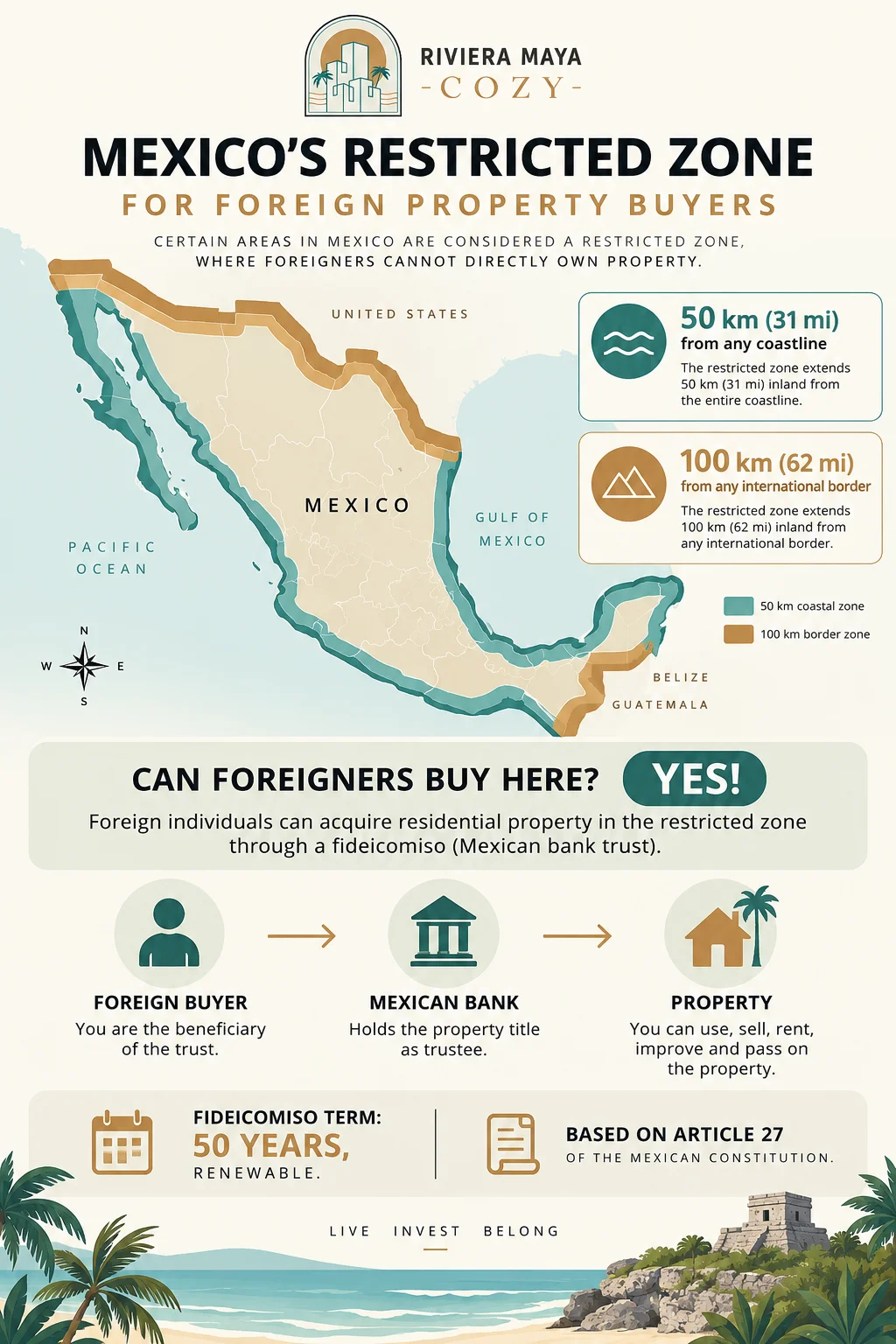
A fideicomiso is a Mexican bank trust used by foreign buyers to acquire residential property inside the restricted zone. The bank holds legal title as trustee, while you hold the beneficiary rights.
Those rights allow you to use the home, rent it, renovate it, sell it, and designate substitute beneficiaries, subject to Mexican law and the trust agreement.
This means Americans can buy homes in Playa del Carmen, Puerto Morelos, Akumal, Tulum, and other coastal communities.
Do You Need Mexican Residency to Buy a Home?
No. Mexican residency is not generally required simply to purchase real estate.
You can therefore buy a retirement property before obtaining temporary or permanent residency. You can also own a vacation home in Mexico while remaining primarily resident in the United States.
Immigration status and property ownership are separate matters. Buying a Mexican home does not automatically qualify you for residency either.
Should You Rent or Buy When Retiring in Mexico?
If you have never lived in your chosen destination, renting first can be a very sensible decision.
A place that feels perfect during a two week vacation can feel quite different after six months. Traffic, summer heat, construction noise, walkability, medical access, and everyday errands become much more important once you live there.
Renting gives you time to test different neighborhoods without committing a large amount of capital. It can be particularly useful if you are choosing between several Mexican cities.
Buying starts to make more sense once you know where you want to stay and understand your long term housing needs.
Retirees should also think further ahead than the next few years. A three story house may look appealing at 60 but become inconvenient later. A condo with an elevator, nearby supermarket, and manageable HOA may prove more practical over time.
There is no universal answer. We would rather see a client rent for six months and buy confidently afterward than rush into a retirement property during their first week in Mexico.
How Much Does It Cost to Retire in Mexico?
Your retirement budget can vary enormously depending on location and lifestyle. Living near the beach in a major tourist destination costs more than living in many smaller inland cities.
Housing will usually create the biggest difference between retirement budgets.
Housing Costs
Mexico does not have one useful national housing price for retirees. A condo near the beach in Playa del Carmen belongs to a completely different market from a house in a smaller inland town.
Within the same city, prices can also change considerably by neighborhood, distance from the beach, building age, amenities, and property size.
When comparing places to retire, look at the actual housing options you would realistically choose. National averages can make an expensive destination appear cheaper than it really is.
Utilities and Everyday Expenses
Your monthly expenses can include electricity, water, internet, mobile service, groceries, transportation, healthcare, insurance, entertainment, and home maintenance.
Air conditioning deserves special attention on the Caribbean coast. Electricity use can become a meaningful expense if you run several units throughout the day.
Transportation costs depend heavily on location. Living within walking distance of groceries, restaurants, pharmacies, and medical services can reduce how often you need a car.
We recommend building your retirement budget around the lifestyle you actually expect to have. A couple eating out regularly, running air conditioning daily, and traveling frequently needs a different budget from somebody living more locally.
Property Taxes and Homeownership Costs
Homeowners generally pay annual municipal property tax, known as predial. You should also budget for insurance, repairs, utilities, and routine maintenance.
Condo owners normally pay HOA fees. These can cover services such as common area maintenance, pools, security, elevators, landscaping, and building administration.
Foreign homeowners using a fideicomiso also have an annual trustee fee.
For retirement planning, we recommend looking beyond the purchase price. A property with extensive amenities may be affordable to buy but considerably more expensive to maintain for the next 15 or 20 years.
Where Do American Retirees Live in Mexico?
American retirees live throughout Mexico, but several destinations consistently attract larger international communities. Climate, healthcare, airport access, housing, and daily lifestyle usually drive the decision.
The right location depends on what you want retirement to look like. Some people want Caribbean beaches and warm winters. Others prefer a cooler climate, colonial city, or established expat community.
Riviera Maya
The Riviera Maya works well for retirees who want warm weather, beaches, international connections, and plenty of everyday services.
Cancún International Airport is a major advantage. Direct connections with many U.S. cities make visiting family considerably easier than from more remote parts of Mexico.
You also have several communities with very different personalities. Playa del Carmen offers an urban lifestyle, while Puerto Morelos and Akumal provide quieter alternatives.
The tradeoff is cost. Popular coastal areas can be more expensive than many inland Mexican cities, particularly for well located real estate.
Lake Chapala and Ajijic
Lake Chapala and Ajijic, in Jalisco, have long attracted retirees from the United States and Canada.
The area offers a milder climate than Mexico’s Caribbean coast and has an established international community. Guadalajara is also relatively accessible for major healthcare, shopping, and air connections.
This can appeal to retirees who want Mexico without year round tropical heat or a beach focused lifestyle.
San Miguel de Allende
San Miguel de Allende is another established destination for American residents. Its historic center, cultural scene, restaurants, and international community are major draws.
Retirees should think carefully about mobility when choosing a property there. Cobblestones, hills, stairs, and historic buildings can become more relevant as you get older.
Property in desirable central areas can also command a substantial premium.
Puerto Vallarta
Puerto Vallarta combines a coastal lifestyle with the services of an established city. It has an international airport, private healthcare, restaurants, shopping, and a large foreign resident community.
The surrounding Bay of Banderas also provides alternatives for retirees who prefer to live outside the busiest parts of the city.
As with the Riviera Maya, proximity to the ocean usually comes with higher property prices and ongoing maintenance considerations.
Mérida
Mérida appeals to retirees who want a larger Mexican city without living directly in a beach resort.
It offers hospitals, shopping, restaurants, cultural activities, and an international airport. The Gulf coast is also reachable for day trips or weekend stays.
The climate deserves a test run before relocating. Mérida can become extremely hot, so we would spend time there during the hotter months before buying a retirement home.
Los Cabos
Los Cabos attracts retirees who value beaches, golf, boating, direct U.S. connections, and a well developed luxury property market.
The main consideration is budget. Housing and everyday expenses in popular parts of Los Cabos can be considerably higher than in many other Mexican retirement destinations.
For retirees with sufficient budget, however, the combination of infrastructure and proximity to the western United States can be attractive.
What Type of Property Makes Sense for Retirees?
The best retirement property is not necessarily the property that impresses you most during a viewing. we would focus on how easily you can live there every day.
Maintenance, stairs, location, security, healthcare access, and monthly costs become increasingly important when you plan to stay for many years.
Condos
Condos are popular with American retirees in the Riviera Maya because they can simplify property ownership.
The building administration normally handles common areas, pools, landscaping, and other shared facilities. That can be useful if you travel frequently or spend part of each year in the United States.
Security can also be easier to manage. Many developments have controlled access, reception, or on site staff.
However, look beyond the rooftop pool and gym. Check the HOA fee, what it covers, the financial condition of the condominium, rental rules, elevator access, and how the building is maintained.
For long term retirement, we often prefer practical amenities over a long list of facilities you may rarely use.
Houses and Gated Communities
A house gives you more privacy, space, and control. It can make sense if you want a garden, pets, additional bedrooms, or simply prefer not to share walls with neighbors.
The tradeoff is maintenance. You become responsible for more of the building, outdoor areas, security, and repairs.
Gated communities can provide a middle ground. You keep the space of a house while benefiting from controlled access and shared infrastructure.
Before buying, check the HOA rules and fees carefully. Some communities include extensive services, while others provide little more than security and common area maintenance.
Beachfront and Beach Area Properties
Living beside the Caribbean sounds like an obvious retirement goal. For some buyers, it absolutely is.
Just remember that proximity to saltwater affects buildings, appliances, metalwork, air conditioning systems, and outdoor furniture. Maintenance can be more demanding than farther inland.
Beachfront properties also tend to command higher prices. Insurance, HOA fees, and maintenance budgets deserve extra attention.
You do not necessarily need to be directly on the sand either. Living five or ten minutes from the beach can sometimes give you better value while keeping the lifestyle you moved to Mexico for.
What Should Retirees Look for When Choosing a Property?
Retirement changes the way we would evaluate a property. Investment potential still matters, but daily convenience and long term usability deserve at least as much attention.
Walkability and Access to Everyday Services
Think about where you will buy groceries, collect prescriptions, meet friends, exercise, and eat out.
A property that requires a car for every small task can become inconvenient. This matters even more if you eventually prefer not to drive.
When viewing homes, we recommend exploring the neighborhood on foot. A map can make everything look close until you discover a busy highway, unfinished sidewalk, or unpleasant walking route between you and the supermarket.
Hospitals and Healthcare
Healthcare should influence your location choice before it becomes urgent.
Look at the hospitals, clinics, pharmacies, laboratories, and specialists available nearby. If you have ongoing medical needs, investigate whether the appropriate specialists are actually accessible from the property.
Also consider travel time. A beautiful home an hour from the medical services you regularly need may not be the best retirement property.
Security and Gated Communities
Some retirees feel more comfortable in gated communities or buildings with controlled access. Others prefer central neighborhoods with more activity around them.
Neither option is automatically better. Evaluate the specific neighborhood, building, access system, lighting, parking, and security arrangements.
I would also visit the area at different times. A street can feel completely different at 10 a.m. and 10 p.m.
Maintenance and HOA Fees
HOA fees should be treated as part of your retirement housing budget, not as a minor extra.
Ask what the fee includes and how frequently it can change. Review the condition of common areas and ask about major upcoming work where possible.
A very low HOA fee is not always good news. If a building collects too little to maintain elevators, pools, roofs, pumps, and common areas properly, owners can eventually face larger assessments.
Accessibility and Long Term Living
This is one of the easiest factors to overlook when you are healthy and active.
Consider stairs, elevators, bathroom layouts, door widths, parking access, slippery surfaces, and the distance between your home and everyday services.
A fourth floor walk up might not bother you today. It could become a serious limitation later.
If you are buying your long term retirement home, try to choose for the person you may be in 15 years as well as the person you are today.
Can American Retirees Get Healthcare in Mexico?
Yes. American retirees can access healthcare in Mexico, but the best arrangement depends on residency status, location, budget, and medical needs.
Mexico has public and private healthcare systems. Many foreign retirees use private doctors and hospitals, particularly in areas with established international communities.
Private health insurance is another option. Coverage, exclusions, age limits, deductibles, and premiums vary considerably, so policies should be compared carefully before moving.
Some retirees also keep healthcare arrangements in the United States. Standard Medicare coverage generally does not pay for routine medical care received outside the United States, apart from limited exceptions.
For that reason, healthcare planning should be done before choosing your retirement destination. Access to a good hospital matters much more when you actually need one.
Do American Retirees Pay Taxes in Mexico?
Potentially, yes. Moving to Mexico can create Mexican tax obligations, and being an American citizen can leave you with U.S. tax responsibilities at the same time.
Your tax position depends on factors such as tax residency, sources of income, property ownership, rental activity, investments, and whether you sell Mexican real estate.
Owning a home also brings local obligations such as annual property tax. If you rent the property, Mexican tax obligations related to that income can apply.
Meanwhile, U.S. citizens generally remain subject to U.S. tax rules on worldwide income even while living abroad.
This is not an area where we would rely on another retiree’s experience at dinner. Before moving permanently, speak with professionals familiar with both Mexican and U.S. taxation.
Can You Keep Your US Home and Own Property in Mexico?
Yes. There is no general requirement to sell your U.S. home before buying property in Mexico.
Many American retirees keep property in both countries. Some spend most of the year in Mexico but return to the United States regularly. Others divide their time more evenly.
Keeping both homes gives you flexibility, especially during the first years of retirement. It also gives you somewhere to return if your plans change.
The downside is obvious… you are maintaining two properties. Insurance, taxes, repairs, utilities, and general upkeep continue even when one home sits empty.
You should also consider your tax situation separately from property ownership. Where you own a house does not, by itself, determine every question about tax residency.
What Should You Do Before Buying a Retirement Home in Mexico?
A retirement home is different from a vacation property. You are choosing somewhere that may need to work for you for the next 10, 20, or even 30 years.
Before buying, we recommend spending enough time in the destination to understand normal life outside vacation mode. Visit during different weather conditions if possible and explore neighborhoods at different times of day.
Then look at the property itself from a long term perspective. Consider healthcare, supermarkets, pharmacies, transportation, accessibility, security, maintenance, HOA costs, and how dependent you would be on a car.
Once you find a property, complete independent legal due diligence before committing substantial money. Your closing team should verify the title, seller, liens, debts, permits, and other documentation relevant to that particular transaction.
If you are buying in the Riviera Maya, remember that the area falls within Mexico’s restricted zone. American retirees purchasing residential property here normally use a fideicomiso rather than direct title.
For pre construction, investigate the developer and the specific project. For land, confirm private title, legal access, permitted use, and boundaries. Be particularly careful with ejido land or parcels that have not completed the transition into private property.
Finally, calculate the ongoing cost rather than focusing only on what you can afford today. HOA fees, insurance, maintenance, fideicomiso fees, utilities, taxes, and future repairs all become part of your retirement budget.
Mexico can give American retirees many different ways to build a life here. The important part is not rushing to recreate a vacation experience permanently.
Choose the location first, test the lifestyle, understand your residency and financial position, and then find a home that still makes sense when retirement becomes everyday life.