


Buying Property as an American in Mexico
Mexican law allows Americans and other foreigners to purchase real estate, subject to specific rules concerning location and ownership structure.
There is no general rule requiring you to have Mexican citizenship before buying a home. Americans regularly purchase condos, houses, villas, and privately titled land throughout the country.
The main question is how you will hold the property. Location matters because Mexico applies special rules to land near its coastlines and international borders.
This distinction is particularly relevant for buyers interested in the Riviera Maya. Places such as Cancún, Playa del Carmen, and Tulum are inside the restricted zone, so foreign residential buyers normally use a fideicomiso.
Can Americans Own Property in Mexico?
Yes. The idea that Americans cannot own Mexican real estate is one of the most persistent misconceptions we hear from buyers.
Outside the restricted zone, an American can generally hold qualifying private property through direct title. Inside the restricted zone, residential property is commonly held through a Mexican bank trust known as a fideicomiso.
The structure changes, but the foreign buyer still receives extensive property rights. A fideicomiso beneficiary can generally use the home, improve it, rent it, sell it, and designate substitute beneficiaries according to the trust terms and Mexican law.
So, when somebody says, “Foreigners cannot own property in Mexico,” they are simplifying the rule far too much.
Where Can Americans Own Property Directly in Mexico?
Americans can generally acquire direct title to private property located outside Mexico’s constitutionally defined restricted zone.
In a direct title purchase, your ownership is recorded through the normal private property system. You do not need a fideicomiso solely because you are American.
This applies to large areas of inland Mexico. The important question is the property’s exact location relative to the coast and international borders.
Other issues still need to be checked, of course. A property being outside the restricted zone does not eliminate the need for title verification, due diligence, and a properly completed closing.
What Is the Restricted Zone in Mexico?
Mexico’s Constitution establishes a restricted zone along the country’s coastlines and international borders. Article 27 defines it as land within 50 kilometers of the coast and 100 kilometers of an international border.
Foreigners cannot acquire direct ownership of land within this zone in the same way they generally can farther inland. However, Mexican law provides established structures that allow foreigners to acquire rights to property there.
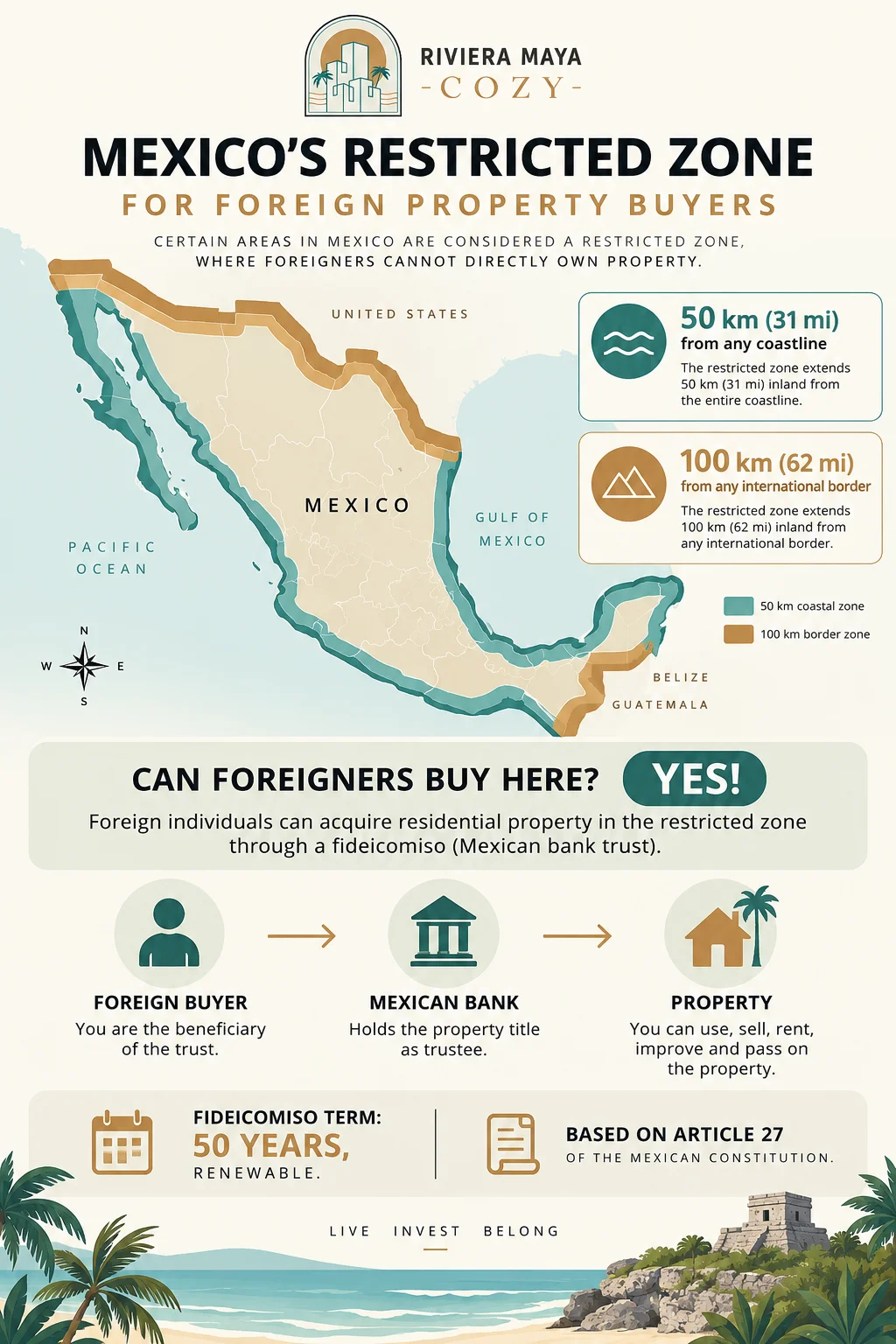
For Americans buying residential real estate, the most common solution is a fideicomiso.
How Close to the Coast Can Americans Own Property?
The restricted zone extends 50 kilometers inland from Mexico’s coastline. That is approximately 31 miles.
This means most popular coastal destinations fall within it. If you are buying a beachfront condo or a home several kilometers inland in the Riviera Maya, you are still comfortably inside the restricted zone.
It is therefore not just a rule affecting properties directly beside the sea.
How Close to the Border Can Americans Own Property?
The restricted zone also extends 100 kilometers from Mexico’s international borders, approximately 62 miles.
This affects property near Mexico’s borders with the United States, Guatemala, and Belize.
For most Riviera Maya buyers, the coastal restriction is the relevant one. However, the same constitutional concept applies to both coastal and border areas.
How Can Americans Buy Property in Mexico’s Restricted Zone?
For residential purchases, Americans commonly use a fideicomiso. This is a Mexican bank trust designed to allow a foreign beneficiary to hold rights to restricted zone property while complying with Mexico’s constitutional ownership rules.
It is a standard structure in coastal real estate markets and should not be confused with renting or leasing the property from the bank.
How a Fideicomiso Works
A Mexican bank acts as trustee and holds legal title to the property. The American buyer is named as the beneficiary of the trust.
The bank’s role is fiduciary. It administers the property according to the trust agreement rather than using the home as its own asset.
We explain the structure in much greater detail in our complete guide to fideicomiso.
Do You Actually Own the Property With a Fideicomiso?
This question mostly comes down to what you mean by “own.”
The trustee bank holds legal title, while you hold the beneficiary rights established by the fideicomiso. In practical terms, those rights give you control over how the property is used and what happens to it, subject to the trust and Mexican law.
The bank does not get to move into your condo, rent it for itself, or decide to sell it because it feels like it.
What Rights Do You Have as the Beneficiary?
A fideicomiso beneficiary can generally occupy the property, rent it, renovate it, sell it, transfer beneficiary rights, and designate substitute beneficiaries.
You can therefore buy a condo in Playa del Carmen, use it during winter, rent it while you are away, and later sell it.
The trust is the legal ownership vehicle. It does not turn the bank into the practical owner of your home.
How Long Does a Fideicomiso Last?
A fideicomiso used for restricted zone property can generally be established for a term of up to 50 years and can be extended through the applicable procedures.
The 50 year term does not mean an American must surrender or sell the property when year 50 arrives. It refers to the term of the particular trust structure.
If you are buying a resale property with an existing fideicomiso, check its actual expiration date rather than assuming your purchase automatically starts a new 50 year period.
Can Americans Buy Property in Mexico Without a Fideicomiso?
Yes, if the property is outside Mexico’s restricted zone. In that situation, an American can generally acquire qualifying private property through direct title.
A fideicomiso is therefore not a nationwide requirement for foreign buyers. It becomes relevant because of where the property is located.
There are also situations inside the restricted zone where another legally permitted structure may apply. A Mexican corporation is one example, although it serves a different purpose and comes with different obligations.
Can Americans Buy Property Through a Mexican Corporation?
Yes, a properly structured Mexican corporation can own certain property, including property within the restricted zone. However, that does not make a corporation the automatic alternative to a fideicomiso.
For an American buying a condo or house primarily for personal residential use, a fideicomiso is usually the more straightforward structure.
A corporation may become relevant for commercial activity, development, multiple investment properties, or a business involving several partners. It also brings accounting, tax, reporting, and corporate compliance obligations.
The intended use of the property matters. We would choose the structure with a Mexican attorney and accountant rather than create a corporation simply to avoid having a bank trust.
Do You Need Mexican Residency to Buy Property?
No. Americans do not generally need temporary or permanent Mexican residency simply to purchase real estate in Mexico.
You can therefore buy a vacation home while continuing to live primarily in the United States.
Property ownership and immigration status are separate issues. Buying a home does not automatically give you Mexican residency either.
If you plan to live in Mexico for extended periods, your immigration situation should be considered separately from the property purchase.
What Types of Property Can Americans Buy in Mexico?
Americans are not limited to one particular type of real estate. The correct ownership structure and due diligence depend more on the property’s location and legal status.
Condos and Apartments
Condos are one of the most common purchases we handle with foreign buyers in the Riviera Maya.
An American can buy a completed or pre construction condo, subject to the normal legal checks. For a coastal residential condo, ownership will commonly be structured through a fideicomiso.
Condominium buyers should also review the HOA rules, fees, common areas, rental restrictions, and the legal condominium regime before closing.
Houses and Villas
Americans can also purchase houses and villas. The same restricted zone rules apply, so a coastal home will normally require an appropriate foreign ownership structure.
With standalone houses, we pay particular attention to the land title, property boundaries, construction documentation, permits, and whether additions to the home were properly documented.
Land
Americans can buy privately titled land, again subject to the applicable foreign ownership rules.
Land requires particularly careful due diligence. You should verify title, boundaries, zoning, permitted land use, access, utilities, environmental restrictions, and what you can legally build.
Be especially careful with ejido land. Agrarian rights are not the same as ordinary private property title, and an informal agreement with an ejidatario does not automatically give a foreign buyer privately registered ownership.
Can Americans Buy Beachfront Property in Mexico?
Yes. Americans can acquire rights to beachfront residential property in Mexico through the legally permitted ownership structure, commonly a fideicomiso.
The constitutional coastal restriction does not mean beachfront real estate is completely unavailable to foreigners.
However, buying directly beside the sea adds issues beyond the fideicomiso. Mexico has a federal maritime terrestrial zone along much of the coastline, commonly known as ZOFEMAT. That federal zone should not be confused with the privately titled land behind it.
If you are considering genuine beachfront property, your due diligence should establish exactly where the private parcel ends and whether any federal zone concession or related rights affect the property.
How Does an American Buy Property in Mexico?
The buying process is different from what many Americans are used to back home. However, the basic sequence is straightforward when the property and documents are in order.
We recommend having your own closing professionals involved early, especially before transferring a significant deposit.
1. Find the Property
Start by finding a property that fits your budget, intended use, and location. Do not focus only on the asking price.
For condos, review HOA costs and rental rules. For land, investigate zoning and legal access. With pre construction, the developer and project documentation become particularly important.
2. Make an Offer
Once you choose a property, you can negotiate the price and main transaction terms with the seller.
The written agreement should clearly establish the purchase price, payment structure, deposit, relevant conditions, and what happens if a legal problem appears during due diligence.
3. Complete Legal Due Diligence
This is one of the stages we would never rush.
Your closing team should confirm that the seller has the legal right to sell and investigate the property’s title. They should also check for liens, outstanding obligations, and inconsistencies in the documentation.
The exact investigation depends on what you are buying. A completed condo, undeveloped lot, resale villa, and pre construction unit each require a slightly different review.
4. Set Up the Fideicomiso If Required
If you are an American purchasing residential property within the restricted zone, your closing team can coordinate the fideicomiso process with the trustee bank.
This involves the bank, notary, required documentation, and the applicable Mexican authorities. You will also decide matters such as who should be named as beneficiary and substitute beneficiary.
Our guide on how to set up a fideicomiso in Mexico covers this process separately, so we will not repeat every step here.
5. Sign the Deed Before a Notary
A Mexican Notario Público has an important legal role in a real estate closing. This position is very different from the ordinary notary public you may know in the United States.
The notary formalizes the transaction, prepares or reviews the required public instruments, and handles important legal and tax elements of the transfer.
Remember that the notary is not automatically your personal attorney. For that reason, many foreign buyers also use independent legal representation.
6. Register the Property
After signing, the transaction needs to complete the appropriate registration process. For private real estate, the relevant ownership documents are recorded with the Public Registry of Property.
Signing at closing and completing registration are therefore related but separate stages. Keep your final deed, fideicomiso documents where applicable, payment records, and other closing paperwork once the process is complete.
What Documents Do Americans Need to Buy Property in Mexico?
The exact requirements vary with the transaction and ownership structure. However, an American buyer will commonly need a valid passport and proof of address, along with tax or identification information requested for the transaction.
If a fideicomiso is required, the trustee bank will have its own documentation requirements. Additional information may also be needed for beneficiaries and substitute beneficiaries.
Marital status can matter as well, particularly when determining how ownership or beneficiary rights should be structured.
Do not rely on one universal online checklist. Ask your closing team and trustee for the documents required for your specific purchase before traveling or sending originals.
How Much Does It Cost to Buy Property in Mexico?
The purchase price is only part of your budget. Americans should also account for closing costs and, where applicable, fideicomiso expenses.
Closing Costs
As a broad planning range, buyer closing costs in Mexico can sometimes reach around 5% to 8% of the purchase price. The actual amount can fall outside that range depending on the property, location, value, ownership structure, and transaction.
These costs can include acquisition tax, notary expenses, registration, certificates, permits, and professional or administrative charges.
We prefer obtaining an estimated closing statement for the actual property rather than applying one percentage to every purchase.
Fideicomiso Setup and Annual Fees
If you need a fideicomiso, budget for the initial establishment cost and the bank’s recurring administration fee.
A general planning range is roughly $500 to $1,500 USD for setup and around $500 to $1,000 USD per year for trustee administration. Banks set their own fees, so current quotes should always be checked.
These bank charges are separate from the wider closing costs associated with buying the property.
Property Taxes and Ongoing Costs
After closing, you will normally have annual property tax, known as predial. Depending on the property, you may also have HOA fees, insurance, utilities, maintenance, and property management costs.
If you plan to rent the property, include the related tax, accounting, management, and operating expenses in your calculations as well.
Can Americans Get a Mortgage in Mexico?
Yes, financing can be available to American buyers, including through certain Mexican lenders and financing providers serving foreign purchasers.
However, do not expect the same terms you might receive for a primary residence in the United States. Down payment requirements, interest rates, documentation, loan terms, and qualification standards can differ substantially.
Some buyers also finance the purchase using assets or credit available in the United States rather than taking a Mexican mortgage.
If financing is essential to your purchase, investigate it before making an unconditional commitment. A property being affordable with your expected loan does not help if the financing structure turns out to be unavailable.
Can Americans Rent Out Property They Own in Mexico?
Yes. Americans can rent out property they own in Mexico, including homes held through a fideicomiso.
This can include long term rentals and vacation rentals. However, owning the property does not remove your tax and regulatory responsibilities.
Rental income generated from Mexican property can create Mexican tax obligations. Depending on how you operate the rental, you may also need tax registration, invoices, accounting support, and compliance with local rules.
Short term rentals deserve extra attention. Condominium rules may restrict vacation rentals, and state or municipal requirements can apply. Platforms such as Airbnb do not replace your responsibility to comply with those rules.
American owners should also consider their obligations in the United States. Cross border taxation can become complicated, so we recommend discussing your particular situation with accountants familiar with both countries.
Can Americans Sell Their Property in Mexico?
Yes. An American owner can sell Mexican property just like other legally recognized property owners.
If your home is held through a fideicomiso, the transaction can involve transferring beneficiary rights, establishing a new trust for the buyer, or using another appropriate structure.
The exact process depends partly on the buyer. A foreign buyer purchasing residential property inside the restricted zone may need a fideicomiso, while a qualifying Mexican buyer can generally acquire direct title.
The sale can also trigger Mexican capital gains tax. Do not assume the taxable gain is simply your sale price minus the amount you originally paid.
Your notary and tax adviser can calculate the applicable tax based on the actual transaction, documented costs, permitted deductions, and current rules.
Can Americans Leave Mexican Property to Their Heirs?
Yes. Mexican property can pass to heirs, and estate planning should be considered when you buy rather than years later.
A major advantage of a fideicomiso is the ability to designate substitute beneficiaries. These are the people who can receive your beneficiary rights after your death according to the trust structure.
This can make succession more organized, but it should still be coordinated with your wider estate plan.
If you already have a will in the United States, do not simply assume it resolves every issue involving Mexican property. Cross border estates can involve documents and legal systems from both countries.
Check the beneficiary information in your fideicomiso periodically as well. Marriage, divorce, deaths, and other family changes can make old instructions unsuitable.
What Taxes Do Americans Pay When Owning Property in Mexico?
There is no single “American property tax” charged simply because you are a U.S. citizen buying in Mexico. Instead, different taxes can arise at different stages of ownership.
At purchase, the buyer normally encounters acquisition related taxes and closing expenses. During ownership, you generally pay annual municipal property tax, known as predial.
If you earn rental income, Mexican income tax and other tax obligations may apply. When you eventually sell, capital gains tax may also become relevant.
Americans also need to consider U.S. tax and reporting rules because the United States generally taxes its citizens on worldwide income. How those rules interact with Mexican taxes depends on your circumstances.
This is one area where generic internet advice can become expensive. For rental income, business activity, or a future sale, work with tax professionals who understand cross border ownership.
What Should Americans Check Before Buying Property in Mexico?
The ownership rules for Americans are usually not the part that causes trouble. Problems are more likely to come from the individual property or transaction.
This is why we put so much emphasis on due diligence before closing.
Verify the Property Title
Start by confirming who legally owns the property and whether the seller has authority to transfer it.
The names, property description, boundaries, and registration information should correspond across the relevant documents. Never rely only on a sales brochure, utility bill, possession, or somebody saying the family has owned the land for decades.
Check for Liens and Outstanding Debts
Your closing team should investigate whether liens or other registered encumbrances affect the property.
Property taxes, HOA obligations, utilities, and other outstanding amounts should also be reviewed where relevant. You want the financial and legal position understood before ownership changes hands.
Be Careful With Ejido Land
This is particularly important when buying undeveloped land.
Ejido land belongs to Mexico’s agrarian property system. Rights to an ejido parcel should not be confused with an ordinary privately registered property title.
Some ejido parcels can legally transition into private property through the appropriate process. If a seller claims this has already happened, verify the completed legal status rather than relying on promises that the paperwork is “almost ready.”
For an American buyer, we would want the private title situation clearly established before treating the parcel as an ordinary real estate purchase.
Check the Developer and Permits When Buying Pre Construction
Pre construction requires a different type of due diligence because the finished property may not exist yet.
Look beyond the renderings and payment plan. Investigate the developer, land ownership, project documentation, permits, contracts, delivery terms, and what happens if construction is delayed.
Past projects can provide useful context about a developer, but previous success does not guarantee the next project. Review the actual development you are considering.
Is It Safe for Americans to Buy Property in Mexico?
Yes, Americans can legally buy property in Mexico through established ownership structures. However, a legal path to ownership does not make every property or transaction safe.
A fideicomiso cannot fix a bad title. A beautiful condo cannot fix missing permits. A cheap lot does not become a bargain if the seller cannot legally transfer it.
That is why we separate two questions when working with foreign buyers. First, can you legally own this type of property in this location? Second, is this particular property a sound transaction from a legal perspective?
For Americans buying in the Riviera Maya, the first question is usually straightforward. Residential property in the restricted zone is commonly acquired through a fideicomiso.
The second question requires proper due diligence. Verify the title, seller, debts, permits, ownership structure, and contract before committing substantial money.
If those pieces are handled correctly, buying property in Mexico does not need to feel mysterious simply because you are American. The system is different from the United States, but different does not mean inaccessible.